

جدول المحتويات
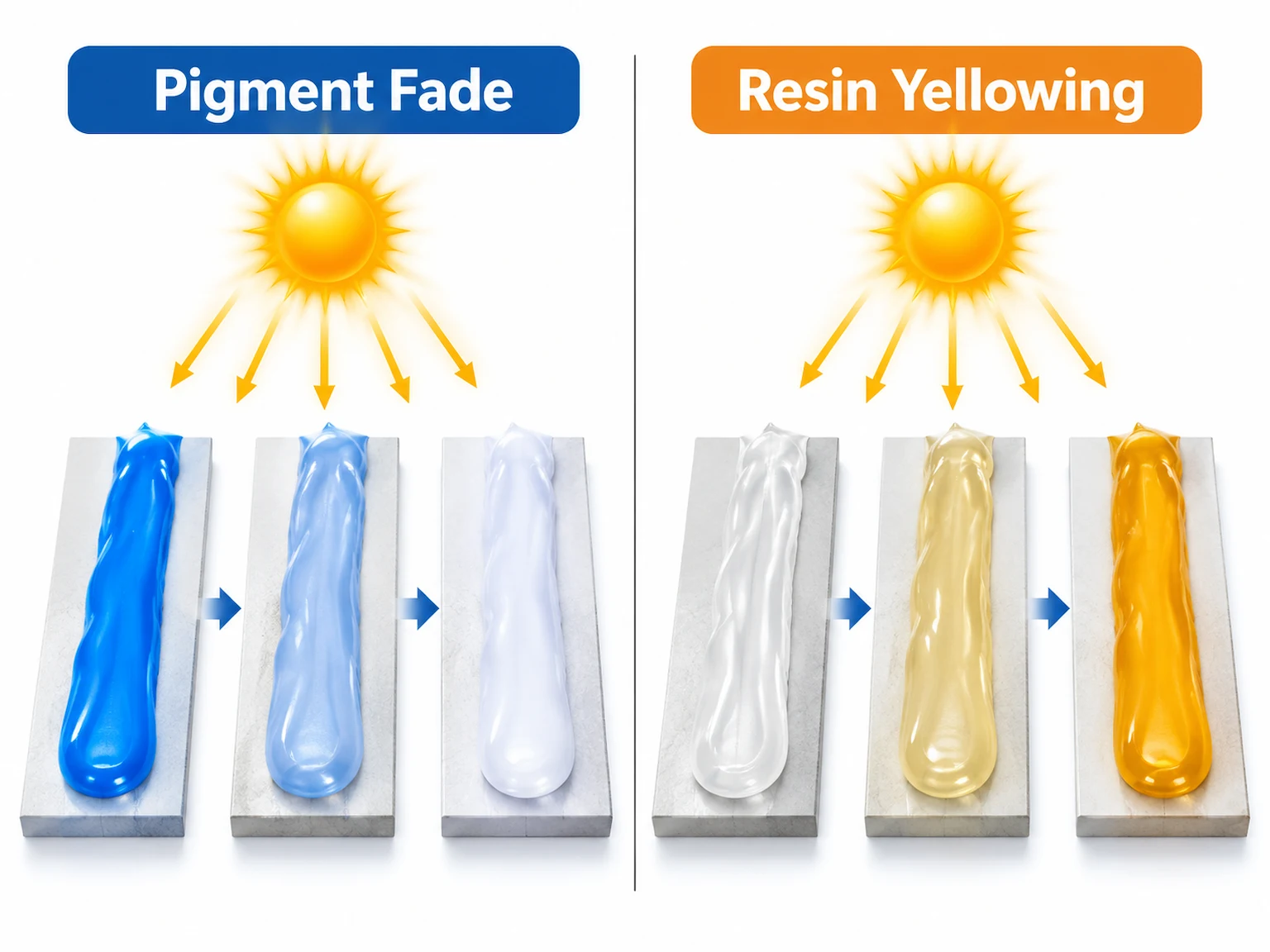
Sealant color problems split into two unrelated failure modes that get treated as the same issue. One is pigment fading — the color itself washing out under UV exposure. The other is base resin yellowing — a shift in the cured material’s own color, independent of any pigment added to it. Diagnosing which one is happening, and buying against the right specification for each, prevents the mismatched-facade problem years after installation.
Two Different Color Problems: Pigment Fade vs. Resin Yellowing
Pigment fade happens when the colorant itself breaks down under sustained UV exposure. Organic pigments, while often available in a wider and more vivid color range, are generally more prone to UV degradation than inorganic pigments like iron oxides and titanium dioxide, which tend to hold their color over much longer exposure periods. A sealant tinted to a vivid custom color using organic pigments may visibly shift or wash out in a timeframe that a similar product using inorganic pigments wouldn’t.
Resin yellowing is a separate mechanism entirely — it’s the base cured material itself shifting color, typically toward yellow or amber, due to the chemistry of the resin system rather than any pigment. Some acrylic and polyurethane formulations have an inherent tendency toward yellowing under UV and heat exposure over time, visible even in clear or white-pigmented products where there’s no colorant to fade. Silicone generally resists this resin-level yellowing better than acrylic or many polyurethanes, which is part of why silicone remains the default choice for exterior glazing and facade joints where long-term color stability matters.
Distinguishing the two matters practically because the fix is different for each. A faded pigment problem can sometimes be addressed by switching to a more UV-stable pigment within the same base chemistry, keeping the rest of the formulation unchanged. A resin yellowing problem requires switching the base chemistry itself — no pigment adjustment corrects a resin that’s shifting color on its own, since the yellowing originates in the cured polymer backbone rather than in any additive. Misdiagnosing one as the other leads to a repeat failure: reformulating pigment choice does nothing for a resin that yellows regardless of what’s tinted into it. This base-chemistry distinction is the same one that drives UV and weathering performance in our Sealant Shelf Life vs. Service Life guide.
Pre-Colored vs. Field-Tinted Sealant
Pre-colored sealant arrives from the manufacturer already formulated to a specific, repeatable color, with the pigment load and type controlled during production. This gives more predictable long-term colorfastness, since the manufacturer controls pigment selection and concentration precisely, and batch-to-batch color consistency is far easier to verify against a reference standard.
Field-tinted sealant, mixed on-site by injecting paint or colorant into a base cartridge, offers genuine flexibility — matching an exact existing paint color without waiting for a custom manufacturing run. The trade-off is that long-term colorfastness depends heavily on the specific tinting product used and how thoroughly it was mixed, since the colorant wasn’t engineered and tested as a system with that particular sealant base the way a pre-colored product was. Field-tinted sealant suits small repair jobs matching an existing color exactly; pre-colored sealant suits large-scale facade work where long-term, verifiable color consistency across the entire project matters more than exact-match flexibility.
Verifying Colorfastness Before Large-Scale Purchase
Accelerated UV weathering test data, commonly reported as a Delta E (ΔE) color difference value after a specified exposure period, is the closest thing to an objective colorfastness comparison between products. A lower ΔE value after equivalent accelerated weathering indicates better color retention; this data should be requested directly from the manufacturer rather than assumed from marketing claims like “UV resistant,” which carries no standardized definition on its own.
For large facade or curtain wall projects where color consistency across hundreds of linear feet matters visually, requesting a small sample batch and performing a basic side-by-side exposure comparison — placing a sample in direct sun alongside a control sample kept indoors for a few weeks — gives a low-cost reality check before committing to full-project quantities. This step catches formulation-specific colorfastness issues that generic chemistry-class assumptions (silicone generally fades less than acrylic, for example) don’t fully predict for any specific product.
It’s worth asking the manufacturer directly whether the ΔE figure reported reflects testing against the specific pigment and batch being ordered, rather than a generic figure for that product line. Pigment suppliers and lot-to-lot variation can shift actual field performance even within the same nominal product, so a ΔE value tested years ago on an earlier formulation revision isn’t necessarily representative of current production. For projects spanning a long installation timeline, specifying that all sealant comes from the same production lot where feasible further reduces the risk of visible batch-to-batch color drift across the finished facade.
Color Stability by Application: Quick Reference
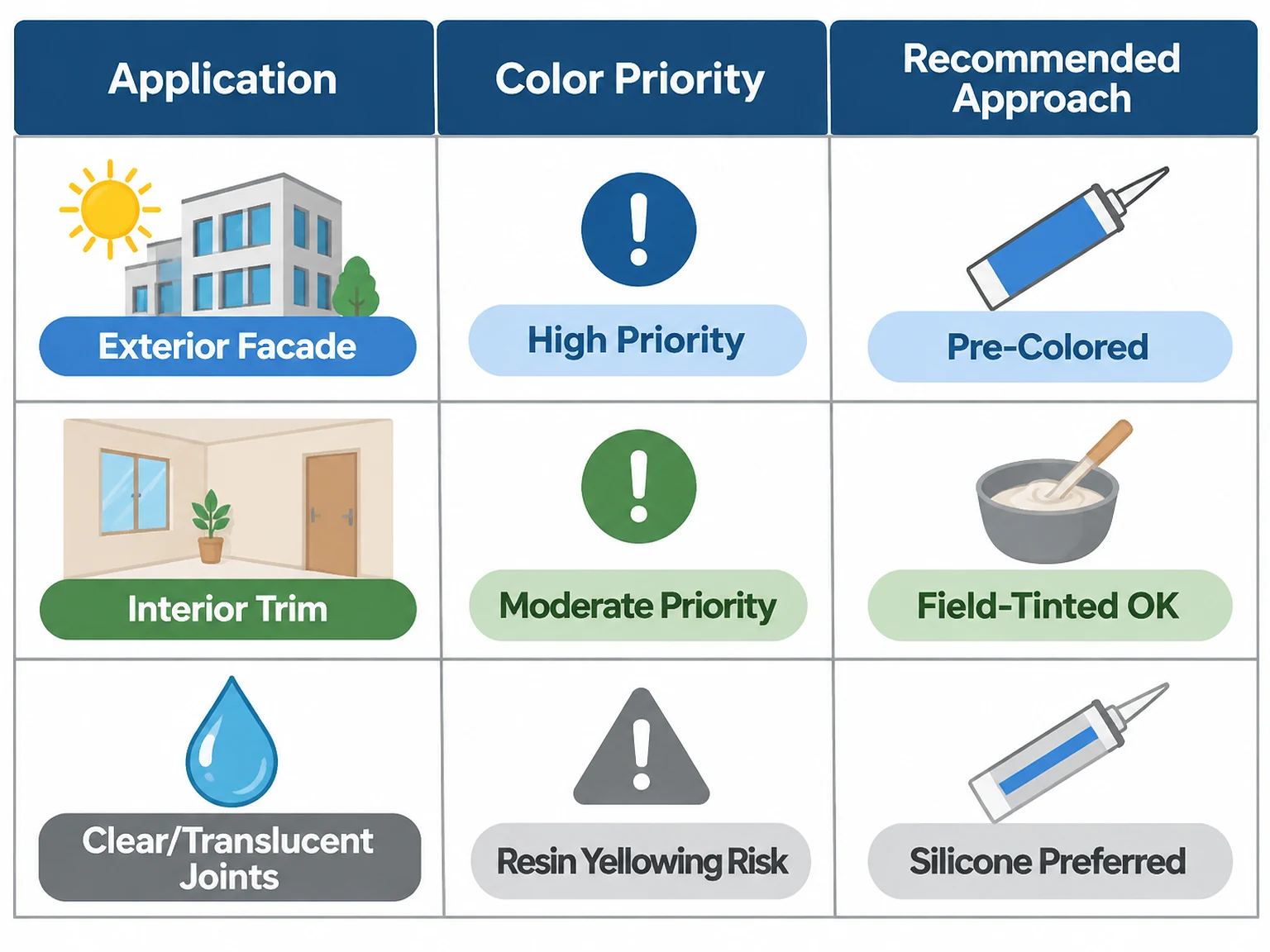
| التطبيق | Color Priority | Recommended Approach |
|---|---|---|
| Exterior facade, long exposure | High — visible shift is costly to correct | Pre-colored, inorganic pigment, request ΔE data |
| Interior trim, low UV exposure | معتدل | Field-tinted acceptable for exact match needs |
| Small repair matching existing color | High match accuracy, lower long-term stability need | Field-tinted, test on inconspicuous area first |
| Clear or translucent sealant joints | Resin yellowing is the main risk, not pigment | Silicone or low-yellowing formulation preferred |
الأخطاء الشائعة
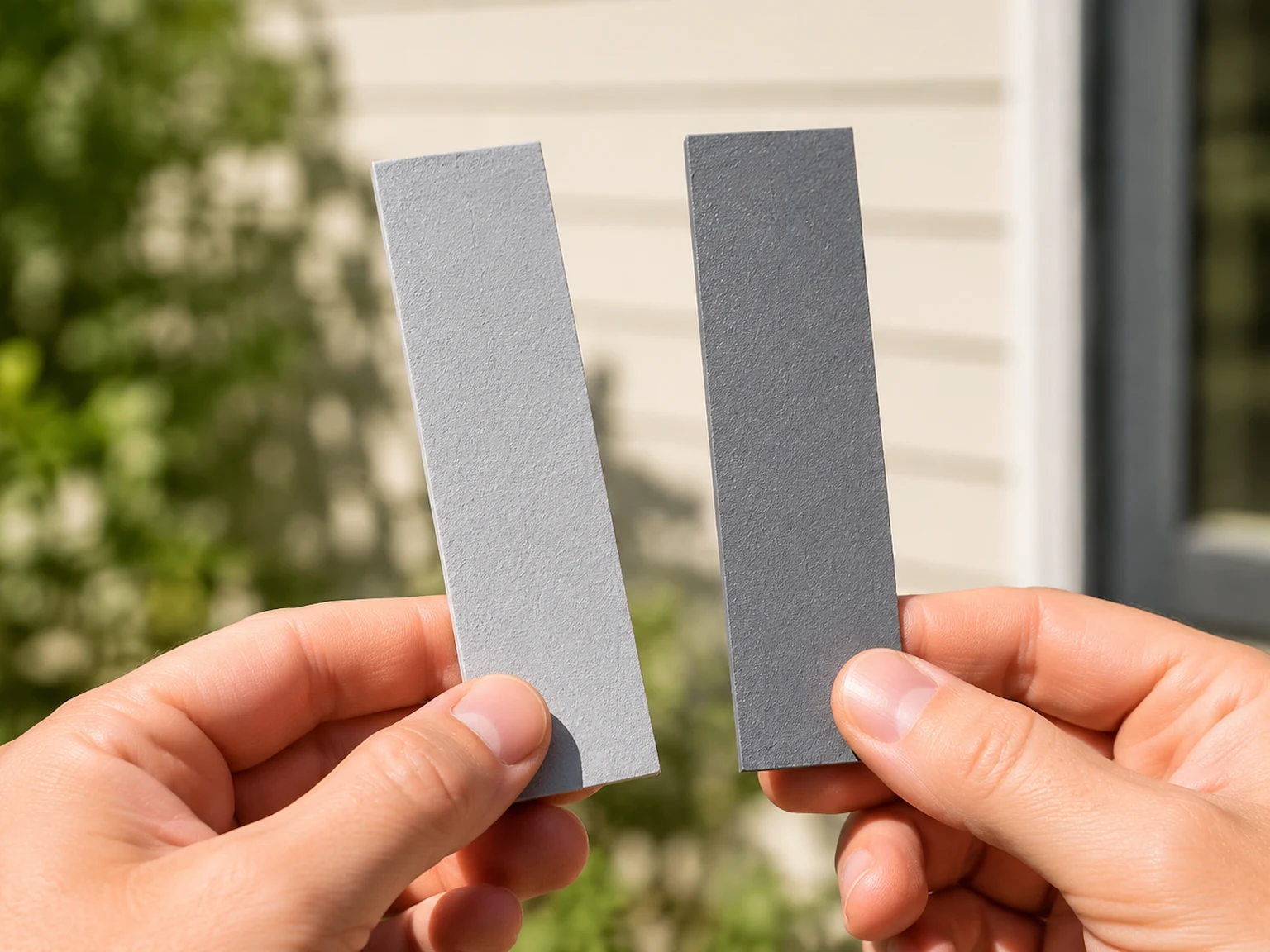
Assuming a vivid custom color will hold its appearance as well as a standard white or gray formulation is a frequent and costly mistake — vivid colors often rely on organic pigments more prone to fading, and this risk should be confirmed rather than assumed regardless of how good the initial color match looked. Choosing field-tinted sealant for a large exterior facade project because the color match looked perfect at installation, without considering long-term colorfastness data, can result in visibly inconsistent fading across different application batches years later.
Treating “UV resistant” marketing language as equivalent to tested colorfastness data is another common error — this phrase has no standardized measurement behind it unless the manufacturer provides actual accelerated weathering test results. Requesting that data directly, rather than relying on general product descriptions, is the only reliable way to compare colorfastness between competing products. Our How to Read a Sealant Technical Data Sheet guide covers the same “request real test data, not marketing claims” principle for movement capability and modulus figures.
الأسئلة المتداولة
Why does my sealant turn yellow even though I used white caulk?
This is resin yellowing, not pigment fade — some acrylic and polyurethane base chemistries shift toward yellow or amber under UV and heat exposure independent of any added colorant. Silicone generally resists this base-resin yellowing better than acrylic or many polyurethane formulations.
Is pre-colored sealant more colorfast than field-tinted sealant?
Generally yes, for large-scale or long-term applications, since the manufacturer controls pigment type and concentration precisely during production. Field-tinted sealant offers exact-match flexibility for small repairs but depends on the specific tinting product and mixing quality for its long-term colorfastness.
What does ΔE mean on a sealant colorfastness test?
Delta E (ΔE) is a numerical measure of color difference after accelerated UV weathering testing, compared to the original unexposed color. A lower ΔE value after equivalent exposure time indicates better color retention, giving an objective basis for comparing colorfastness between different products.
Are organic pigments always a bad choice for exterior sealant?
Not always, but they generally carry higher fading risk under sustained UV exposure than inorganic pigments. For exterior applications where long-term color stability matters, requesting accelerated weathering test data for the specific pigment and formulation used is more reliable than assuming based on pigment type alone.
How can I test colorfastness before committing to a large order?
Request a small sample batch and place it in direct sun alongside a control sample kept indoors for a few weeks. This low-cost comparison, combined with manufacturer-provided ΔE accelerated weathering data, gives a reasonable reality check before committing to full-project quantities.
هل تحتاج إلى مساعدة في اختيار مادة مانعة للتسرب؟
أخبرنا عن المواد التي تستخدمها ومتطلبات التطبيق.
أرسل استفسارًا English
 العربية
 Español de México
 Русский
 Tiếng Việt
 Português do Brasil
 Bahasa Indonesia
 Türkçe