

Daftar Isi
- 1. Movement Capability: The Number That Decides If a Sealant Can Handle Your Joint
- 2. Modulus: Stiffness vs. Flexibility, and Why Higher Isn’t Better
- 3. Shore A Hardness and Elongation: Reading Them Together, Not Alone
- 4. Cure Time Terminology: Tack-Free, Skin Time, and Full Cure Are Not the Same Clock
- 5. TDS Parameter Checklist: What to Ask for Each Value
- 6. What a TDS Cannot Tell You
- 7. Common TDS Misreads
- 8. Pertanyaan yang Sering Diajukan
A sealant technical data sheet looks straightforward until you try to use it to actually choose between two products. Movement capability, modulus, Shore A hardness, elongation — these values only become useful once you connect them to the joint’s actual movement range and the substrates on either side. Buyers who skip this step and choose based on brand recognition or price alone often discover the mismatch only after the joint has already failed.
Movement Capability: The Number That Decides If a Sealant Can Handle Your Joint
Movement capability, expressed as a percentage, states how much a cured sealant can stretch and compress from its original installed width without losing adhesion or tearing. A sealant rated at ±25% can accommodate joint movement up to 25% of its width in either direction — compression or extension — while one rated at ±12.5% has roughly half that tolerance. Our Sealant Joint Design Guide walks through the full calculation for sizing joint width from this exact percentage.
This number should be read against your joint’s actual expected movement, not treated as a general quality indicator. A high-movement-capability sealant isn’t automatically “better” — it’s simply formulated for joints that move more. Applying a ±25% product at a joint that barely moves wastes the product’s engineered flexibility, while applying a ±12.5% product at a wide seasonal expansion joint guarantees eventual cohesive failure as the material is stretched beyond its rated range repeatedly.
Modulus: Stiffness vs. Flexibility, and Why Higher Isn’t Better
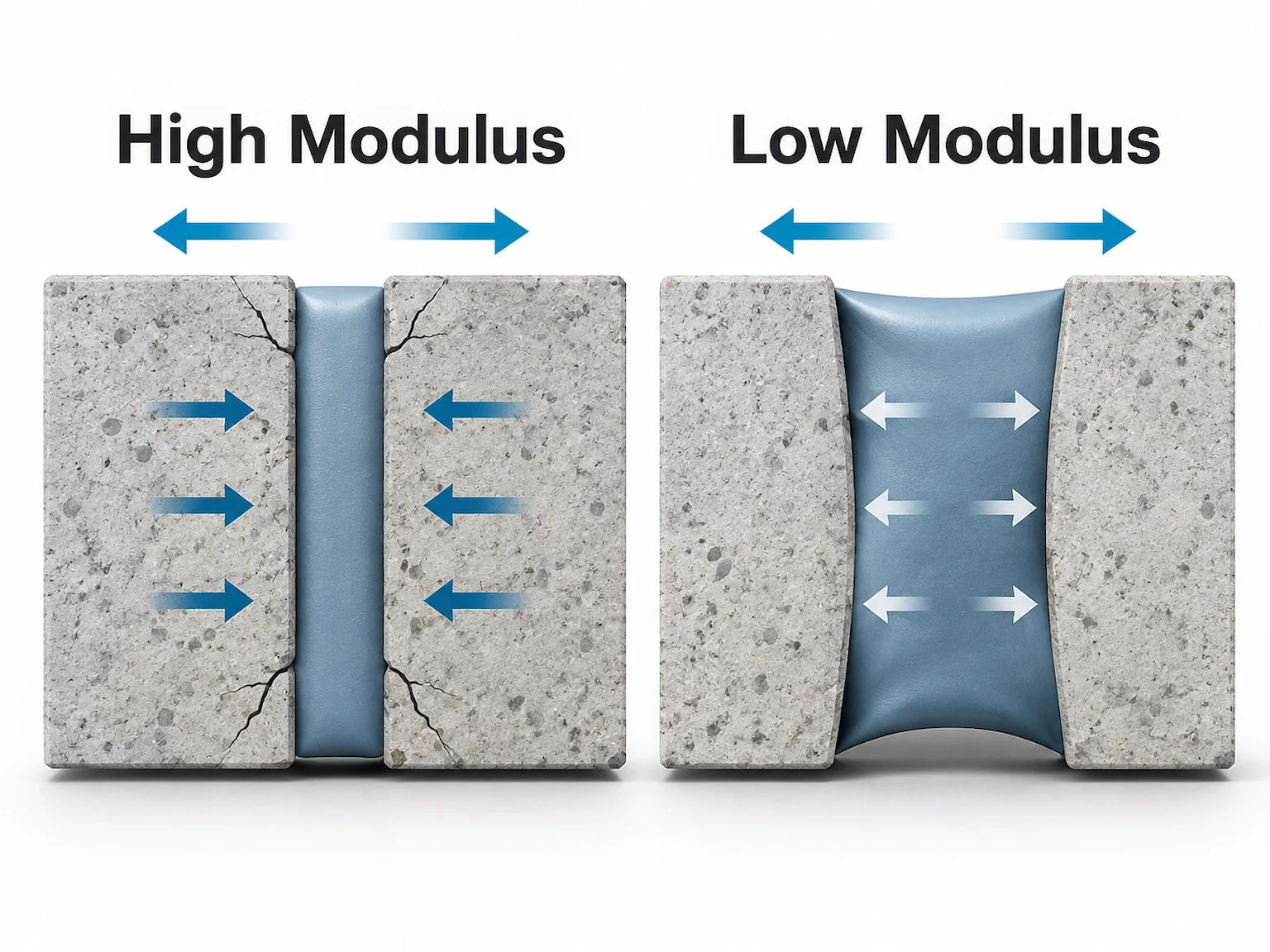
Modulus describes how much force the cured sealant resists as it’s stretched — essentially, how stiff or soft the material behaves under movement. High-modulus sealants resist deformation strongly, transferring more stress back into the substrate and the joint edges; low-modulus sealants deform more readily, absorbing movement with less resistance but also providing less structural support at the joint.
Neither is universally preferable. A low-modulus sealant suits a joint that moves significantly and where the substrates themselves are fragile or lightly supported — brittle stone, aged masonry, or thin panel edges that could crack under a stiffer sealant’s pulling force. A high-modulus sealant suits joints needing more structural contribution from the sealant itself, or substrates robust enough to handle the stress transfer without damage. Reading modulus without connecting it to substrate fragility and joint movement is the single most common TDS misread in sealant selection.
Shore A Hardness and Elongation: Reading Them Together, Not Alone
Shore A hardness measures the cured sealant’s resistance to indentation — a lower number indicates a softer, more pliable cured material, while a higher number indicates a firmer one. On its own, Shore A tells you relatively little about joint performance, since a soft sealant with poor elongation can still tear under movement despite feeling flexible to the touch.
Elongation at break, the percentage a sealant can stretch before it physically tears, matters more directly for movement tolerance, but it also shouldn’t be read in isolation. A sealant with very high elongation but low recovery — meaning it stretches far but doesn’t fully return to its original shape — can accumulate permanent deformation over repeated movement cycles, eventually leaving a joint that looks intact but has lost its effective sealing cross-section. The combination of Shore A, elongation, and recovery percentage (when listed) gives a more complete picture than any single value read alone.
Cure Time Terminology: Tack-Free, Skin Time, and Full Cure Are Not the Same Clock
Tack-free time and skin time both refer to how quickly the sealant’s surface stops feeling sticky to the touch, typically ranging from 10 minutes to a few hours depending on chemistry and ambient humidity. This is the earliest point at which light dust contact becomes less of a concern, but it says nothing about the sealant’s internal cure state or its readiness for any kind of load or water exposure.
Full cure — sometimes listed separately as the point at which the sealant reaches its rated mechanical properties — takes substantially longer, commonly 24 hours to a full week depending on the product’s cross-section thickness and curing chemistry. Confusing tack-free time with full cure is a recurring and costly mistake: exposing a joint to water or movement stress after tack-free time but before full cure routinely causes early failures that get misattributed to a defective product rather than premature use.
TDS Parameter Checklist: What to Ask for Each Value
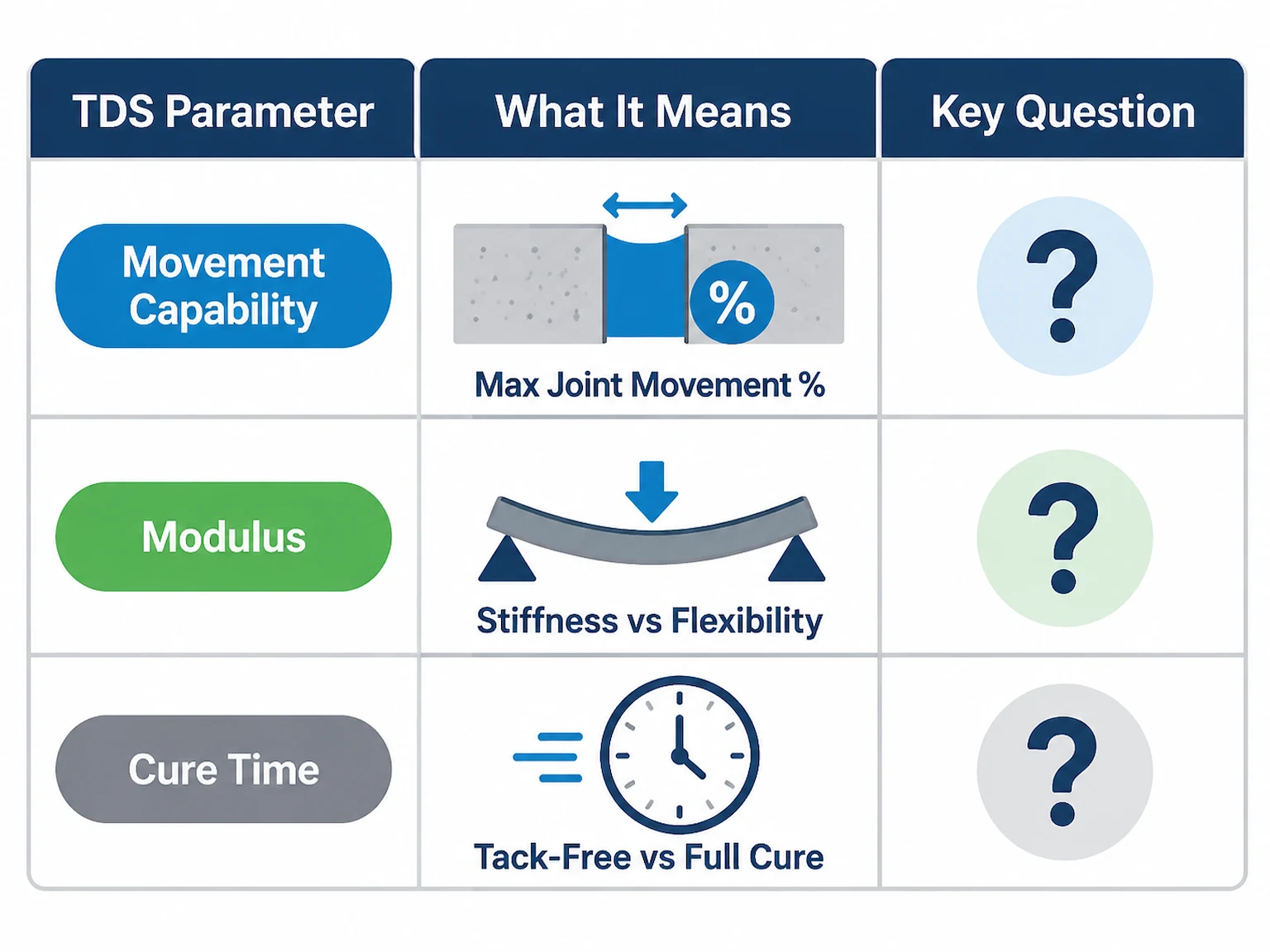
| TDS Parameter | What It Suggests | Decision Question to Ask |
|---|---|---|
| Movement capability (±%) | Maximum joint movement tolerance | Does this match my joint’s actual expected movement range? |
| Modulus | Stiffness vs. flexibility of cured bead | Can my substrates tolerate the stress this modulus transfers? |
| Kekerasan Shore A | Relative softness/firmness after cure | Does this feel appropriate combined with elongation and recovery? |
| Elongasi saat putus | Stretch capacity before tearing | Is recovery percentage also listed, or just peak stretch? |
| Tack-free / skin time | Surface dust resistance point only | Am I confusing this with readiness for water/load exposure? |
| Waktu pengeringan sempurna (full cure) | Point of rated mechanical properties | Has this much time actually passed before stressing the joint? |

What a TDS Cannot Tell You
A technical data sheet is a screening document, not a guarantee of performance in your specific application. It reports values from controlled test conditions — specific substrates, specific surface preparation, specific environmental conditions — that may not match your actual joint. Two sealants with similar movement capability numbers can perform very differently if one was tested against grit-blasted concrete and the other against untreated painted metal, since substrate adhesion varies significantly by surface condition.
For projects where the joint design is unusual, the substrate pairing is uncommon, or the service environment is demanding (continuous submersion, extreme temperature cycling, chemical exposure), TDS screening should be followed by a small test application before committing to large-scale use. This staged approach — TDS screening, then sample testing, then full application — catches mismatches that a data sheet alone cannot reveal. For chemical-exposure joints specifically, our Chemical Resistant Sealant Selection Guide covers how to request immersion-specific and temperature-specific test data rather than relying on a generic resistance claim.
Common TDS Misreads
Choosing based on movement capability alone, without checking whether the modulus and substrate combination actually suits the joint, is one of the most frequent mistakes — a high movement capability number means little if the sealant’s stiffness is wrong for the substrates it’s bonded to. Treating tack-free time as “ready to use” rather than “dust resistant only” causes early failures that get blamed on the product rather than premature exposure. Comparing elongation figures across two products without checking whether both were tested under the same method and substrate conditions leads to apples-to-oranges comparisons that don’t predict actual field performance.
Pertanyaan yang Sering Diajukan
What does movement capability actually mean on a sealant data sheet?
Movement capability is a percentage stating how much a cured sealant can stretch or compress from its installed width without losing adhesion or tearing. A ±25% rating means the joint can move up to 25% of its width in either direction. This number should be matched to your joint’s actual expected movement, not used as a general quality ranking.
Is a higher modulus sealant always better quality?
No. Higher modulus means more stiffness and more stress transferred into the substrate, which is appropriate for robust substrates needing structural support but can crack fragile or lightly supported materials. Lower modulus sealants absorb movement more readily with less substrate stress, better suited to delicate or heavily moving joints.
Is tack-free time the same as the sealant being fully cured?
No. Tack-free time only indicates the surface no longer feels sticky, typically within minutes to a few hours. Full cure, when the sealant reaches its rated mechanical properties, usually takes 24 hours to a week. Exposing a joint to water or stress before full cure is a common cause of early failure.
Can I compare elongation values between two different sealant brands directly?
Only if the test method and substrate conditions were comparable. Elongation figures generated under different test setups or substrate preparations aren’t directly comparable, even when the headline numbers look similar. Checking the test method noted on the data sheet before comparing is necessary for a fair comparison.
Should I trust the TDS alone for an unusual joint application?
For standard applications with common substrates, TDS screening is usually sufficient. For unusual joint designs, uncommon substrate pairings, or demanding environments like continuous submersion or extreme temperature cycling, follow TDS screening with a small-scale test application before committing to full installation.
Butuh Bantuan Memilih Sealant?
Beri tahu kami bahan dan kebutuhan aplikasi Anda.
KIRIM PERTANYAAN English
 العربية
 Español de México
 Русский
 Tiếng Việt
 Português do Brasil
 Bahasa Indonesia
 Türkçe
Pingback: Masa Simpan vs. Masa Pakai Sealant: Apa Arti Sebenarnya dari Setiap Linimasa - Joobond
Pingback: Sealant Joint Design: How to Calculate Width, Depth, and Movement Capability - Joobond