

Mục lục
- 1. What “Food Grade” Actually Means
- 2. Verifying a Genuine Food-Safe Claim
- 3. Common Food-Safe Sealant Applications
- 4. Quy trình thi công tối ưu
- 5. Common Mistakes
- 6. Những câu hỏi thường gặp
- 7. Food Grade vs. Food Safe vs. Food Contact: Terminology That Isn’t Interchangeable
- 8. Choosing the Right Food-Safe Sealant
Not every silicone sealant that looks food-safe actually is, and the gap between “clear and odorless” and “certified for food contact” is exactly where kitchen, food processing, and appliance repair projects go wrong. Food grade silicone sealant has to meet specific regulatory standards that general-purpose silicone was never tested against, and using the wrong product around food contact surfaces is a compliance risk, not just a cosmetic one. This guide covers what actually makes a sealant food-safe and where buyers most commonly get misled.
What “Food Grade” Actually Means
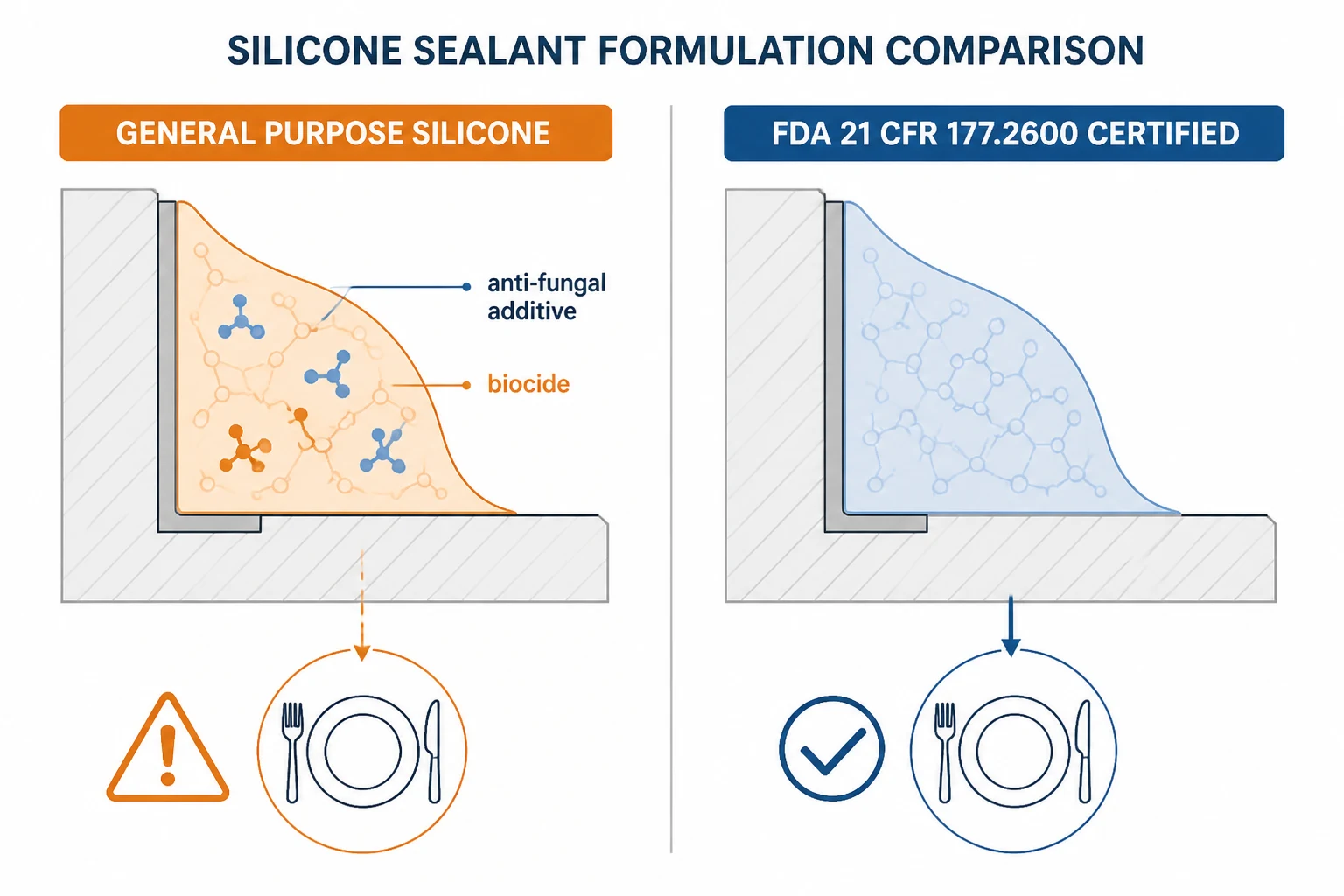
In the US, food-contact silicone sealants are typically evaluated against FDA 21 CFR 177.2600, the regulation covering rubber articles intended for repeated food contact. A sealant meeting this standard has been formulated and tested to confirm it doesn’t leach harmful substances into food under the conditions it’s expected to encounter, including specified temperature ranges and contact durations.
Critically, “food grade” is not a universal label silicone products qualify for by default, and silicone’s reputation as a generally inert material has led to a persistent misconception that most silicone is automatically food-safe. In practice, additives used in standard formulations — including certain curing agents, pigments, and anti-fungal compounds used in bathroom-specific sealants — can disqualify a product from food-contact use even when the base silicone chemistry is similar to a certified product.
Verifying a Genuine Food-Safe Claim
Marketing language alone isn’t sufficient verification. A legitimate food-grade sealant should have documentation that specifically cites FDA 21 CFR 177.2600 compliance (or the equivalent regional standard, such as EU 1935/2004 in Europe), rather than general phrases like “safe” or “non-toxic” without a cited standard.
- Request the specific regulatory citation rather than accepting “FDA approved” as a standalone claim — ask which section and what testing was performed.
- Check the temperature range tested for food contact compliance, since a product certified at room temperature isn’t automatically validated for oven, freezer, or steam-cleaning conditions.
- Confirm cure chemistry — some food-safe formulations are acetoxy-cure (vinegar-smelling during cure) while others are neutral-cure; the application substrate may dictate which is appropriate.
- Verify the claim applies to the cured product, not just the uncured sealant in the tube, since food-contact safety is about the final cured state that will actually touch food.
Common Food-Safe Sealant Applications
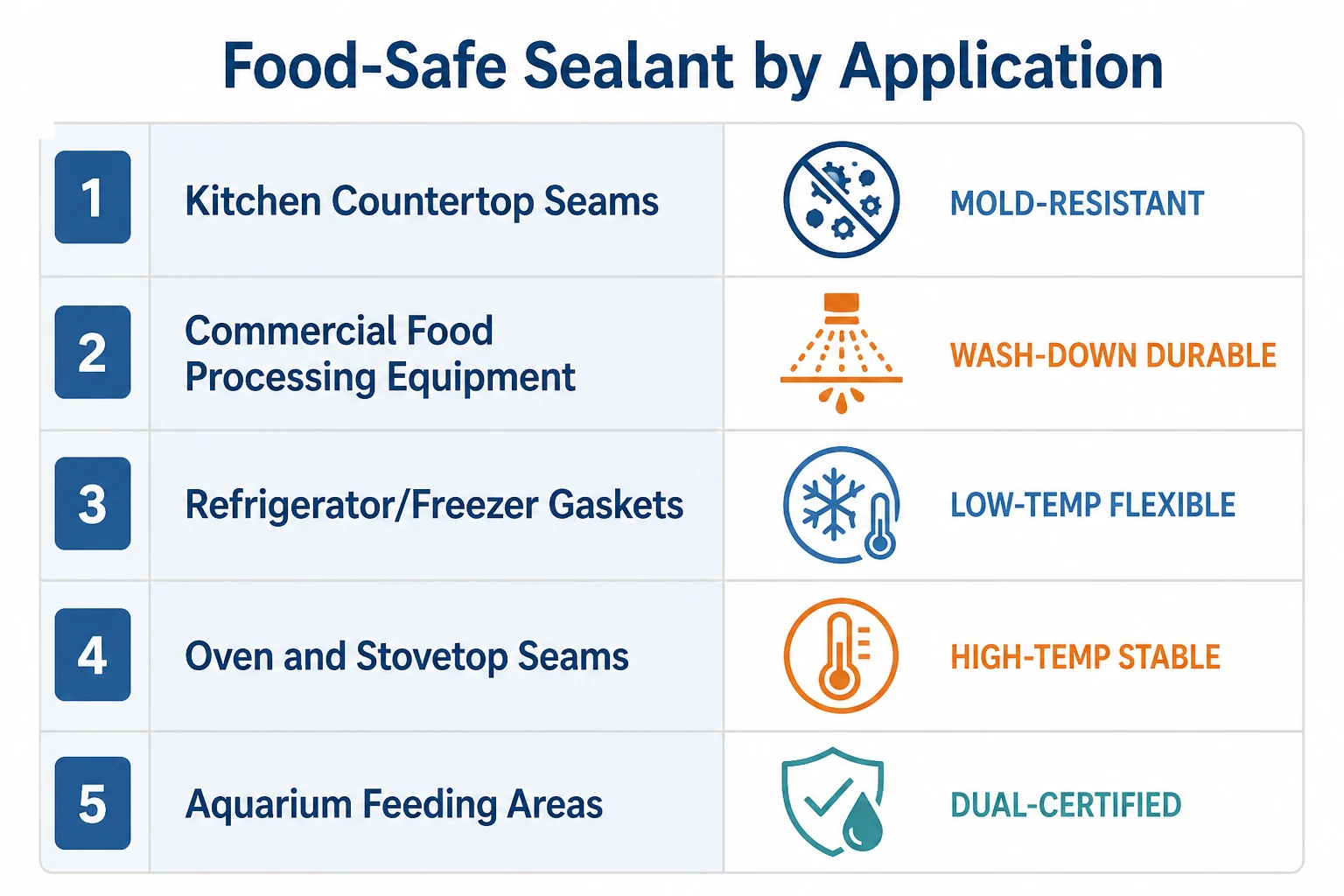
| Ứng dụng | Key Requirement | Note |
|---|---|---|
| Kitchen countertop-to-backsplash seams | Mold-resistant, food-safe when cured | Needs both food safety and the mold resistance typical of kitchen/bath formulations |
| Commercial food processing equipment | FDA 21 CFR 177.2600 compliant, wash-down durable | Must survive repeated sanitation cycles without degrading |
| Refrigerator and freezer gaskets/seams | Low-temperature flexibility, food-safe | Verify the tested temperature range extends to freezer conditions |
| Oven and stovetop seams | High-temperature stability, food-safe | Standard food-grade silicone may not be rated for oven-adjacent heat; check the upper temperature limit |
| Aquarium and reptile enclosures (feeding areas) | Food-safe, often also needs to meet aquarium-safe criteria | Two different safety standards can both apply; confirm the product addresses both where relevant |
Quy trình thi công tối ưu
- Làm sạch bề mặt thật kỹ with a food-safe cleaner before application — residue from standard cleaning chemicals can affect both adhesion and the food-safety of the finished joint.
- Respect the full cure time before food contact, since food-safety ratings typically apply to the fully cured sealant, not the material during its cure window.
- Match the sealant to the actual temperature cycle the application will see — don’t default to a general food-grade product if the application involves oven heat or freezer cold specifically.
- Avoid substituting bathroom or general-purpose silicone even when a tube appears clear and odor-free, since appearance alone does not indicate food-contact compliance.
- Keep the product documentation on file for commercial kitchens and food processing facilities, since health inspectors may request proof of food-grade compliance for sealed joints.
Common Mistakes
- Assuming “silicone” automatically means food-safe without checking the specific formulation and its additives.
- Using a kitchen-and-bath sealant that’s marketed for mold resistance but not actually tested or labeled for food contact.
- Ignoring the tested temperature range and applying a room-temperature-rated product near an oven or inside a freezer.
- Accepting vague marketing claims like “non-toxic” without a cited regulatory standard behind them.
- Trám đè lên lớp chất trám cũ đã xuống cấp without full removal — this is a cross-cutting sealant failure mode, and in food-contact applications it also risks trapping contamination under the new bead.
- Treating a commercial kitchen inspection as a formality rather than confirming documentation is actually on hand — health inspectors in many jurisdictions can and do ask for proof of food-grade compliance on sealed joints near prep surfaces, and not having it on file can delay a passing inspection even when the correct product was actually used.
Những câu hỏi thường gặp
Is all silicone sealant food grade?
No. Standard silicone sealants, including many marketed for kitchen and bath use, are not automatically certified for food contact. Only sealants specifically formulated and tested against standards like FDA 21 CFR 177.2600 should be used where the cured sealant will contact food.
Does food-grade sealant need to be reapplied more often than standard silicone?
Not inherently — a quality food-grade sealant should have a comparable service life to a standard silicone sealant in a similar environment. Lifespan depends more on the specific application’s temperature cycling, cleaning frequency, and substrate movement than on the food-grade certification itself.
Can food-grade sealant be used in a freezer or oven?
Only if the specific product’s tested temperature range covers that use case. A food-grade rating confirms contact safety, not automatic temperature compatibility — check the product’s rated temperature range separately before using it in freezer or oven-adjacent applications.
Food Grade vs. Food Safe vs. Food Contact: Terminology That Isn’t Interchangeable
Marketing copy often uses “food grade,” “food safe,” and “food contact” as if they mean the same thing, and treating them as interchangeable is itself a source of selection errors.
“Food contact” is the most precise term — it refers directly to materials evaluated under regulations like FDA 21 CFR 177.2600 for substances intended to touch food. “Food safe” is a broader, less regulated phrase that can describe anything from a certified food-contact material to a product the manufacturer simply believes won’t cause harm, without a specific cited standard behind it. “Food grade” sits somewhere between the two in common usage: it often implies regulatory compliance but isn’t a legally defined term on its own, which is exactly why asking for the specific regulatory citation matters more than the label a product uses to describe itself.
Choosing the Right Food-Safe Sealant
Verify food-grade claims against a specific cited standard rather than general marketing language, confirm the tested temperature range matches your actual application, and never substitute a general kitchen-and-bath sealant for a genuinely certified food-contact product. The small amount of extra diligence required to confirm a specific regulatory citation, rather than accepting a general “food safe” label at face value, is a minor step compared to the cost of a failed health inspection or a product recall traced back to an uncertified sealant near food-contact surfaces. For broader silicone sealant selection beyond food-contact-specific requirements, our Aquarium Sealant Guide covers a related specialty-certification use case with its own distinct verification requirements.
Khám phá các sản phẩm của Joobond Keo silicone range for formulations suited to specialty certification requirements including food-contact applications.
Keyword research source: SeoTools8 (Semrush-backed), US database, desktop, 2026-10-17. Seed “food grade sealant” — Volume 260/mo, KD 6%. Primary long-tail “food grade silicone sealant” — Volume 1,000/mo, KD 26%, Intent Informational + Commercial.
 English
 العربية
 Español de México
 Русский
 Tiếng Việt
 Português do Brasil
 Bahasa Indonesia
 Türkçe