

Table of Contents
- 1. Why Precast Joints Need a Different Sealant Approach Than Cast-in-Place Concrete
- 2. Movement Capability: The Number That Matters Most
- 3. Substrate Compatibility: Precast Concrete Is Not All the Same
- 4. Sealant Chemistry Selection for Precast Joints
- 5. Joint Design Details That Affect Sealant Performance
- 6. Common Precast Sealant Specification Mistakes
- 7. Conclusion: Specify by Performance, Not Just by Product Category
Precast concrete construction moves fast — panels are cast off-site, cured under controlled conditions, and assembled on-site in a fraction of the time cast-in-place construction requires. But that speed advantage disappears quickly if the joint sealant between panels fails within a few years, forcing water infiltration repairs on a building that was supposed to be low-maintenance. This guide covers what actually differentiates a precast joint sealant from a general construction sealant, and how to specify correctly for the movement and exposure conditions precast joints experience.

Why Precast Joints Need a Different Sealant Approach Than Cast-in-Place Concrete
Precast panel joints behave differently from monolithic concrete cracks or expansion joints in cast-in-place structures, for three structural reasons:
- Panel-to-panel joints are designed movement joints, not incidental cracks. They are engineered gaps that must accommodate thermal expansion, wind load deflection, and minor seismic movement between independently supported panels.
- Joint width tolerances are typically larger and more variable than cast-in-place control joints, since precast panel dimensions and installation alignment introduce more variability.
- Two-stage and back-bedded joint designs are common in precast facades, meaning the sealant may need to work alongside a compressible backer rod and, in rainscreen systems, an air/water barrier behind the visible joint.
Movement Capability: The Number That Matters Most
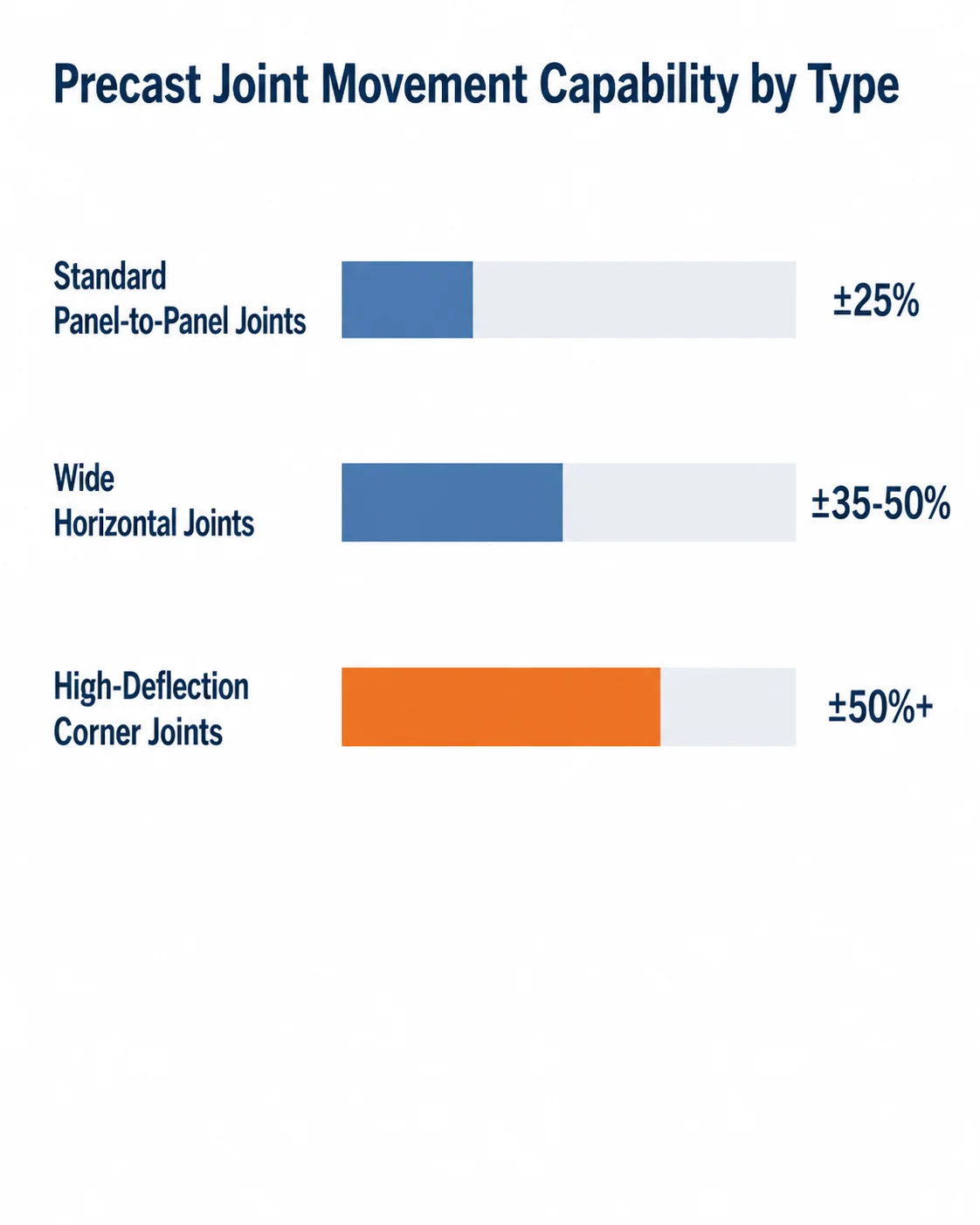
The single most important specification for a precast joint sealant is its movement capability, expressed as a percentage of joint width (e.g., ±25%, ±35%, ±50%). This number tells you how much the joint can expand and contract from its as-installed width without the sealant tearing or losing adhesion.
| Joint Type | Typical Movement Range Needed | Sealant Class Generally Required |
|---|---|---|
| Standard panel-to-panel vertical joints | ±25% | Medium-movement sealant (many single/multi-component polyurethanes) |
| Wide horizontal joints with thermal cycling exposure | ±35% to ±50% | High-movement silicone or high-performance hybrid (MS Polymer) |
| Joints near building corners/high-deflection zones | ±50% or engineer-specified | High-movement silicone, often specified by the structural engineer directly |
Under-specifying movement capability is one of the most common and costly precast sealant failures — a sealant rated for ±25% installed in a joint experiencing ±40% real-world movement will eventually tear at the bond line regardless of how well it was applied.
Substrate Compatibility: Precast Concrete Is Not All the Same
Precast concrete panels are frequently treated with form-release agents, curing compounds, and surface coatings during manufacturing — all of which can interfere with sealant adhesion if not addressed:
- Form-release agent residue on the joint surface prevents proper primer and sealant bonding; specifications should require joint surfaces to be cleaned or lightly abraded before sealant application.
- Architectural finishes and coatings (exposed aggregate, acid-etched, or painted surfaces) may require a sealant/primer combination specifically tested for that finish.
- Compatibility with the panel’s insulation and vapor barrier system matters in rainscreen and insulated precast panels.
Sealant Chemistry Selection for Precast Joints
- Silicone: Preferred for high-movement joints and long-term UV exposure on exposed façade joints; requires compatible primer on most precast surfaces for reliable long-term adhesion.
- Polyurethane: Common for standard movement joints where paintability or below-grade/plaza deck exposure is a factor — see our Polyurethane Sealant Supplier Guide for selection criteria.
- MS Polymer (Hybrid): Increasingly specified where the combination of paintability, primerless adhesion to damp or textured concrete, and strong movement capability is needed — see our MS Polymer vs. Silicone comparison.
Joint Design Details That Affect Sealant Performance
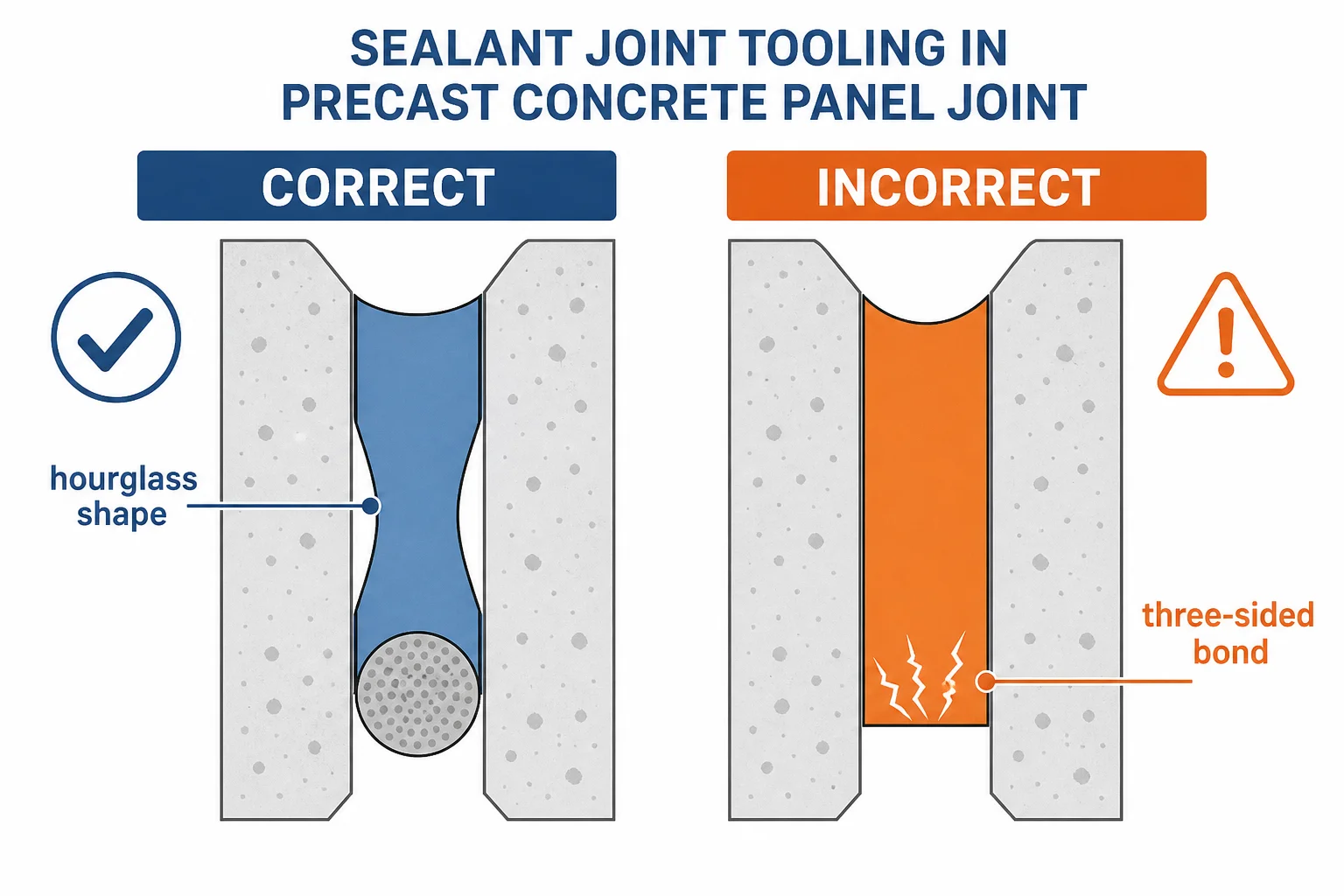
- Backer rod sizing and compatibility. Controls sealant depth-to-width ratio and must be a closed-cell or compatible material that does not off-gas or bond to the sealant.
- Joint depth-to-width ratio. An incorrect ratio reduces the sealant’s ability to stretch and compress without excessive internal stress.
- Tooling and bond-breaker practice. Proper tooling ensures the sealant only bonds to the two intended joint faces, essential for hourglass-shaped movement rather than tearing.
Common Precast Sealant Specification Mistakes
- Specifying by product name instead of by performance class. Leaves too much room for a low-performance substitution during value engineering.
- Ignoring form-release agent compatibility during specification. Frequently caught too late, during installation.
- Mismatching primer to the specific precast surface finish. A primer that works on smooth precast may not perform the same on exposed-aggregate or coated panels.
- Under-sizing the joint width relative to expected building movement. Pushes even a correctly-rated sealant beyond its tested movement range.
- Skipping a field mock-up/adhesion test before full production application.
Conclusion: Specify by Performance, Not Just by Product Category
Precast concrete joint sealant selection depends on matching movement capability to actual joint design movement, verifying substrate compatibility against the specific precast finish and release agent used, and following correct backer rod and tooling practice. Explore Joobond’s Polyurethane Sealant and Silicone Sealant ranges for formulations suited to precast panel joint applications.
 English
  العربية
  Español de México
  Русский
  Tiếng Việt
  Português do Brasil
  Bahasa Indonesia
  Türkçe