

Table of Contents
- 1. Quick comparison
- 2. 1. Introduction
- 3. 2. Composition and Structure
- 4. 3. The Practical Difference Buyers Notice First: Density and Feel
- 5. 4. Manufacturing Process
- 6. 5. Properties of Foam
- 7. 6. Properties of PU Foam
- 8. 7. Common Applications by Use Case
- 9. 8. Cost Comparison
- 10. 9. Durability and Mechanical Behavior
- 11. 10. Environmental Impact
- 12. 11. Comfort and Support
- 13. 12. Maintenance and Care
- 14. 13. Sustainability
- 15. 14. Consumer Preferences
- 16. 15. Future Innovations
- 17. 16. Making an Informed Choice
- 18. FAQ
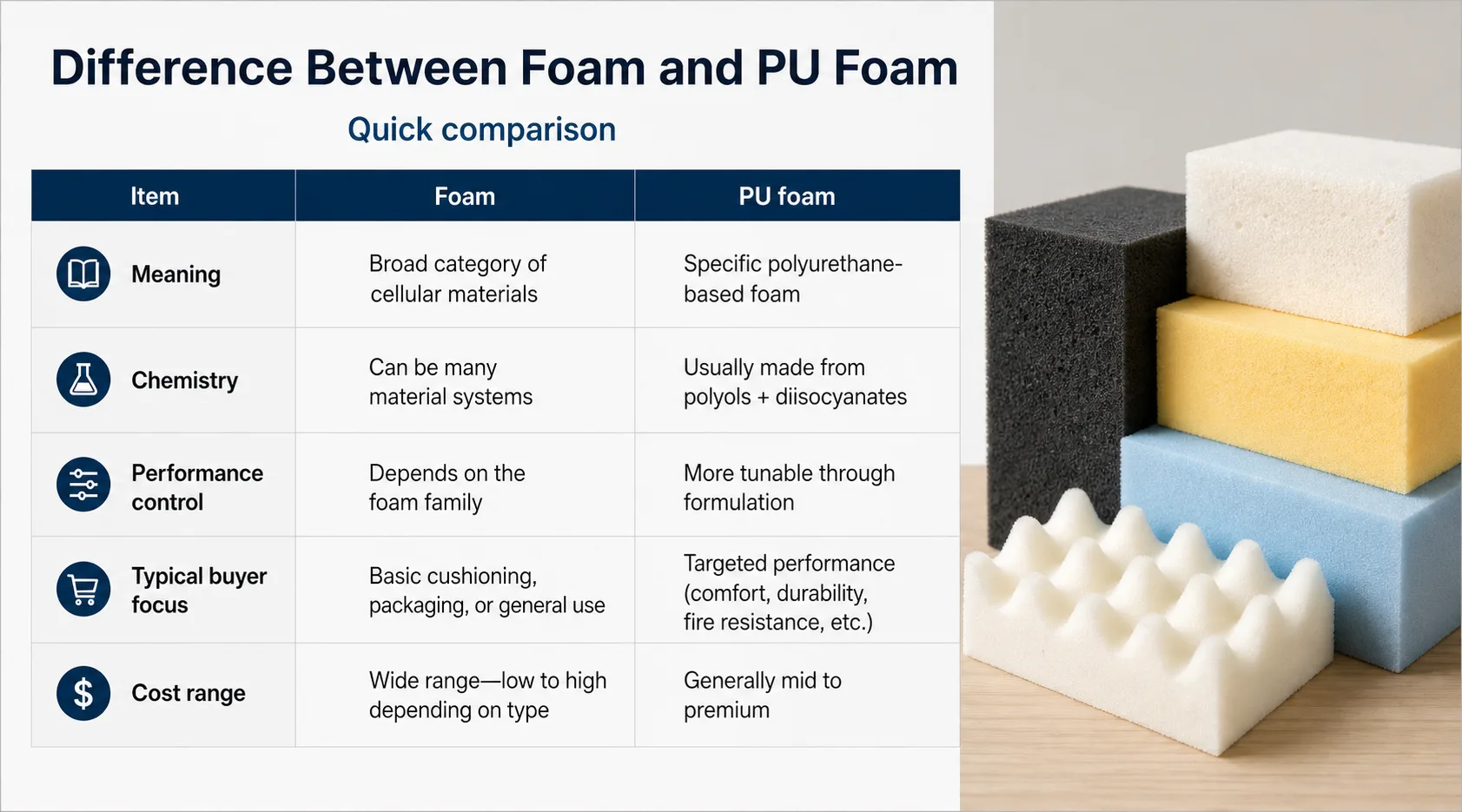
“Foam” is a broad material category, while PU foam is a specific type of foam, usually polyurethane foam, made from polyols and diisocyanates. The key difference is that PU foam has defined chemistry and can be engineered into flexible, rigid, molded, or spray-applied forms with measurable properties such as density, compression set, IFD, resilience, thermal conductivity, and rebound.
Quick comparison
| Item | Foam | PU foam |
|---|---|---|
| Meaning | Broad category of cellular materials | Specific polyurethane-based foam |
| Chemistry | Can be many material systems | Usually made from polyols + diisocyanates |
| Performance control | Depends on the foam family | More tunable through formulation |
| Typical buyer focus | Basic cushioning, packaging, or general use | Support, comfort, insulation, molded parts, spray applications |
| Common data to check | Density, firmness, use-case fit | Density, IFD, compression set, resilience, thermal conductivity |
For buyers and project teams, this distinction matters when comparing supplier specifications. As a building materials manufacturer, QingDao Joobond New Materials Co., LTD. (Joobond) emphasizes technical consistency, quality control, and product customization across adhesive and material applications, which is the kind of supplier capability many buyers look for when evaluating foam-related products and system compatibility.
1. Introduction
Foam is a substance formed by trapping pockets of gas in a liquid or solid. It is widely used because it can be lightweight, cushioning, insulating, or protective depending on the material system and structure.
PU foam, commonly known as polyurethane foam, is a type of foam derived from the reaction of polyols and diisocyanates. In polyurethane chemistry, these raw materials react to form a polymer network that expands into a foam structure. Manufacturer technical data sheets and safety data sheets commonly identify these components, and polyurethane chemistry is widely covered in polymer reference materials and industry documentation.
When sourcing materials, product documentation matters as much as the foam name itself. Joobond’s focus on quality control and customized solutions reflects the same practical need seen in foam procurement: stable performance, verified composition, and fit-for-application material selection.
2. Composition and Structure
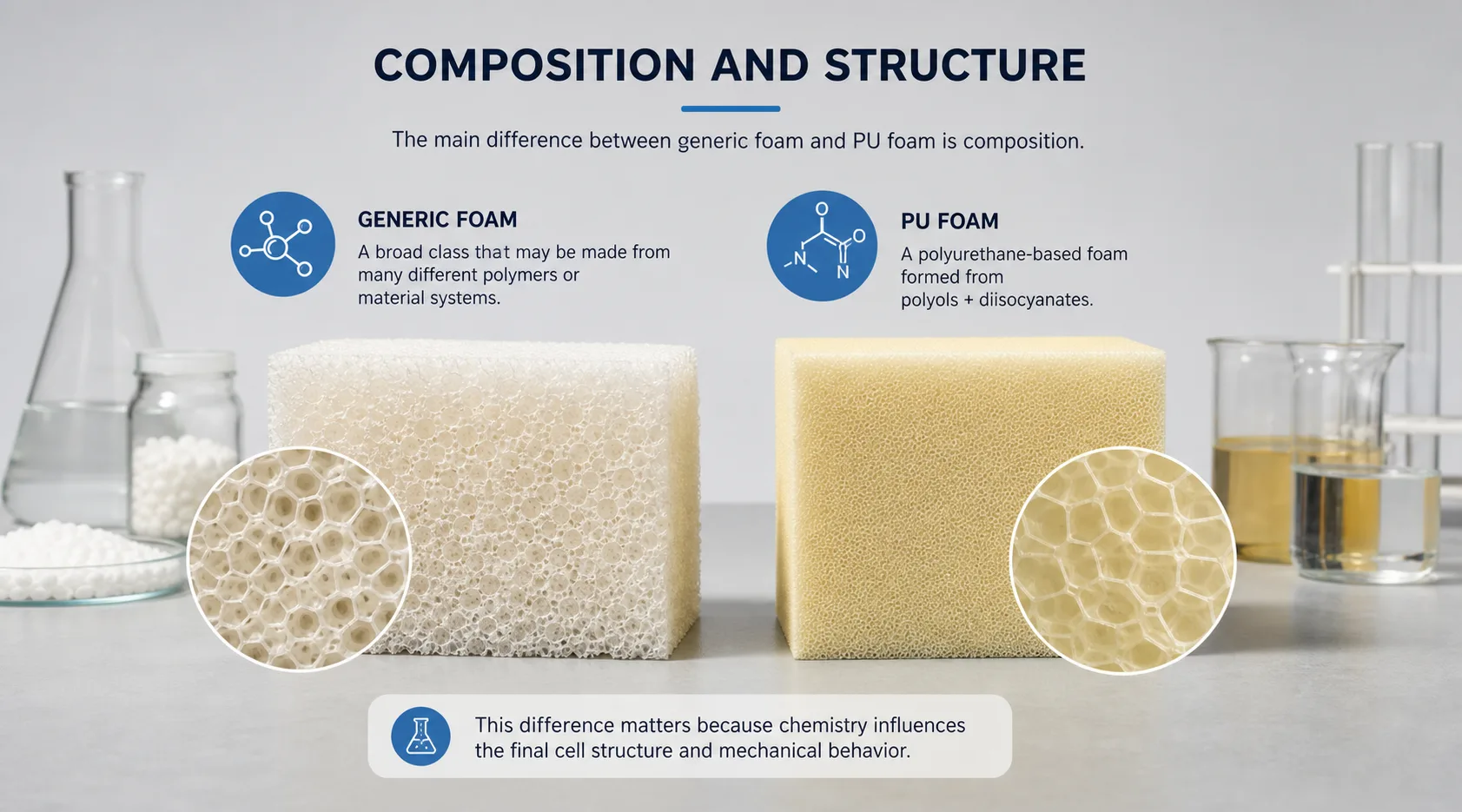
The main difference between generic foam and PU foam is composition.
- Generic foam: a broad class that may be made from many different polymers or material systems.
- PU foam: a polyurethane-based foam formed from polyols + diisocyanates.
This difference matters because chemistry influences the final cell structure and mechanical behavior. PU foam formulations may also include catalysts, surfactants, blowing agents, and additives to adjust cell size, density, airflow, firmness, and recovery behavior.
For example:
- Flexible PU foam is often designed for seating comfort and cushioning.
- Rigid PU foam is often designed for insulation and structural thermal performance.
- Memory foam, high-resilience foam, and spray PU foam are all related polyurethane foam products or application forms.
- Polyfoam is another term buyers may see in mattress or furniture discussions, usually referring to polyurethane-based foam products.
For verification, buyers usually rely on a product’s technical data sheet (TDS), safety data sheet (SDS), or manufacturer specification sheet to confirm the foam chemistry and performance claims.
3. The Practical Difference Buyers Notice First: Density and Feel
In real purchasing decisions, the most visible difference is often not the label but the density and feel.
- General foam can range widely in density and performance because it is a broad category.
- PU foam can be formulated as lower-density comfort foam, higher-density support foam, or rigid insulation foam.
Higher-density PU foam is often associated with more support and better shape retention in seating and mattress applications, while lower-density versions may be chosen for softer or lighter-duty uses. That is why density should be checked alongside firmness, compression set, and recovery behavior rather than treated as a standalone quality label.
A practical buyer should ask:
- Is the foam meant for cushioning or support?
- Does it need pressure relief or stronger rebound?
- Is the priority lightweight packaging or long-term insulation?
- Does the application require a high-density foam feel or a softer, more conforming structure?
4. Manufacturing Process
Foam in general is made by introducing gas into a material system and then allowing it to set, cure, or solidify. Depending on the foam type, this can happen through chemical reaction, mechanical foaming, or both. PU foam is made through the polyurethane reaction process.
During manufacturing, producers can control:
- density
- firmness
- rebound or resilience
- airflow
- compression set
- thermal insulation behavior
- open-cell or closed-cell structure
This control is one reason PU foam is widely used in engineered products. In furniture, automotive seating, packaging, and insulation, the key question is often not just “what is the foam?” but “what measurable performance does it deliver?”
5. Properties of Foam
Traditional foam products are often selected for their lightweight and cushioning behavior. Depending on the chemistry, a foam can be soft, compressible, buoyant, or acoustically absorptive.
Common foam characteristics include:
- low weight
- cushioning and padding
- protective shock absorption
- packaging support
- acoustic dampening in some designs
Typical applications include mattresses, pillows, packaging, and soundproofing. In each case, the relevant performance depends on the specific foam formulation rather than the broad word “foam.”
6. Properties of PU Foam
PU foam is often chosen because it can be formulated to meet more specific performance requirements.
Common PU foam characteristics include:
- adjustable firmness across formulations
- a wide density range
- molded-part capability
- good recovery or rebound in flexible grades
- strong thermal insulation performance in rigid grades
- suitability for spray-applied and cavity-filling products
- better support potential in furniture and mattress applications
Instead of describing PU foam as simply having “enhanced properties,” it is more accurate to say it is more tunable. The same polyurethane chemistry can be adapted for comfort layers, rigid insulation boards, automotive interiors, and molded industrial parts.
A practical comparison usually relies on test-based attributes such as:
- density
- compression set
- indentation force deflection (IFD) or firmness
- resilience/rebound
- tensile strength
- tear resistance
- thermal conductivity for insulation uses
7. Common Applications by Use Case
General foam is commonly found in everyday items such as mattresses, pillows, packaging materials, and acoustic products. PU foam, with its more specific chemistry and tunable properties, is often chosen for applications that require controlled support, insulation, or molded shape retention.
Common PU foam uses
- upholstery and seating
- mattress layers and comfort foams
- building insulation systems
- automotive seats and interior padding
- molded consumer and industrial parts
- spray foam applications in construction
- sealing, filling, and gap insulation products
Concrete industry examples
- Flexible PU foam: furniture cushions, mattresses, car seats
- Rigid PU foam: building insulation panels, appliance insulation, cold-storage systems
- Spray PU foam: sealing around gaps, roof insulation, wall cavities
- Molded PU foam: shaped seating parts, armrests, packaging inserts
Comfort-focused applications
For mattresses and seating, buyers often compare pressure relief, support, and buoyancy.
- Memory foam generally conforms more closely to the body and can reduce pressure points.
- PU foam is often more buoyant and supportive, with a more responsive feel.
- High-density foam is often chosen when stronger support or longer-lasting shape retention is needed.
A related term is PU foam spray, which usually refers to spray-applied polyurethane foam used for insulation, air sealing, or filling cavities in building work.
8. Cost Comparison
Traditional foam can sometimes be cheaper to produce when the formulation and processing are simple. PU foam may require more controlled chemistry and more specialized raw materials, which can increase cost. However, cost is not determined by the foam family alone.
It depends on:
- foam density
- raw material selection
- flexible vs. rigid formulation
- manufacturing method
- product volume
- intended end use
- market demand
So the most accurate comparison is not “foam is always cheaper.” It is that cost varies by foam type, required performance, and specification level. For example, a low-cost packaging foam may be cheaper than a high-spec PU seating foam, while a rigid PU insulation product may deliver value through energy-saving performance over time.
9. Durability and Mechanical Behavior
Durability depends on the exact foam, but PU foam is often selected for applications where the material must keep its shape or support repeated use. In practical terms:
- General foam may prioritize softness, lightness, or basic cushioning.
- PU foam may be formulated for better recovery, better support, or more stable performance under repeated compression.
This should be evaluated with measurable properties, not vague claims. Common durability indicators include:
- compression set
- fatigue resistance
- long-term firmness retention
- tear resistance
- tensile strength
These values help compare products more reliably than broad statements such as “more durable.” If a supplier provides test data, that documentation is usually the best way to verify the claim.
10. Environmental Impact
Environmental impact depends on the foam formulation, production method, service life, and end-of-life pathway. Traditional foam products can raise disposal concerns if they are hard to separate, recycle, or recover after use. PU foam can also be difficult to recycle in many real-world cases, although some formulations and recovery methods are designed to improve reuse or recycling.
A careful comparison should look at:
- whether the foam is recyclable in practice
- whether it contains recycled content
- how much waste is created during manufacturing
- whether the product can be recovered, reused, or reprocessed
- whether the product can be disassembled from bonded layers or coverings
That means it is better to avoid blanket claims such as “more eco-friendly.” Sustainability depends on the foam chemistry, the product design, and the available collection or recycling infrastructure. In some cases, PU foam may offer environmental advantages through long service life or insulation performance; in other cases, disposal and recovery remain the main challenge.
11. Comfort and Support
For consumer products, the difference often comes down to feel.
- General foam is often valued for softness and basic cushioning.
- PU foam is often valued for a more engineered balance of comfort and support.
That is why PU foam is common in mattresses, seating, and upholstery where pressure distribution, rebound, and shape retention matter. The exact feel still depends on density, cell structure, and whether the foam is flexible, memory-oriented, or more rigid.
Related product terms include memory foam, high-resilience foam, high-density foam, and soft flexible PU foam. These names describe different polyurethane foam behaviors, not one universal foam feel.
12. Maintenance and Care
Care requirements vary by product design.
- Foam products are often maintained with basic cleaning and protection from excessive moisture.
- PU foam products may have care instructions tied to the surrounding product, especially in furniture, insulation, or automotive use.
The foam itself is only one part of maintenance. Covers, adhesives, coatings, installation methods, and exposure to heat or moisture can matter just as much. For example, a PU foam mattress layer may behave differently depending on whether it is enclosed in a fabric cover, laminated to another layer, or used inside a ventilated construction assembly.
13. Sustainability
Sustainability should be evaluated case by case rather than assumed from the foam name. Traditional foam’s limited recyclability can contribute to environmental concerns. Advancements in PU foam formulations are making strides toward improved sustainability, including potential reuse, recycling, or material recovery options in some products.
Relevant decision factors include:
- recycled content
- product life span
- repairability and replacement frequency
- recycling or recovery pathways
- manufacturing waste
- insulation or energy-saving benefits over the use phase
A longer-lasting PU foam product may reduce replacement frequency, but that does not automatically mean every PU foam item is more sustainable than every other foam product.
14. Consumer Preferences
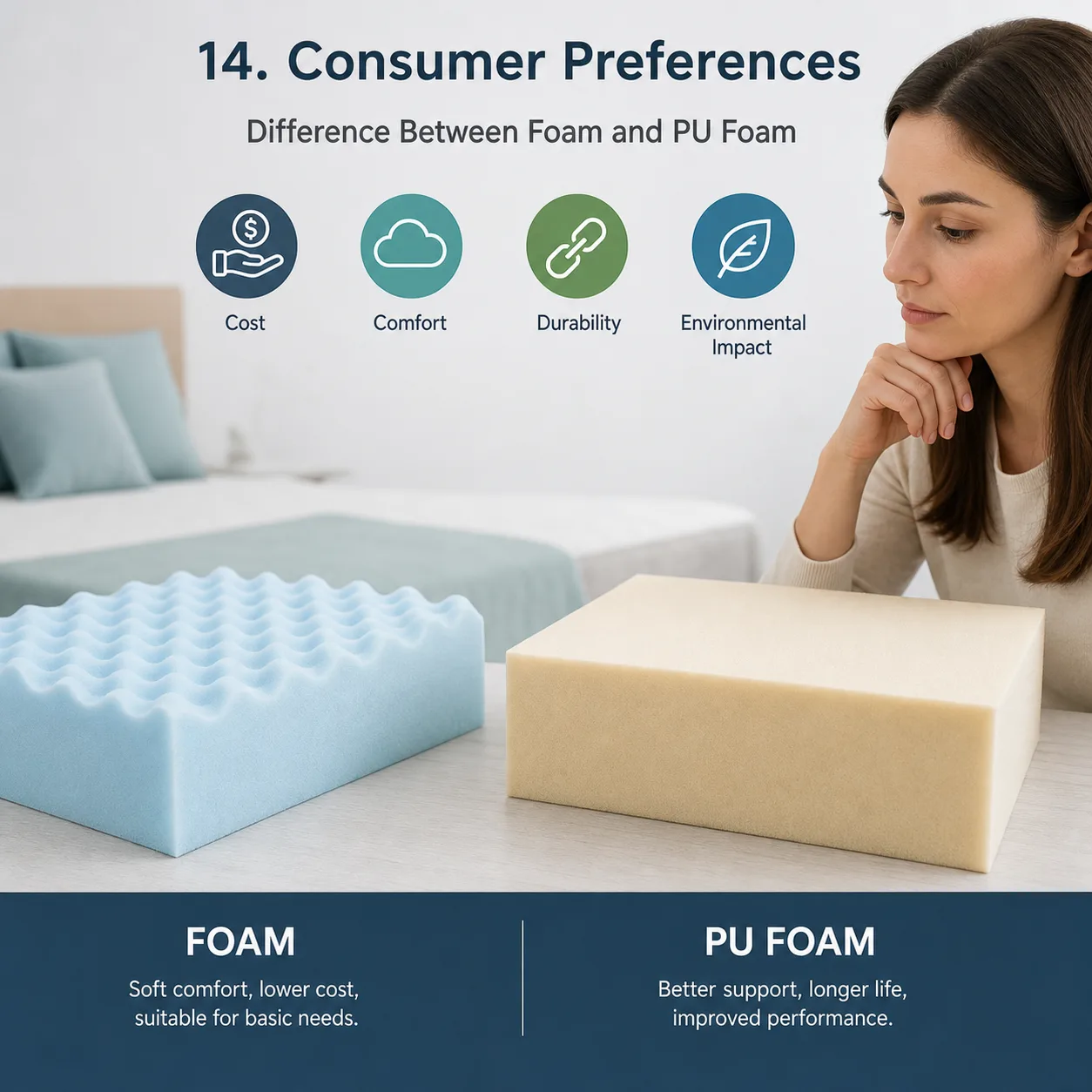
Consumer preferences often hinge on cost, comfort, durability, and environmental impact. Market trends show growing interest in materials that combine comfort with longer service life and better energy performance. That is one reason PU foam remains widely used in furniture, bedding, construction, and transportation.
At the same time, buyers often compare products using measurable factors such as:
- firmness level
- density
- resilience
- insulation value
- pressure relief
- product warranty or expected service life
- recycling or disposal guidance
Those practical criteria usually matter more than the label alone. For B2B buyers, supplier reliability also matters: company scale, customization capability, and documented quality control can reduce uncertainty during product selection and repeat orders.
15. Future Innovations
Ongoing research aims to improve foam performance, reduce material waste, and expand recycling options. For PU foam, innovation often focuses on:
- better durability
- lower emissions in production
- improved recyclability or recovery
- bio-based or recycled raw material content in some formulations
- improved insulation efficiency
This work matters because PU foam is used across many industries, including furniture, automotive, appliances, construction, and packaging. Manufacturers with active R&D teams are better positioned to develop and customize formulations as application needs change.
16. Making an Informed Choice
When choosing between a general foam product and PU foam, the best questions are:
- What density or firmness is required?
- Does the item need soft cushioning or stronger support?
- Will it face repeated compression or heavy use?
- Is insulation, seating comfort, packaging, or acoustic performance the priority?
- What recycling or disposal route is available?
- Does the supplier provide a technical data sheet with measurable properties?
Those requirements usually matter more than the label itself. A cheaper foam can be the right choice for short-term packaging, while PU foam may be better for furniture, insulation, or molded components where performance needs are stricter. If sourcing from a manufacturer such as Joobond, buyers may also consider whether OEM/ODM support, free samples, and a complete quality control system are available to validate the material before production.
FAQ
Is PU foam the same as regular foam?
No. Foam is a general term for many cellular materials. PU foam is one specific type made from polyurethane chemistry.
What is PU foam made from?
PU foam is made from polyols and diisocyanates. The exact formulation can also include catalysts, surfactants, and blowing agents.
Is PU foam more durable than other foams?
It can be, but not always. Durability depends on the formulation, density, and product design. Compression set, fatigue resistance, and firmness retention are better ways to compare products than a broad durability claim.
Is PU foam more eco-friendly?
Not automatically. Environmental performance depends on recyclability, recycled content, manufacturing waste, product life, and end-of-life recovery options.
Where is PU foam commonly used?
PU foam is commonly used in mattresses, upholstery, automotive seating, insulation, molded parts, and spray foam construction applications.
Is PU foam better for mattresses?
It depends on the feel you want. PU foam is often more buoyant and supportive, while memory foam usually gives more contouring and pressure relief.
 English
  العربية
  Español de México
  Русский
  Tiếng Việt
  Português do Brasil
  Bahasa Indonesia
  Türkçe