

Table of Contents
- 1. Why Standard Sealants Fail Below Freezing
- 2. What “Cold Weather Rated” Actually Means on a Datasheet
- 3. Which Chemistries Actually Perform in Cold Conditions
- 4. Cold Weather Roof Sealant: What’s Different About Roofing Applications
- 5. Application Technique Checklist for Below-Freezing Work
- 6. Frequently Asked Questions
- 7. Choosing the Right Product for Your Climate
A caulking gun left outside overnight in freezing weather tells you most of what you need to know about cold weather sealant: squeeze the trigger and the bead comes out stiff, sluggish, sometimes not at all. Below a certain temperature threshold, standard sealants stop curing properly even if you manage to apply them. This guide covers which chemistries actually tolerate low-temperature application, what “rated for cold weather” means on a datasheet, and the roof-specific failures that send people searching for this topic in the first place.
Why Standard Sealants Fail Below Freezing
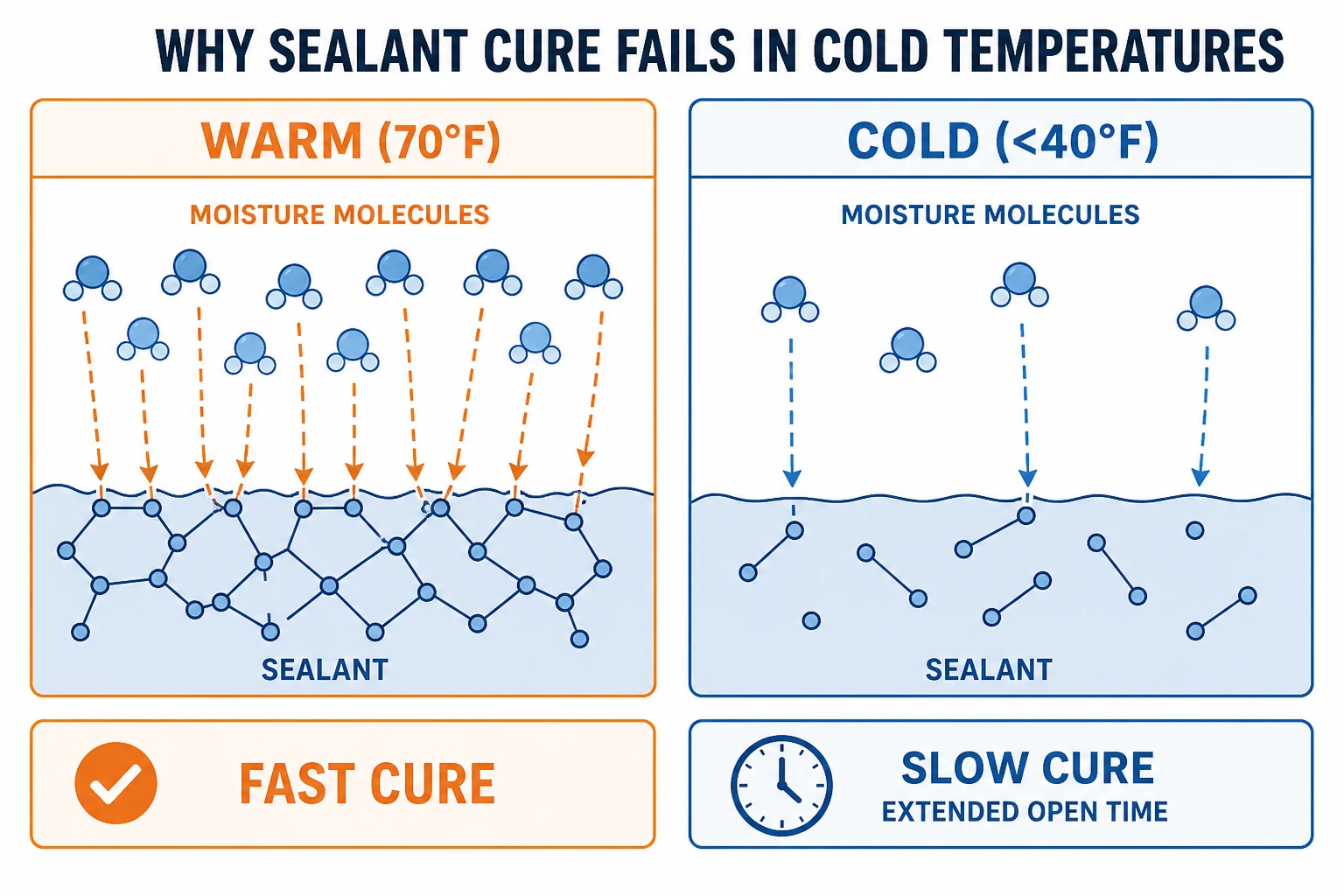
Sealant cure is a chemical reaction, and most chemical reactions slow down as temperature drops. Two separate problems show up once you’re near or below freezing.
First, viscosity climbs. Cold material is thicker material. A sealant that gunned out smoothly at 70°F can turn into a stiff paste at 30°F, making it nearly impossible to tool a clean bead or get full contact with the substrate. Second, and more serious, cure rate drops off sharply. Moisture-cure polyurethanes and silicones rely on ambient humidity reacting with the polymer — and both the reaction rate and the air’s capacity to hold moisture fall as temperature drops. A sealant that skins over in 30 minutes at room temperature might take most of a day below freezing, and during that extended open window, dust, frost, or a second freeze cycle can compromise the surface before it ever fully sets.
There’s a third failure mode specific to roofs: thermal cycling. A sealant applied on a cold morning, then hit by direct sun by early afternoon, experiences a fast temperature swing right during its most vulnerable early-cure window. Products not formulated for this get microcracks before they’ve even reached full strength.
What “Cold Weather Rated” Actually Means on a Datasheet
Not every product labeled for cold climates uses the term the same way. Three datasheet specs matter more than the marketing claim on the front of the tube.
- Minimum application temperature. This is the lowest substrate/air temperature at which the manufacturer has tested successful application and cure — look for an actual number (e.g., -20°F or -29°C), not a vague “cold weather formula” claim.
- Low-temperature flexibility / cold flexibility rating. A sealant can apply fine in the cold but still turn brittle once fully cured if it’s exposed to sub-zero temperatures afterward. This spec tells you whether the cured sealant stays flexible through winter, not just during application.
- Cure time at reduced temperature. Datasheets usually give cure time at 73°F/50% RH as the baseline. A product worth using in winter will also publish a cure-time estimate at 40°F or lower — if that number isn’t available, treat the “cold weather” claim with some skepticism.
Which Chemistries Actually Perform in Cold Conditions
Chemistry choice matters more than brand name once temperatures drop. Here’s how the common categories compare.
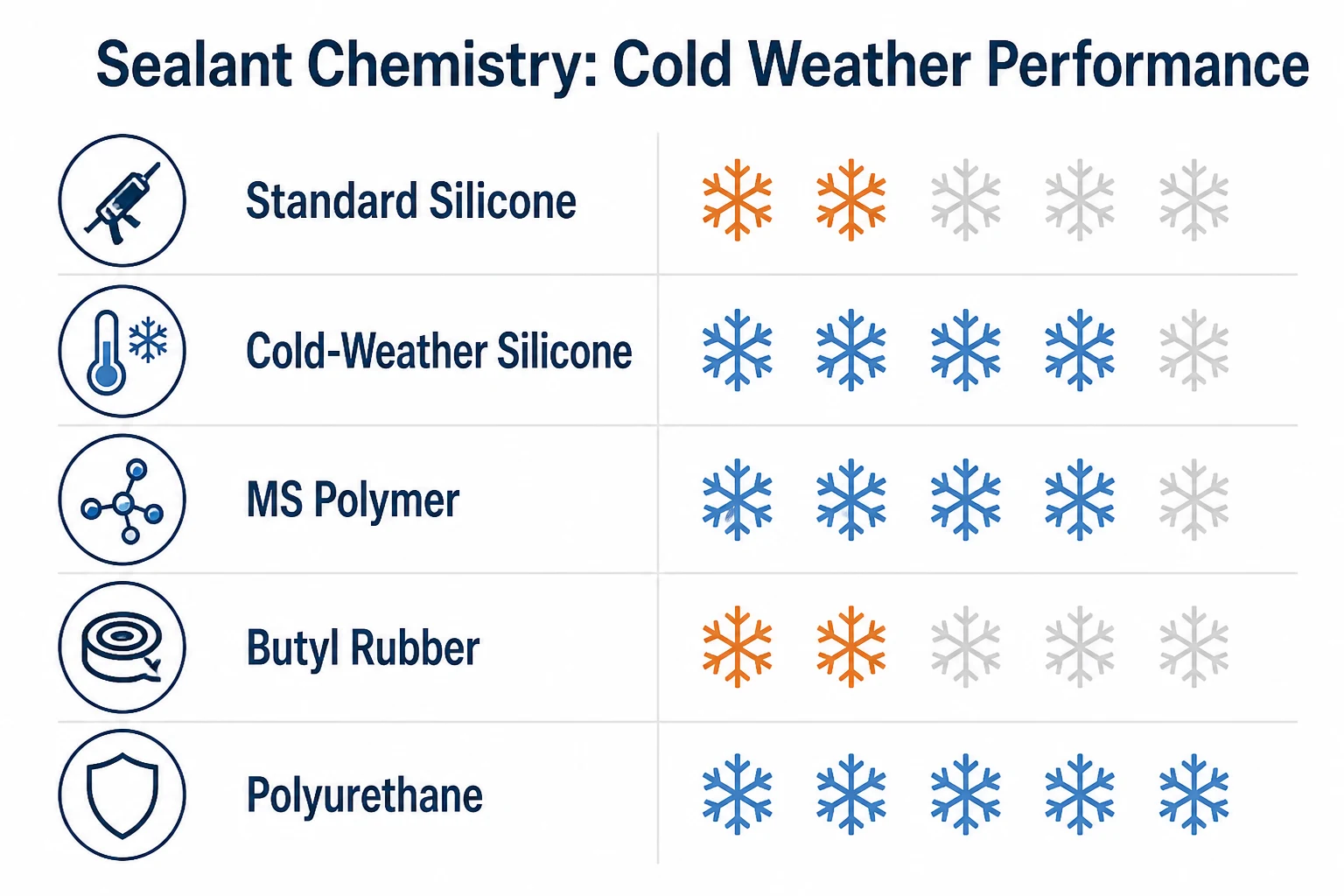
| Chemistry | Cold Application Performance | Cured Flexibility in Freezing Temps | Typical Use |
|---|---|---|---|
| Standard silicone | Poor below ~40°F — skins slowly, hard to tool | Good once cured, but cure window is the problem | Not recommended for winter installs |
| Cold-weather-formulated silicone | Rated down to roughly -20°F to -40°F depending on product | Excellent — stays flexible, minimal brittleness | Window/door perimeter sealing, HVAC penetrations |
| MS Polymer (hybrid) | Generally tolerates lower temperatures than standard silicone; check datasheet minimum | Good, maintains movement capability | Roof flashing, general exterior joints — see our MS Polymer vs. Silicone comparison |
| Butyl rubber | Remains workable at lower temperatures than silicone, though stiffer | Good, naturally pliable chemistry | Roof flashing laps, gutter seams |
| Polyurethane | Cure rate drops sharply below 40°F unless specifically formulated | Variable — check cold-flex rating | Below-grade and structural joints — see our Polyurethane Sealant Supplier Guide |
Cold Weather Roof Sealant: What’s Different About Roofing Applications
Roof sealing in winter carries extra risk that flat-wall caulking doesn’t. Three things show up repeatedly in roofing-specific searches on this topic.
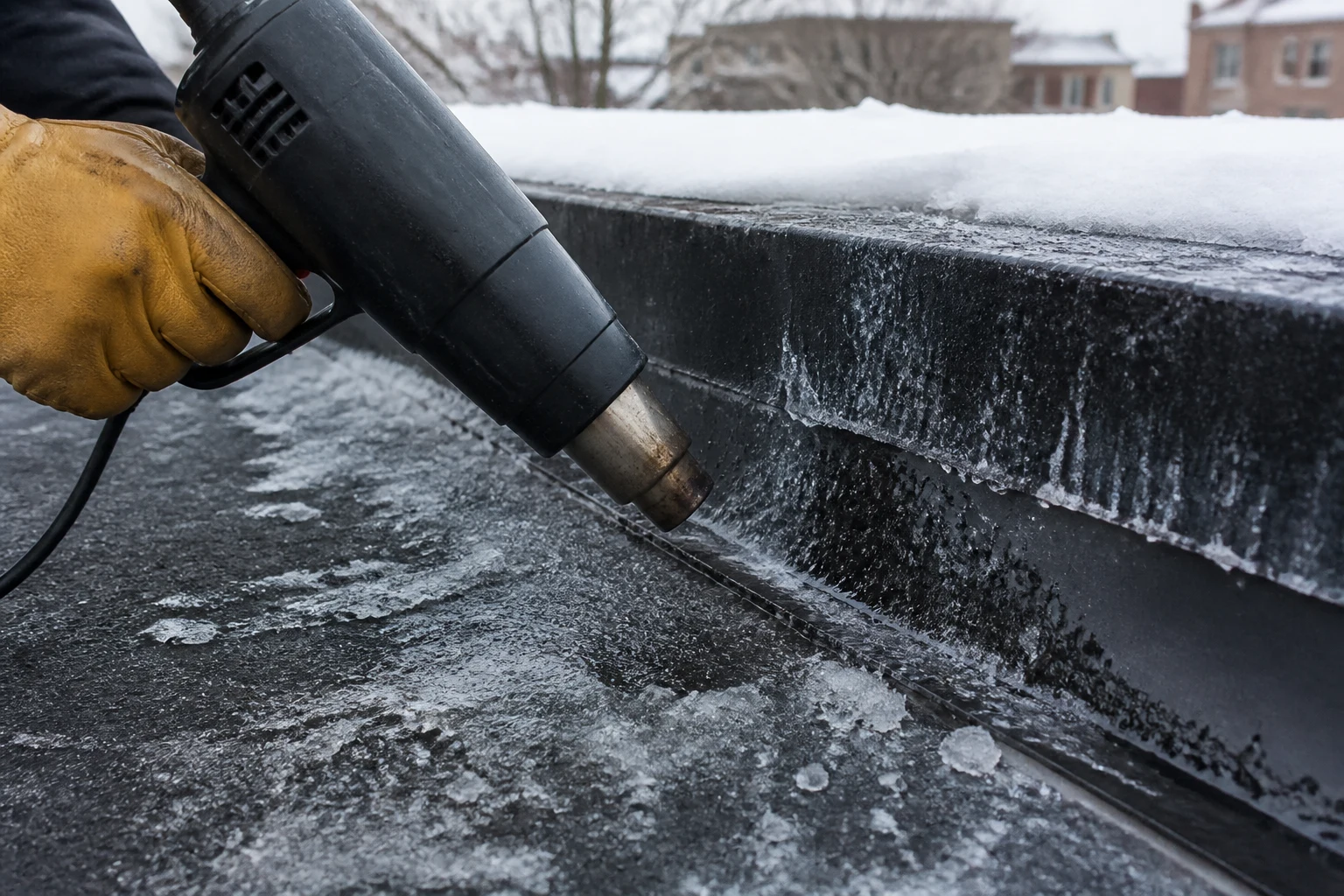
Frost and ice on the substrate is the most common cause of roof sealant adhesion failure in winter. Sealant bonds to the surface it’s applied to — if that surface has a thin frost layer, the sealant is effectively bonding to ice, not to the roofing material. Once that ice melts, the bond releases cleanly, and the leak returns within days even though the application looked fine at the time.
Steep-slope and flat roofs behave differently in cold application. On a steep slope, a slow-curing sealant can sag or slump before it sets, losing the bead profile needed to shed water. On a flat or low-slope roof, standing meltwater from daytime sun exposure can sit directly on a joint that hasn’t fully cured, washing out uncured material before it bonds.
Emergency winter leak repairs are usually a stopgap, not a permanent fix. A sealant applied in January to stop an active leak should be scheduled for proper reinspection and likely reapplication once spring temperatures allow full-cure conditions — treating a cold-weather patch as the final repair is one of the more common and avoidable mistakes.
Application Technique Checklist for Below-Freezing Work
- Confirm the substrate is dry and frost-free — a propane torch held at a safe distance or a heat gun can clear frost immediately before application; wiping with a cloth alone can leave a thin ice film behind.
- Warm the cartridge, not just the gun. Store tubes at room temperature until just before use; a cold cartridge dispenses poorly even in a warm caulking gun.
- Check the actual air temperature against the datasheet minimum, not the forecast high for the day — early morning application temperature is what matters for cure start.
- Tool the bead immediately while the material is still workable; cold sealant stiffens faster once exposed to air, shortening your working window compared to warm-weather application.
- Protect the joint from re-freezing moisture for the first 24–48 hours where possible — a temporary cover or tarp over an exterior joint can prevent an overnight freeze-thaw cycle from disturbing uncured material.
Frequently Asked Questions
Can you apply roof sealant in cold weather?
Yes, but only with a sealant specifically rated for the temperature at hand, applied to a frost-free surface. General-purpose sealants not rated for cold application will show poor adhesion and extended cure times, and the risk of early failure increases significantly below their stated minimum application temperature.
What temperature is too cold to caulk outside?
There’s no single universal number — it depends entirely on the specific product’s minimum application temperature listed on its datasheet. A standard silicone caulk is generally unreliable below 40°F, while a cold-weather-formulated product may remain usable down to -20°F or lower. Always check the datasheet rather than assuming a chemistry category applies uniformly.
Does cold weather sealant need a different gun or tools?
No special gun is required, but a standard caulking gun struggles with cold, stiff material unless the cartridge itself has been kept warm beforehand. Some installers use a battery-powered gun for consistent pressure, since cold material demands more force to extrude evenly than a manual gun comfortably provides.
Choosing the Right Product for Your Climate
Start with the lowest realistic application temperature your project will face, not the average winter temperature for your region — a single early-morning application at the coldest point of the season is what the product actually needs to handle. Match that number against the datasheet minimum, confirm the cold-flexibility rating covers your region’s lowest expected temperature, and favor chemistries proven for roofing specifically if that’s the application. For general sealant chemistry selection beyond cold-weather specifics, our Industrial Epoxy Adhesive Buyer’s Guide covers how to read datasheet specifications more broadly.
Explore Joobond’s Silicone Sealant and Polyurethane Sealant ranges for formulations suited to seasonal and climate-driven project requirements.
 English
  العربية
  Español de México
  Русский
  Tiếng Việt
  Português do Brasil
  Bahasa Indonesia
  Türkçe