

Table of Contents
- 1. Why Duct Leakage Matters More Than Most People Assume
- 2. Duct Sealant vs. Duct Tape: Why the Distinction Matters
- 3. Matching Sealant to Duct Material
- 4. Temperature Range: The Spec Most Often Overlooked
- 5. Where Sealant Alone Isn’t the Full Fix
- 6. Application Best Practices
- 7. Frequently Asked Questions
- 8. Choosing the Right Approach for Your Project
An HVAC system only works as well as its ductwork seals. Every joint, seam, and connection point that isn’t properly sealed bleeds conditioned air into unconditioned spaces — attics, crawlspaces, wall cavities — turning a correctly sized system into one that can’t keep up with the load it was designed for. HVAC duct sealant is the material doing that sealing work, and the right choice depends on duct material, temperature range, and whether the joint needs to be serviceable later. This guide covers how to select correctly and where sealant alone isn’t enough.
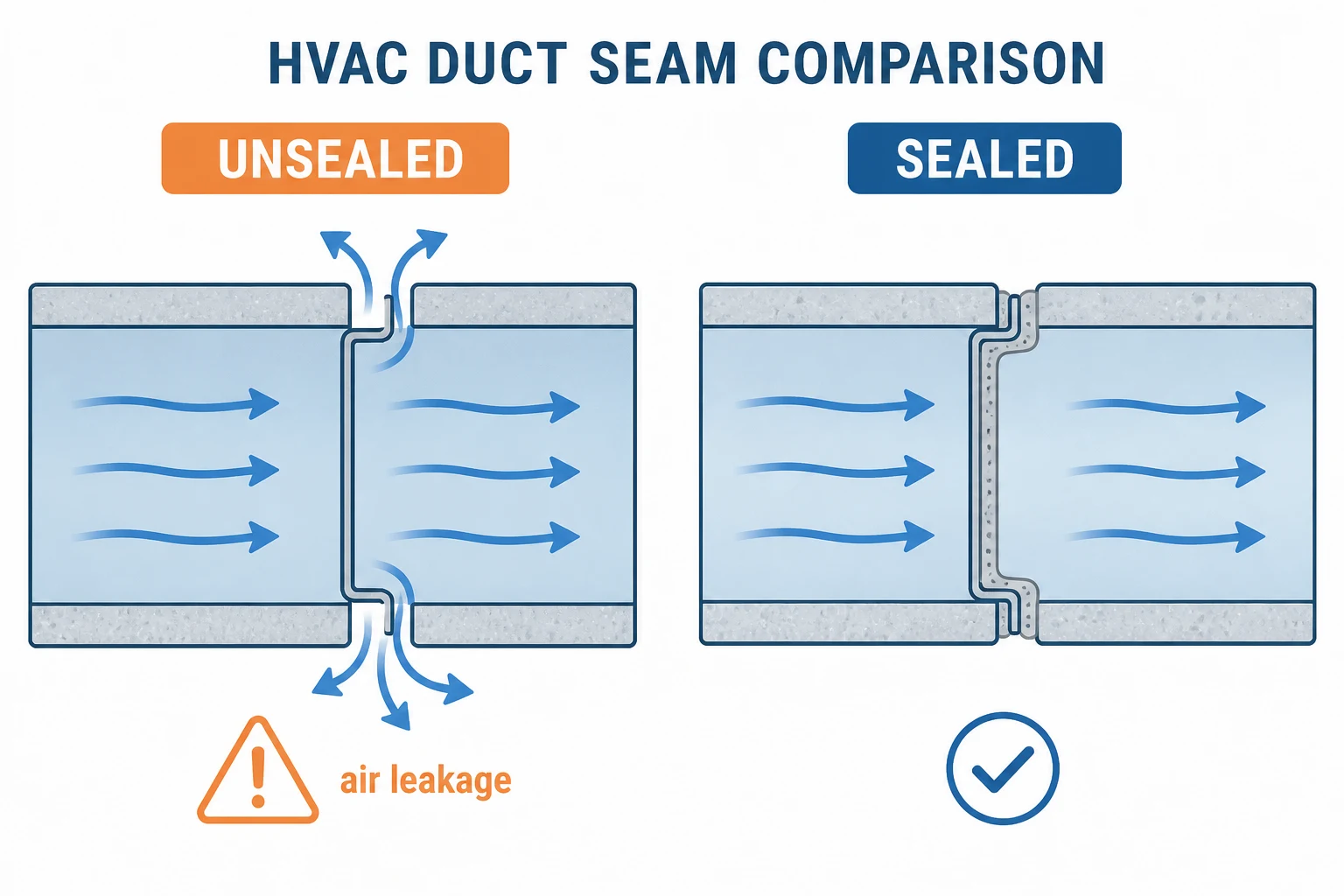
Why Duct Leakage Matters More Than Most People Assume
Duct leakage isn’t a minor efficiency footnote — it’s one of the largest controllable energy losses in a forced-air HVAC system. Air escaping through unsealed seams has already been conditioned at real cost, and once it leaks into an attic or crawlspace, that cooling or heating capacity is simply gone before it reaches the occupied space it was meant to serve.
The problem compounds in two directions. On the supply side, leaking ducts mean rooms don’t receive the airflow the system was designed to deliver, forcing the equipment to run longer to compensate. On the return side, leaks can pull unconditioned, often dusty or humid air into the system, adding both an energy penalty and an indoor air quality concern. A properly sealed duct system is one of the few HVAC efficiency measures where the fix is primarily a sealant and labor cost, not an equipment replacement.
Duct Sealant vs. Duct Tape: Why the Distinction Matters
Despite the name, cloth-backed “duct tape” is not rated for sealing HVAC ductwork and tends to fail within a few years as its adhesive dries out from thermal cycling. Mastic sealant and foil tape (UL 181-rated) are the materials actually specified for duct sealing, and the choice between them depends on the joint type.
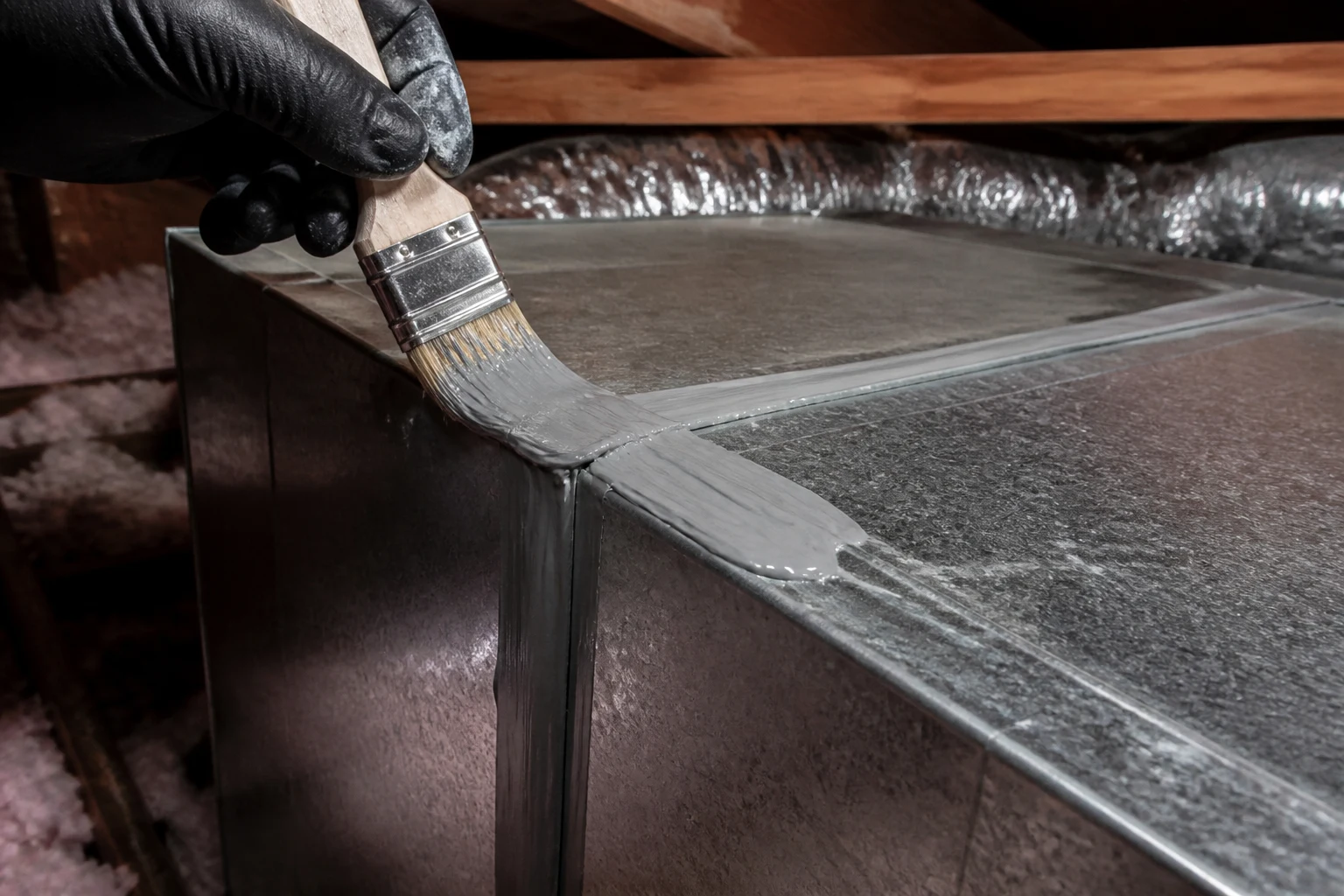
Mastic sealant is a brush- or glove-applied paste that cures to a flexible, airtight coating over a seam. It excels at sealing irregular gaps, around fasteners, and over fibrous duct board where a flat tape can’t conform to the surface texture. UL 181 foil tape, by contrast, works best on flat metal duct seams where a smooth, continuous surface allows the tape’s adhesive to make full contact. Many professional installations use both — mastic over mesh tape reinforcement on larger gaps, foil tape alone on tight metal-to-metal seams.
Matching Sealant to Duct Material
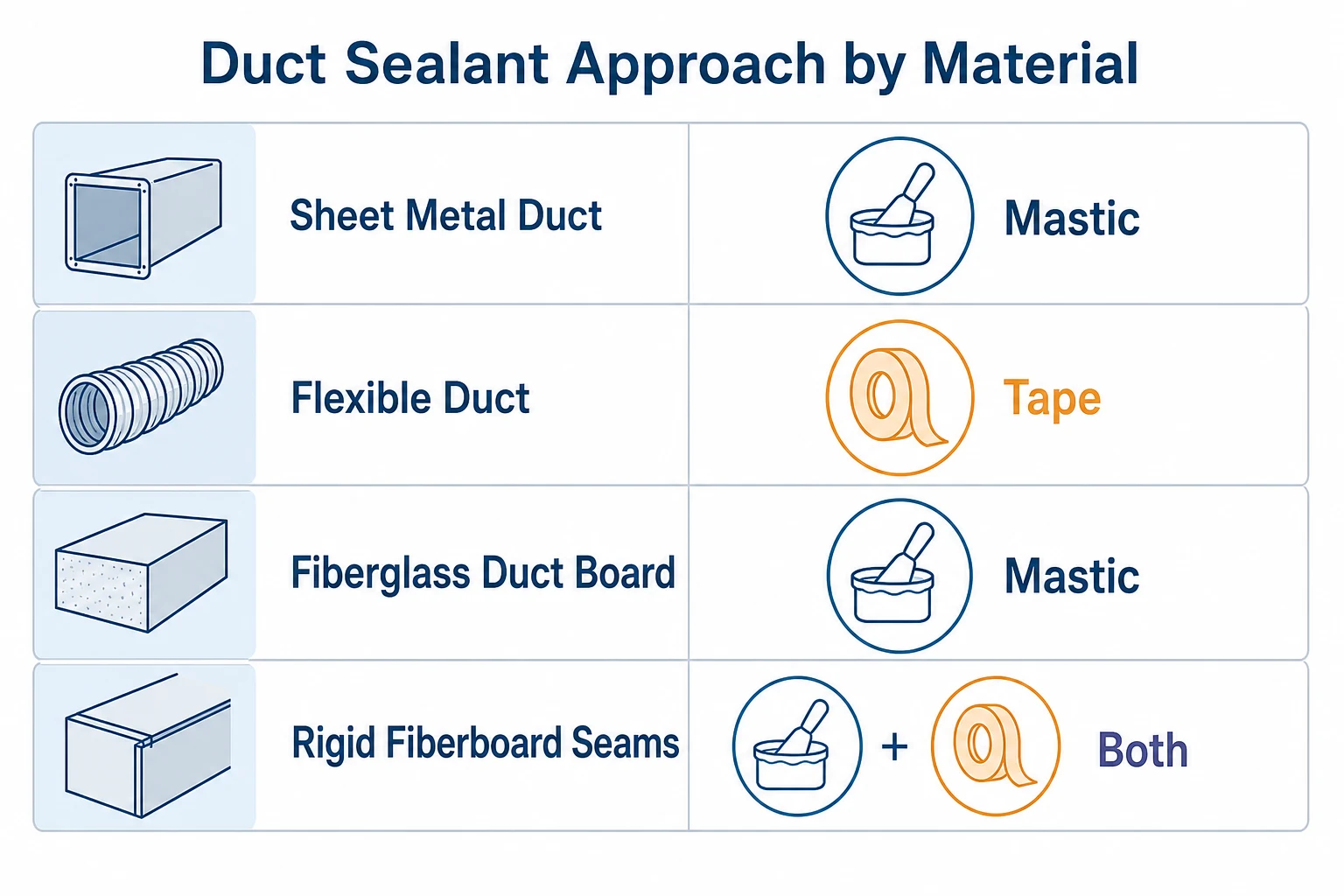
| Duct Material | Recommended Sealant Approach | Key Consideration |
|---|---|---|
| Sheet metal (galvanized/aluminum) | Mastic sealant or UL 181 foil tape on seams | Clean, oil-free surface needed for adhesion; mastic bridges minor gaps better than tape alone |
| Flexible duct (insulated) | UL 181B-FX rated tape or mastic at the connection collar | Must seal both the inner liner and outer jacket separately at connections |
| Fiberglass duct board | Mastic sealant, typically reinforced with fiberglass mesh tape | Porous surface requires mastic’s gap-filling, conformable application rather than a flat tape |
| Rigid fiberboard / ductboard seams | Mastic over joint tape | Mastic alone over an unsupported seam can crack under movement without mesh reinforcement |
Temperature Range: The Spec Most Often Overlooked
Supply-side ducts in a conditioned attic can see very different temperature extremes than return-side ducts in a basement, and sealant chosen without checking its rated temperature range is a common point of early failure.
- Attic and rooftop ductwork can experience sustained high temperatures well above typical indoor conditions during summer; a sealant rated only for moderate indoor temperatures can soften, slump, or lose adhesion in these locations.
- Unconditioned crawlspace or exterior runs swing to the opposite extreme in cold climates, where a sealant without adequate low-temperature flexibility can crack at seams during winter.
- Combustion appliance venting and high-temperature exhaust ducts require sealants specifically rated for continuous high-temperature exposure — a standard duct mastic is not interchangeable with a furnace-rated or exhaust-rated sealant.
Where Sealant Alone Isn’t the Full Fix
Sealant addresses leakage at seams and joints, but it doesn’t correct underlying problems that sealant application can mask rather than solve.
A duct joint held together primarily by failing mechanical fasteners — screws pulled loose, straps rusted through — needs mechanical repair before sealant is applied, not instead of it. Sealing a mechanically unstable joint only buys limited time before the connection separates further and the seal fails with it.
Similarly, a duct system with significant static pressure problems from undersized ductwork won’t be fixed by sealing leaks alone — the airflow restriction causing the system to work harder is a separate design issue. Sealing is a necessary efficiency measure, but it isn’t a substitute for correcting an undersized or poorly designed duct run.
Application Best Practices
- Clean the surface before sealing. Dust, oil film from manufacturing, or old deteriorated tape residue all reduce mastic and tape adhesion significantly compared to a properly cleaned metal or fiberboard surface.
- Apply mastic to a thickness that fully bridges the gap, not a thin cosmetic coat — a seam that still has a visible gap under a thin mastic layer will reopen under thermal movement.
- Reinforce larger or irregular gaps with mesh tape before mastic, giving the sealant a surface to key into rather than spanning open space unsupported.
- Verify duct board and flexible duct connections are sealed at both the inner and outer layers, since sealing only the visible outer jacket while leaving the inner liner connection unsealed still allows significant leakage.
- Allow proper cure time before pressure-testing or operating the system at full capacity, since mastic sealants reach full flexibility and adhesion over a cure period, not immediately on application.
Frequently Asked Questions
Can you use silicone sealant on HVAC ductwork?
General-purpose silicone sealant is not the standard choice for duct seams — it isn’t formulated or rated the way mastic and UL 181 tape are for ongoing air-sealing performance under duct operating conditions. For specific high-temperature flange or appliance connections, a sealant explicitly rated for that application and temperature range should be used instead of a general silicone product.
How long does duct mastic sealant take to cure?
Cure time varies by product formulation and ambient conditions, but most water-based mastic sealants need to dry to the touch within hours and reach full cure within one to several days, depending on thickness and humidity. The datasheet for the specific product in use should be checked rather than assuming a universal cure time across brands.
Is duct sealant the same as duct tape?
No. Common cloth-backed “duct tape” is not rated for long-term HVAC ductwork sealing and tends to dry out and release within a few years. UL 181-rated foil tape and mastic sealant are the materials actually specified and tested for durable duct sealing performance.
Choosing the Right Approach for Your Project
Start by identifying the duct material and the temperature range the joint will actually experience in service, not just the ambient indoor temperature — attic runs, exterior exposure, and appliance venting all demand different ratings than a straightforward interior metal duct seam. Match mastic or UL 181 tape to the joint geometry, reinforce irregular gaps with mesh tape, and address any underlying mechanical or sizing issues before relying on sealant to solve what is really a structural or design problem. For broader sealant chemistry selection beyond duct-specific applications, our Industrial Epoxy Adhesive Buyer’s Guide and energy-efficient construction sealant guide cover related selection criteria.
Explore Joobond’s Silicone Sealant and Polyurethane Sealant ranges for formulations suited to appliance and high-temperature connection applications adjacent to ductwork.
Keyword research source: SeoTools8 (Semrush-backed), US database, desktop, 2026-10-07. Seed “hvac duct sealant” — Volume 1,600/mo, KD 34%. Long-tail “hvac sealant” — Volume 590/mo, KD 15%; “ac duct sealant” — Volume 590/mo, KD 23%.
 English
  العربية
  Español de México
  Русский
  Tiếng Việt
  Português do Brasil
  Bahasa Indonesia
  Türkçe