

Table of Contents
A penetration through a fire-rated wall or floor assembly — a pipe, a conduit, an electrical cable — doesn’t just need to be sealed against air and water. It needs to be sealed in a way that preserves the assembly’s fire rating, and that’s a fundamentally different requirement than the general construction sealants used everywhere else in the same building. Fire caulk, also called firestop sealant or fire-rated sealant, is formulated and tested specifically to maintain fire resistance at these penetration points. This guide covers how it actually works, where it’s required, and the mistakes that most commonly compromise a firestop installation.
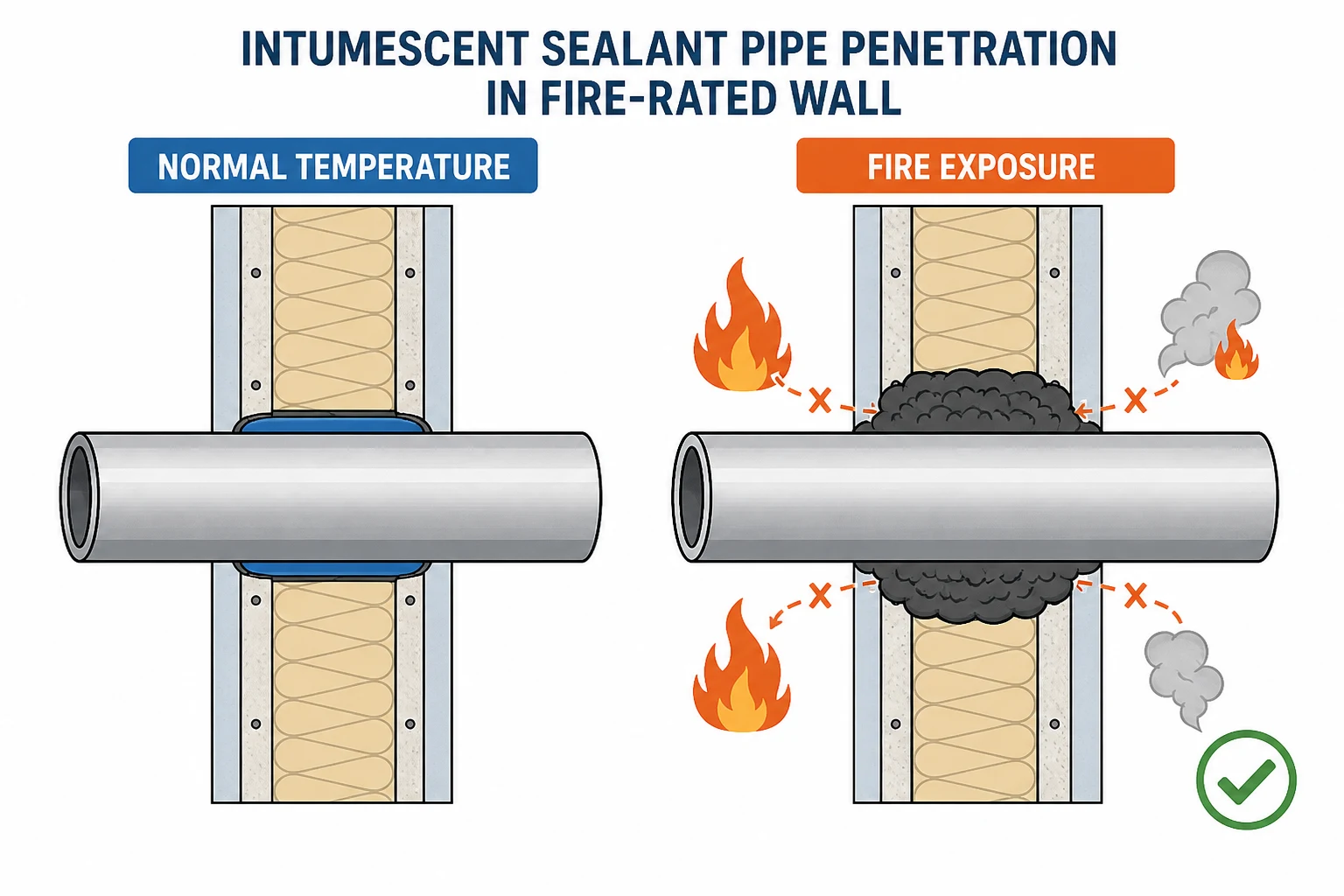
How Fire Caulk Actually Stops Fire Spread
Most fire caulk formulations rely on intumescent chemistry: the material stays flexible and sealant-like at normal temperatures, but when exposed to fire-level heat, it expands significantly, forming a dense char that fills the penetration gap and insulates against heat transfer. This expansion is what allows a relatively thin bead of sealant to block flame and smoke spread through what would otherwise be an open path between fire-rated compartments.
This intumescent behavior is also why fire caulk can’t be substituted with a general-purpose sealant that happens to be heat-resistant. Heat resistance alone doesn’t create the expansion and char formation that an actual firestop system is engineered to produce — the material has to be tested as part of a complete firestop assembly, not evaluated on heat tolerance in isolation.
Firestop Systems Are Tested Assemblies, Not Standalone Products
This is the single most misunderstood point in firestop sealant selection: a fire rating doesn’t belong to the sealant alone. It belongs to a tested system — a specific combination of the wall or floor assembly, the penetrating item (pipe material and diameter, cable bundle, conduit), and the firestop sealant applied in a specific configuration, all tested together under standards like UL 1479 or ASTM E814.
Using a genuinely fire-rated sealant in a configuration that doesn’t match a tested system — wrong pipe material, wrong annular gap size, wrong substrate — can result in a penetration that doesn’t actually perform at the rated level, even though the sealant itself is a legitimate firestop product. Inspectors and fire marshals typically look for documentation referencing a specific UL system number, not just a claim that “fire-rated sealant was used.”
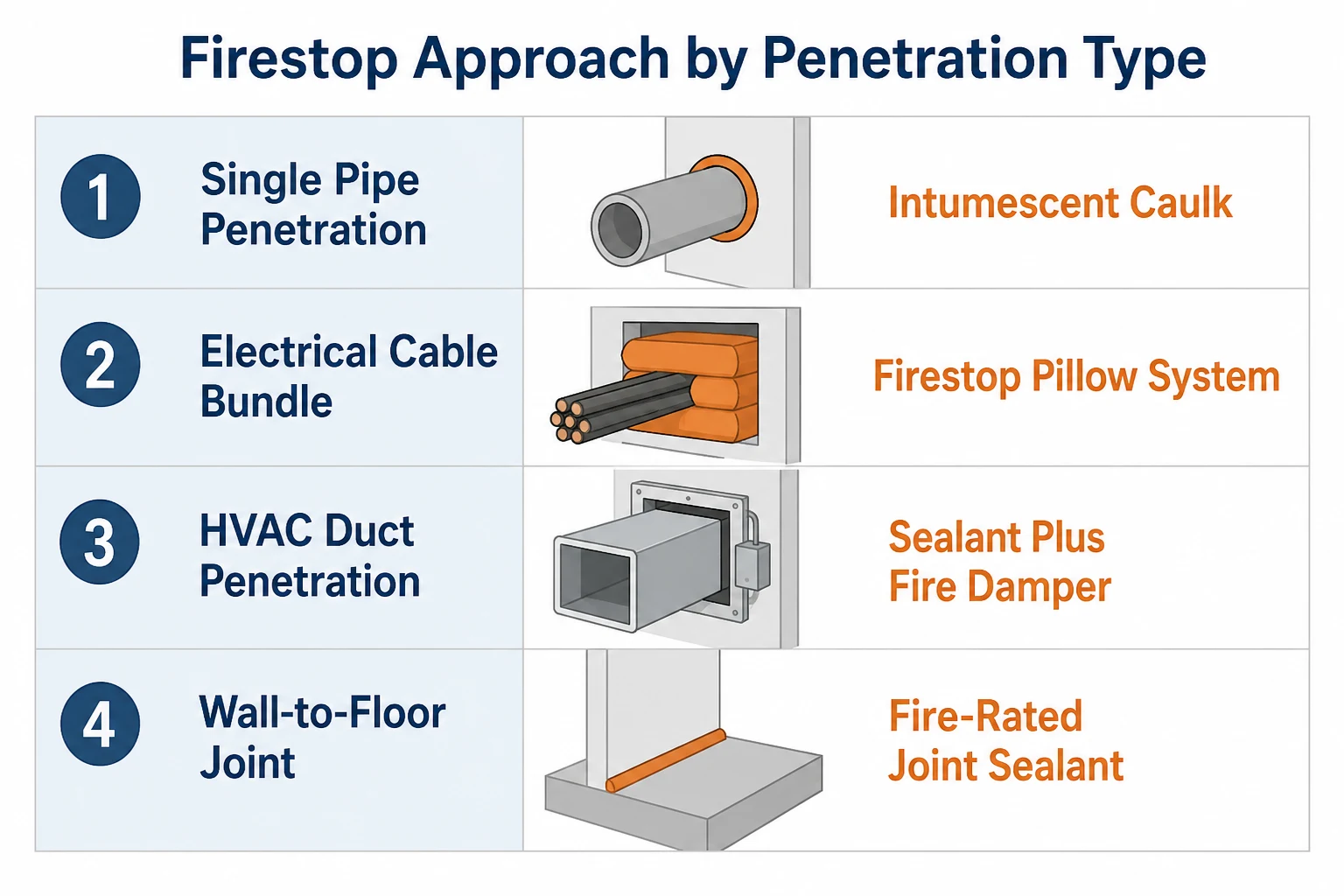
Common Firestop Applications
| Penetration Type | Typical Firestop Approach | Key Consideration |
|---|---|---|
| Single pipe through fire-rated wall | Intumescent fire caulk around annular gap | Annular gap width must match a tested system configuration |
| Electrical cable bundle penetration | Fire-rated sealant or firestop pillow system | Bundle density and cable type affect which tested system applies |
| HVAC duct penetration | Fire-rated sealant combined with a fire damper where required | Sealant alone may not satisfy code if a damper is also mandated |
| Joint between fire-rated wall and floor | Fire-rated joint sealant (distinct from penetration sealant) | Joint systems and penetration systems are tested and rated separately |
Application Best Practices
- Identify the specific UL or ASTM tested system that matches your wall/floor assembly, penetrating item, and gap size before purchasing material — this determines the correct product and application method.
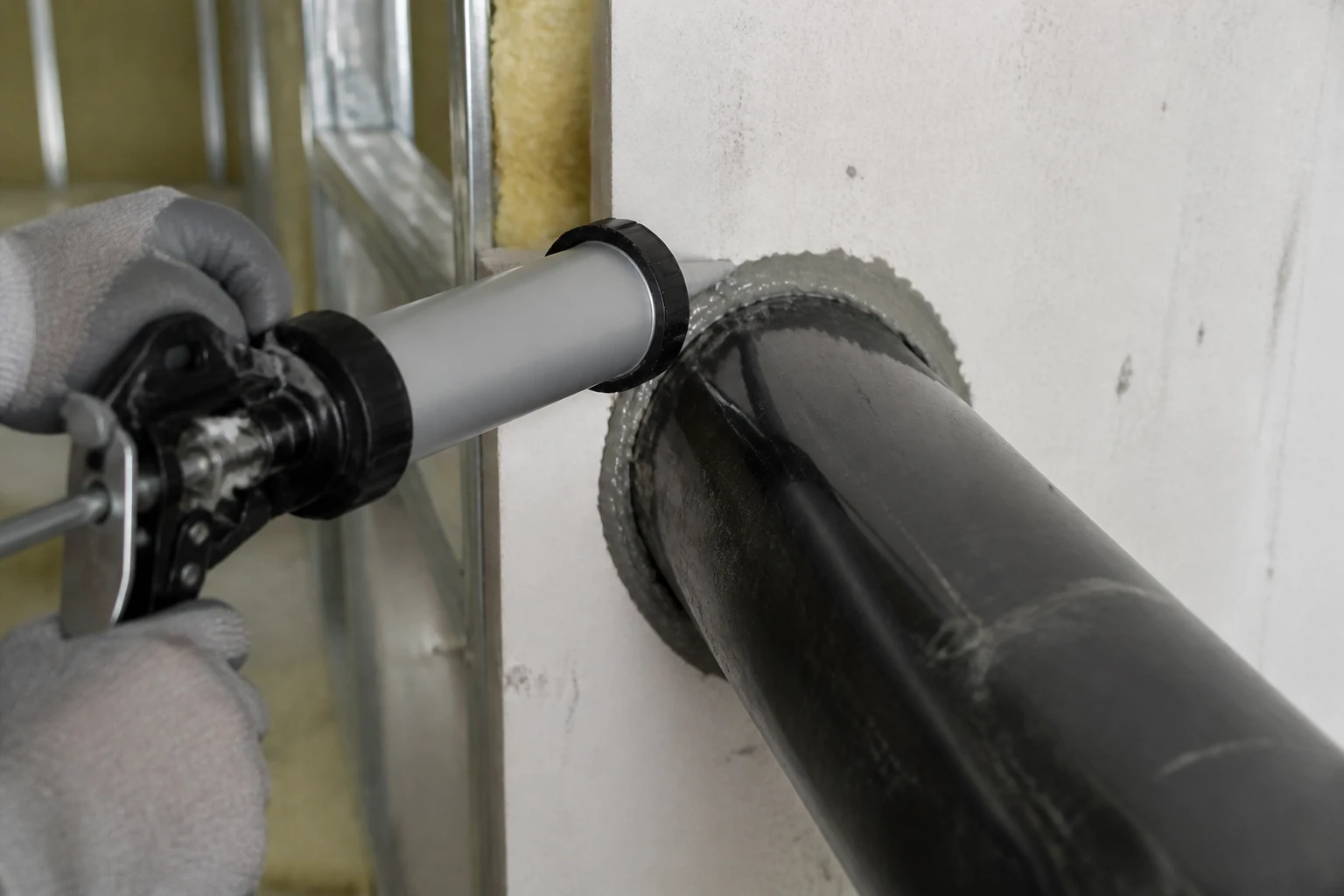
- Measure the annular gap accurately between the penetrating item and the opening, since tested systems specify a gap range, not an arbitrary one.
- Apply to the depth specified in the tested system, not an estimated depth — firestop performance is validated at a specific sealant depth, and underfilling compromises the rating.
- Label the installation per code requirements in many jurisdictions, identifying the system number, installer, and date, so future inspections or renovations can verify compliance.
- Avoid field-modifying a tested system — adding insulation, wrap strips, or backing material not specified in the tested configuration can void the fire rating even if the sealant itself is correct.
Common Firestop Mistakes
- Using heat-resistant sealant instead of a tested firestop product \u2014 heat resistance and intumescent fire-rated performance are not the same thing.
- Not matching the installation to a specific tested system, leaving no documentation that the configuration actually achieves the claimed rating.
- Underfilling the annular gap to save material, which reduces the char formation needed to block fire and smoke spread.
- Skipping labeling requirements, making future code compliance verification difficult during inspections or renovations.
- Assuming joint sealant and penetration sealant are interchangeable \u2014 these are tested and rated as separate system types.
- Mixing hour ratings across a single installation \u2014 for example, using a 1-hour-rated firestop product in a wall assembly that requires a 2-hour system, which leaves the overall compartmentation under-rated even if every other aspect of the installation was done carefully.
Frequently Asked Questions
Is fire caulk the same as firestop sealant?
Yes, these terms are generally used interchangeably in the industry to describe intumescent sealant products tested and rated for maintaining fire resistance at penetrations in fire-rated assemblies. Some manufacturers use “fire caulk” more casually in product names while reserving “firestop sealant” for formal specification documents, but the underlying tested chemistry and intended use are the same.
Can regular silicone sealant be used as a substitute for fire caulk?
No. General-purpose silicone sealant has not been tested as part of a firestop system and does not have the intumescent expansion behavior required to maintain a fire rating at a penetration. Only sealants specifically tested and listed for firestop use should be used in fire-rated assemblies.
Does the fire rating depend only on the sealant product?
No. The fire rating applies to the complete tested system — the wall or floor assembly, the penetrating item, and the sealant applied in a matching configuration. Using a legitimate firestop sealant incorrectly, outside its tested configuration, can still result in a penetration that doesn’t perform at the claimed rating.
Fire Resistance Ratings: Understanding the Hour Rating
Fire-rated assemblies and the firestop systems that penetrate them are rated in hours — commonly 1-hour, 2-hour, or 3-hour ratings — and this number isn’t arbitrary.
The hour rating represents how long the tested assembly, under standardized fire exposure conditions, maintained its ability to resist fire spread and, depending on the test, limit temperature rise on the unexposed side. A firestop sealant tested as part of a 2-hour system doesn’t automatically carry that rating into a 1-hour or 3-hour wall assembly — the sealant has to be matched to a system tested for the same hour rating as the assembly it’s penetrating. A penetration in a wall rated for 2 hours of fire resistance needs a firestop system also tested and listed for a 2-hour rating; using a product only validated at 1 hour effectively creates a weak point that undermines the wall’s full rated performance, even though every other part of the installation may look correct.
Match your installation to a specific tested UL or ASTM system rather than selecting a product based on general “fire-rated” marketing claims, measure and fill the annular gap according to that system’s specifications, confirm the hour rating of the firestop system matches the hour rating of the wall or floor assembly it penetrates, and label the installation for future code verification. These checks take only a few extra minutes per penetration but are exactly what separates a documented, inspectable firestop installation from one that merely looks correct. For broader sealant selection involving other specialty certifications beyond firestop requirements, our Food Grade Sealant Guide covers a related certification-driven selection process with its own distinct verification standard.
Explore Joobond’s Silicone Sealant and Polyurethane Sealant ranges, and consult a qualified firestop specialist to confirm the correct tested system for your specific penetration configuration before purchasing or installing any firestop material.
Keyword research source: SeoTools8 (Semrush-backed), US database, desktop, 2026-10-17. Seed “fire rated sealant” — Volume 260/mo, KD 13%. Primary long-tail “fire caulk” — Volume 4,400/mo, KD 10%, Intent Informational.
 English
 العربية
 Español de México
 Русский
 Tiếng Việt
 Português do Brasil
 Bahasa Indonesia
 Türkçe