

Table of Contents
- 1. Why RV Roofs Need a Different Sealant Than a House
- 2. Matching Sealant to Roof Membrane Type
- 3. Self-Leveling vs. Non-Sag: Choosing the Right Formulation
- 4. Application Best Practices
- 5. Common RV Roof Sealant Mistakes
- 6. Frequently Asked Questions
- 7. Seasonal Storage: An Overlooked Stress Period
- 8. Choosing the Right RV Roof Sealant
An RV roof takes a kind of abuse that a residential roof never sees: constant vibration from highway driving, repeated thermal cycling from being parked in direct sun then driven at highway speed, and — on most RVs — a rubber (EPDM/TPO) or fiberglass membrane that moves and flexes with the vehicle frame in ways a rigid residential roof deck never does. RV roof sealant has to be formulated specifically for that combination of stresses, and using the wrong product is one of the most common causes of water intrusion damage in RVs. This guide covers how to choose and apply RV roof sealant correctly.
Why RV Roofs Need a Different Sealant Than a House
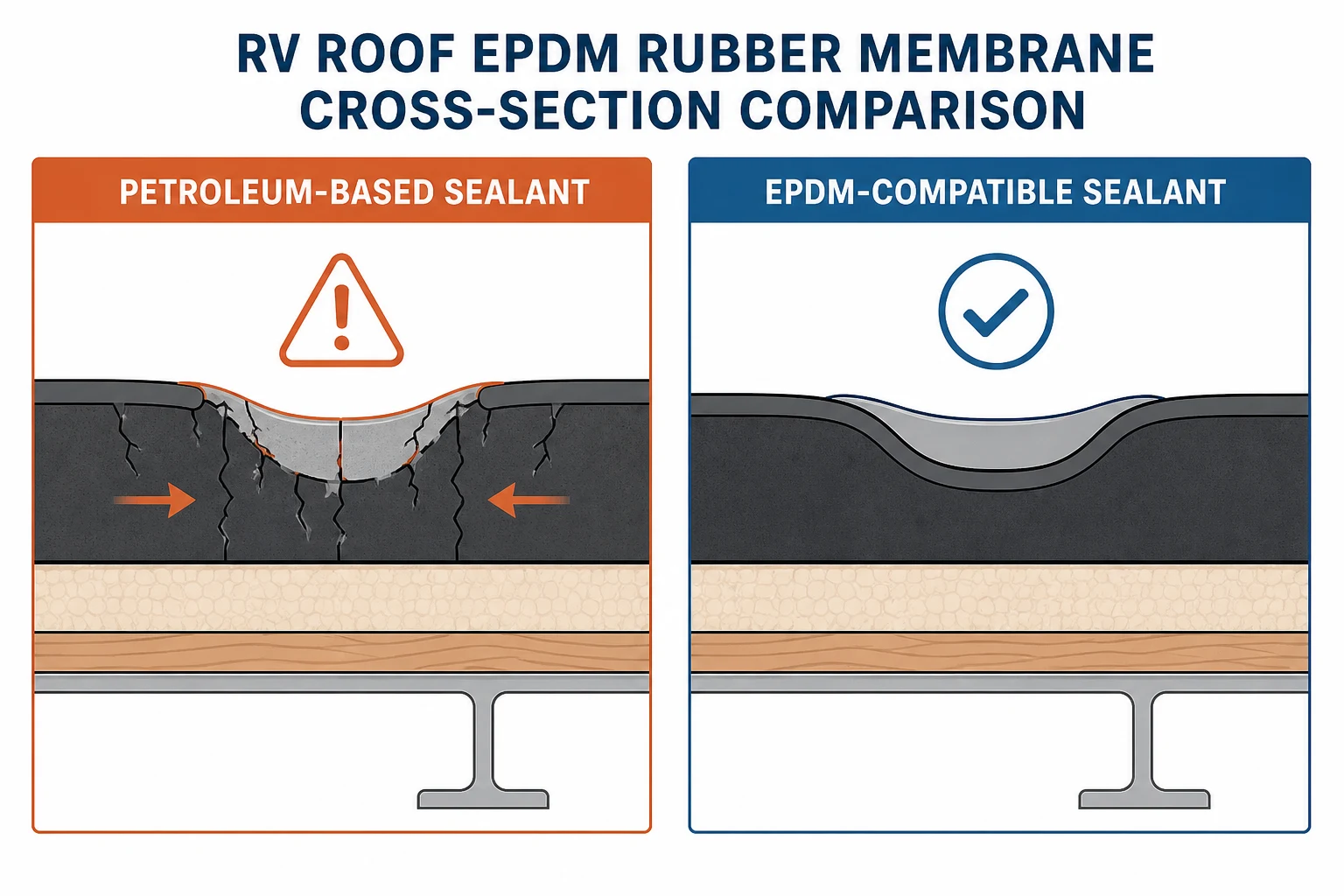
Most RV roofs are covered in one of three membrane types — EPDM rubber, TPO, or fiberglass — and each has different sealant compatibility requirements. Critically, some sealant chemistries can actually damage certain membranes: petroleum-based or solvent-heavy sealants can cause EPDM rubber to degrade, shrink, or lose its bond over time, which is the opposite of what a roof sealant is supposed to do. Identifying the membrane type correctly before buying any sealant is the single highest-leverage step in this entire process, since every other recommendation in this guide depends on getting that first identification right.
The constant flexing an RV roof experiences while driving also demands a sealant with real elastomeric movement capability, not just a rigid caulk that will crack under repeated vibration. A sealant that performs perfectly on a static residential roof can fail within a single driving season on an RV roof purely from fatigue cracking caused by road vibration, which is why products marketed generically as “roof sealant” without specific RV or mobile-application testing data deserve extra scrutiny before purchase.
Matching Sealant to Roof Membrane Type
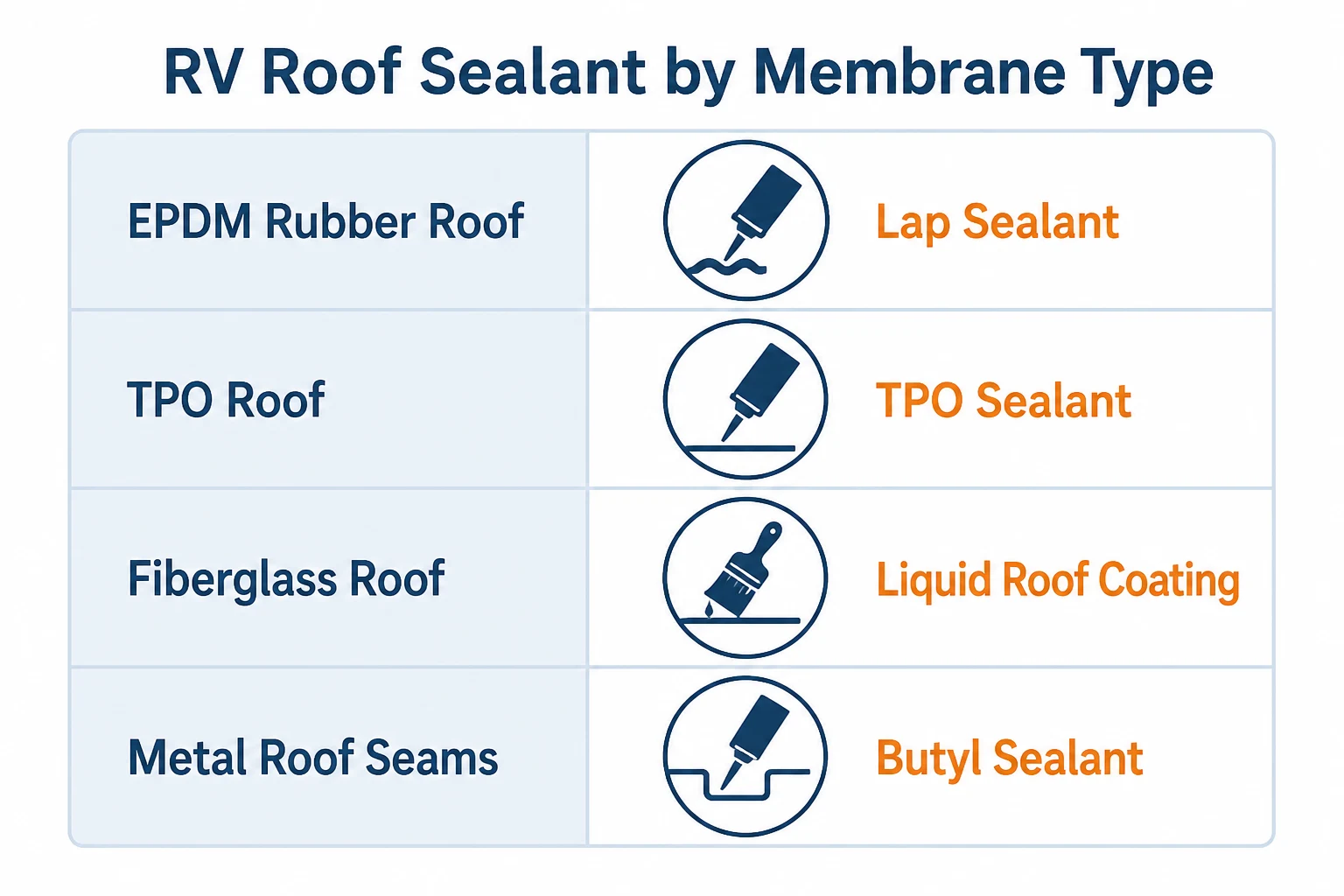
| Membrane Type | Compatible Sealant | Key Consideration |
|---|---|---|
| EPDM rubber roof | Self-leveling lap sealant rated EPDM-safe, or EPDM-specific tape sealant | Avoid petroleum/solvent-based products that can degrade rubber over time |
| TPO roof | TPO-compatible sealant (check manufacturer compatibility list) | Some sealants that work on EPDM are not rated for TPO and vice versa |
| Fiberglass roof | Self-leveling polyurethane sealant | Similar to standard exterior polyurethane applications, less membrane-specific risk |
| Metal roof seams and screws | Metal roof sealant, often butyl or polyurethane-based | Must handle thermal expansion of metal panels without cracking |
Self-Leveling vs. Non-Sag: Choosing the Right Formulation
RV roof sealant comes in two basic application formats, and using the wrong one for the joint orientation is a common installation mistake.
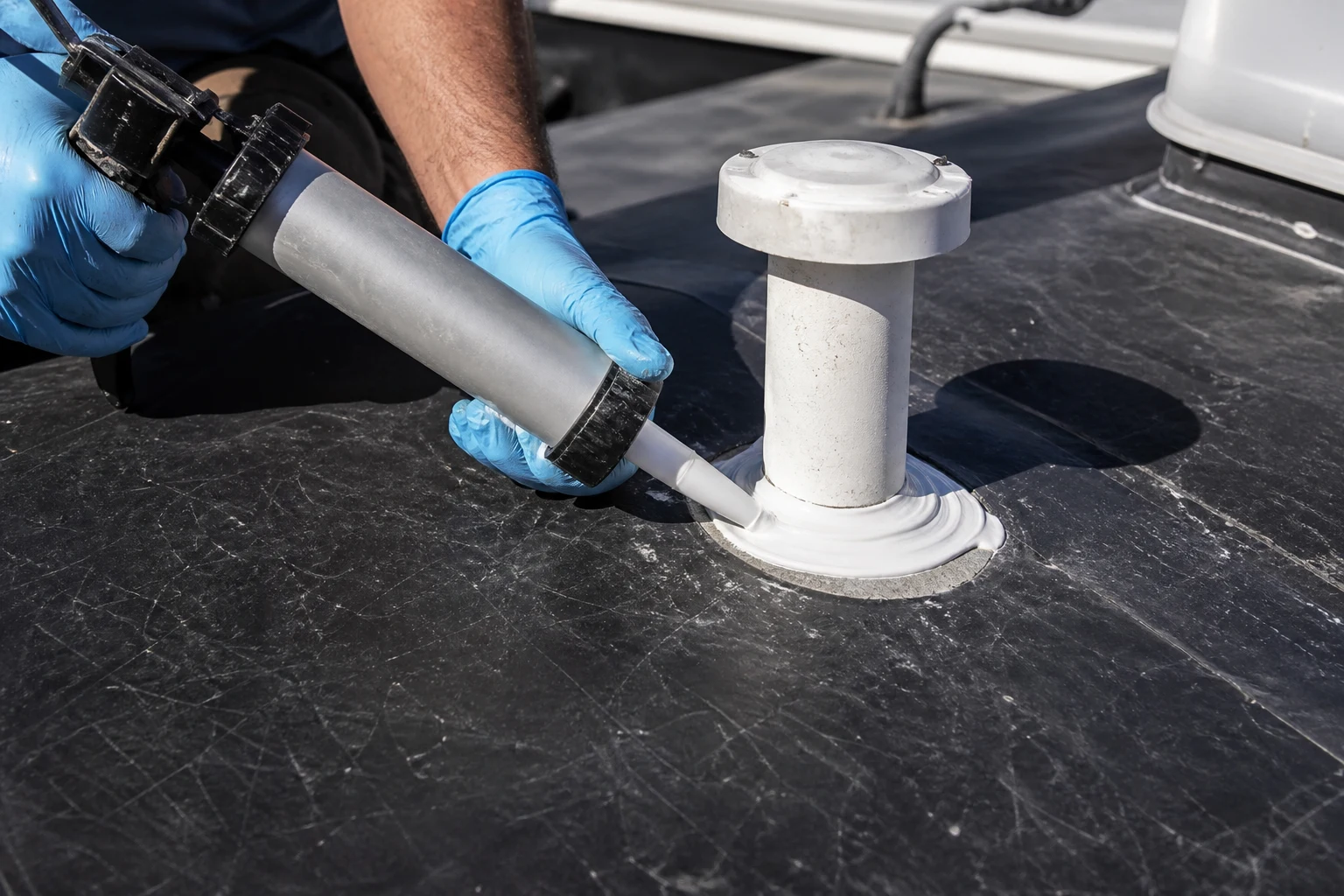
- Self-leveling sealant is designed for horizontal, flat roof surfaces — around vent pipes, skylights, and flat seams — where it can settle and level itself into an even bead without additional tooling.
- Non-sag (vertical-grade) sealant is needed for vertical or near-vertical surfaces, such as the roof-to-wall transition at the front and rear caps, where a self-leveling product would simply run off the joint before curing.
- Using self-leveling sealant on a vertical joint is one of the most common application errors — it slumps and creates an uneven, thin coating that fails to provide adequate coverage.
Application Best Practices
- Clean the roof surface thoroughly with a membrane-safe cleaner before application — residue, chalk from EPDM degradation, or old sealant residue can all compromise adhesion.
- Remove failed old sealant completely rather than sealing over it, since new sealant bonding to degraded old sealant is a common source of early repeat leaks.
- Match the formulation to the joint orientation — self-leveling for horizontal penetrations, non-sag for vertical cap seams.
- Apply generously around all roof penetrations (vents, antennas, AC units, skylights) since these are the highest-risk leak points on any RV roof.
- Inspect and recoat on a schedule, typically annually, rather than waiting for a visible leak — UV exposure and road vibration degrade RV roof sealant faster than most residential sealant applications.
Common RV Roof Sealant Mistakes
- Using a petroleum-based or solvent-heavy sealant on an EPDM roof without confirming rubber compatibility first.
- Applying self-leveling sealant to a vertical cap seam, resulting in slumping and inadequate coverage.
- Sealing over old, failed sealant instead of removing it completely before reapplication.
- Skipping annual inspection and only addressing the roof after a leak has already caused interior damage.
- Ignoring manufacturer membrane compatibility guidance and assuming any “RV-labeled” sealant works on any roof type.
- Walking on the roof carelessly during inspection or application, since concentrated foot pressure on some membrane types, particularly aging EPDM, can create stress points or punctures that then require their own repair in addition to the routine sealant work being performed.
Frequently Asked Questions
Can I use regular roofing sealant on an RV roof?
Not always. General residential roofing sealants aren’t necessarily tested for compatibility with RV membrane types like EPDM or TPO, and some can actually degrade these membranes over time. Confirm the sealant is specifically rated for your RV roof’s membrane material before applying, and when in doubt, contact the sealant manufacturer directly to confirm compatibility rather than relying on general product labeling alone.
How often should RV roof sealant be reapplied?
An annual inspection is a reasonable baseline, with resealing as needed based on visible cracking, chalking, or UV degradation. RV roofs experience more UV exposure and vibration stress than residential roofs, so sealant typically needs more frequent attention.
What’s the difference between self-leveling and non-sag RV roof sealant?
Self-leveling sealant is for horizontal surfaces and settles into an even bead on its own. Non-sag sealant is formulated to stay in place on vertical surfaces, such as roof-to-wall cap seams, without running or slumping before it cures.
Seasonal Storage: An Overlooked Stress Period
Many RV roof sealant failures are discovered at the start of a new season, but the damage often happened during months of unattended storage rather than during active use.
An RV sitting in storage, especially uncovered and exposed to direct sun, snow load, or temperature swings between day and night, puts sustained stress on roof sealant without the regular visual inspection that active use naturally provides. Sealant that developed a small crack mid-season might go unnoticed and worsen over winter storage until it becomes an active leak by spring. A pre-storage inspection and reseal of any marginal joints, combined with a post-storage inspection before the first trip of the season, catches problems while they’re still small repairs rather than after they’ve caused interior water damage.
Choosing the Right RV Roof Sealant
Confirm membrane compatibility before purchasing, match the sealant formulation to the joint orientation (self-leveling for horizontal, non-sag for vertical), and build an annual inspection habit rather than waiting for a leak to appear. Factor pre- and post-storage inspection into that routine as well, since seasonal storage is one of the most common periods for small sealant failures to go unnoticed and worsen. For broader sealant selection criteria involving similarly demanding environmental exposure, our Cold Weather Sealant Guide covers a related set of application challenges under extreme temperature conditions.
Explore Joobond’s Polyurethane Sealant range for formulations suited to demanding outdoor and vibration-exposed applications, and always verify membrane-specific compatibility with the manufacturer before committing a full roof to a particular sealant chemistry.
Keyword research source: SeoTools8 (Semrush-backed), US database, desktop, 2026-10-17. Seed “roofing sealant” — Volume 1,600/mo, KD 23%. Primary long-tail “rv roof sealant” — Volume 9,900/mo, KD 12%.
 English
 العربية
 Español de México
 Русский
 Tiếng Việt
 Português do Brasil
 Bahasa Indonesia
 Türkçe