

Table of Contents
- 1. Deck Sealant vs. Deck Stain-Sealer: Two Different Products
- 2. Where Sealant Actually Belongs on a Deck
- 3. Choosing Sealant by Decking Material
- 4. Application Best Practices for Deck Joints
- 5. Common Mistakes That Shorten Deck Sealant Life
- 6. Frequently Asked Questions
- 7. Matching the Product to the Joint
Search for “deck sealant” and most results are actually about deck stain-sealers — the film-forming or penetrating coatings that protect wood from UV and moisture across the whole board surface. True deck sealant is a different product entirely: a flexible joint compound used at specific gaps and connection points, not a surface treatment. Confusing the two leads to the wrong purchase and, often, a deck that still leaks at the exact spots that caused the original problem. This guide covers where sealant actually belongs on a deck, how to pick the right chemistry for wood versus composite boards, and the application details that determine whether a joint holds up through a full season of thermal movement.
Deck Sealant vs. Deck Stain-Sealer: Two Different Products
A deck stain-sealer is designed to be absorbed into or coat the wood grain across the entire deck surface, forming a UV and moisture barrier on open board faces. A deck sealant is a gap-filling compound applied in a continuous bead at a specific joint — between a ledger board and the house, around a post base, or along a butt joint where two deck boards meet end to end. Stain-sealers are reapplied every one to three years as a maintenance coating. Sealant is applied once at a joint and expected to last for years without reapplication, because it’s doing structural waterproofing work rather than surface protection.
The practical issue is that neither product substitutes for the other. Coating a board face with stain-sealer does nothing to stop water intrusion at a ledger connection, and running a bead of sealant across an open deck surface creates a film that traps moisture against the wood rather than letting it dry — the opposite of what either product is supposed to do.
Where Sealant Actually Belongs on a Deck
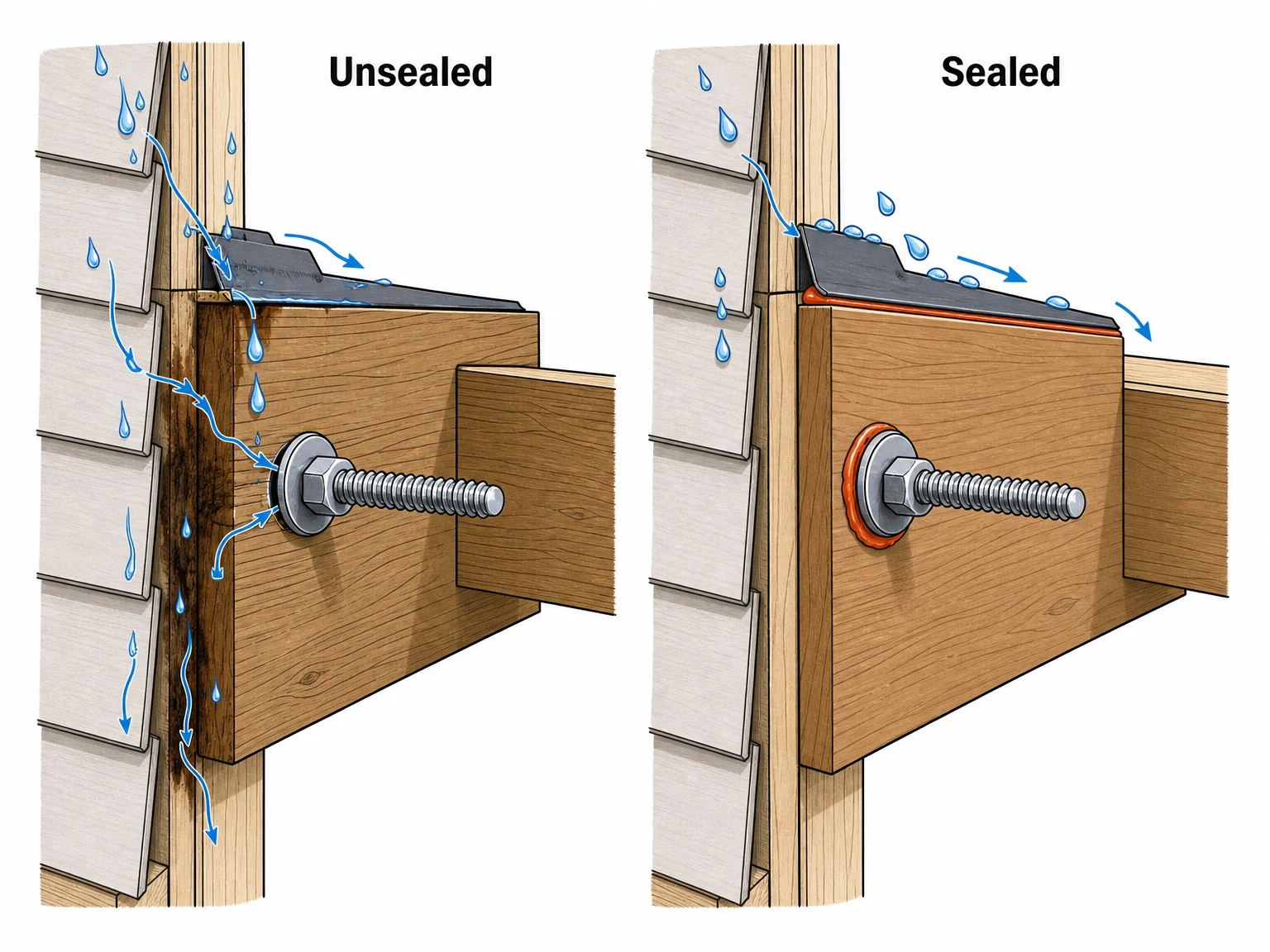
Deck sealant has a short list of legitimate applications, and all of them involve a joint or penetration rather than an open surface. The ledger board connection — where the deck frame attaches to the house rim joist — is the highest-stakes location, since this is where water intrusion causes structural rot hidden behind the siding. Sealant goes behind the ledger flashing and around any lag bolts or structural screws that penetrate it, not as a substitute for proper flashing but as a secondary barrier at fastener penetrations.
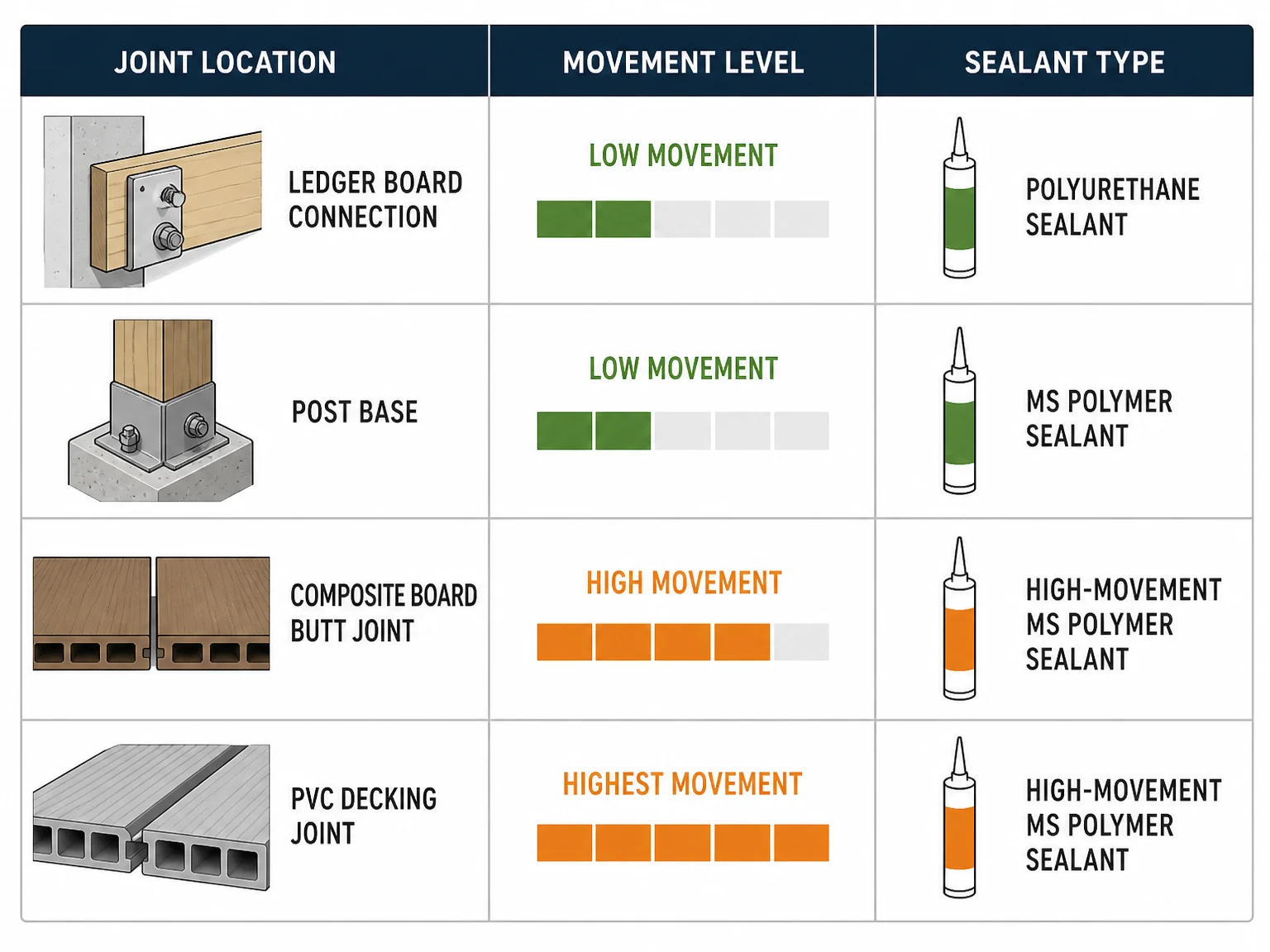
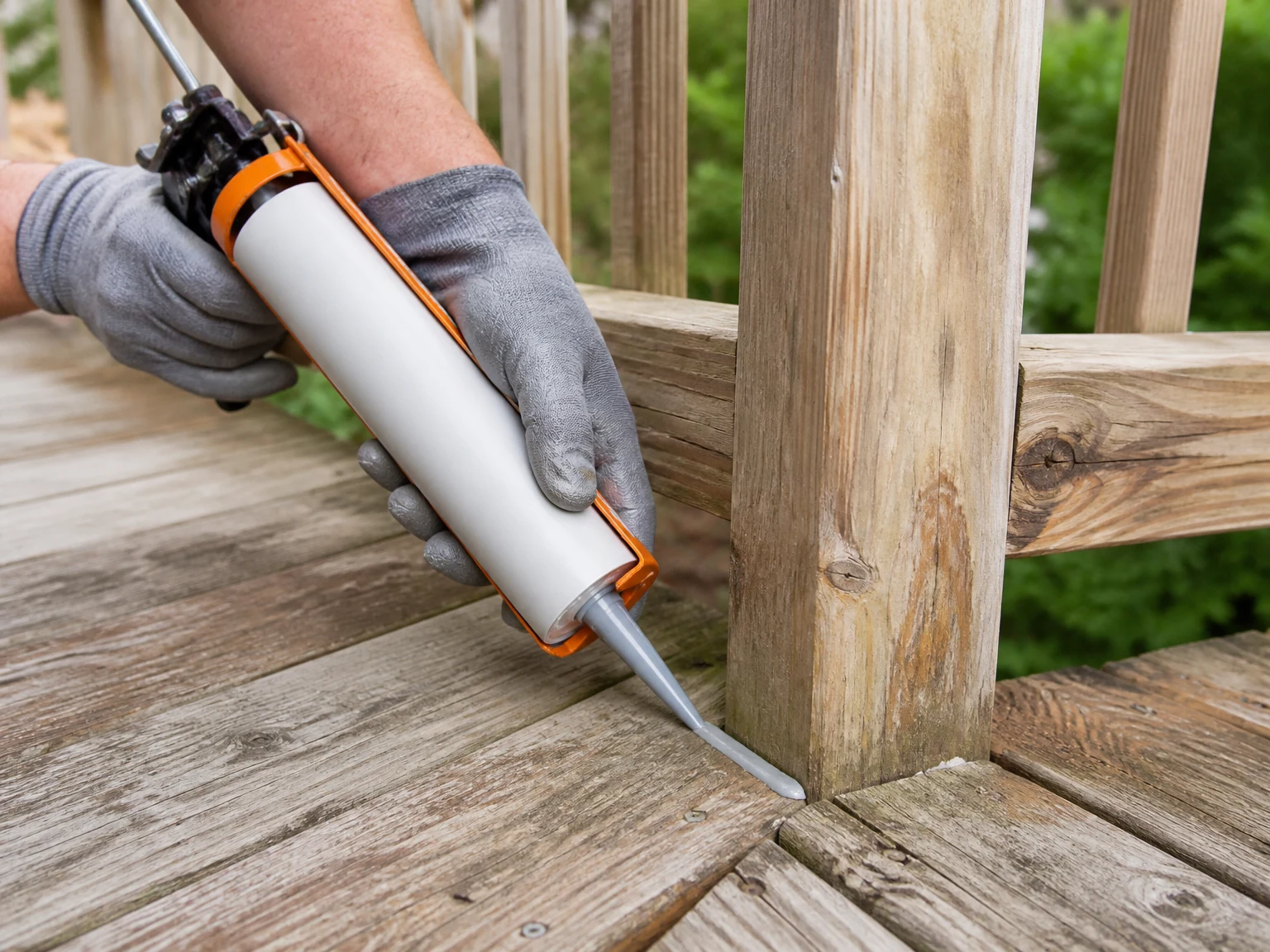
Post bases are the second common location, particularly where a railing or structural post sits on a concrete footing or meets a deck surface — sealant at this interface keeps standing water from wicking into end grain, which is the fastest path to post-base rot. Butt joints between deck boards, stair stringer connections to the deck frame, and any point where a fastener head sits below the board surface and could trap water are the remaining locations worth sealing. An open expansion gap between parallel deck boards is not one of them — those gaps are intentionally left for drainage and airflow, and sealing them defeats the purpose.
Choosing Sealant by Decking Material
Wood and composite decking move differently with temperature and moisture, and the sealant needs enough elongation to track that movement without tearing. Composite and PVC boards expand and contract more than wood across a hot-to-cold cycle, so a joint sealed with a low-movement product can split within a season even if the application was clean.
| Decking Material | Movement Behavior | Recommended Sealant Type |
|---|---|---|
| Pressure-treated wood | Moderate — shrinks as it dries post-installation, then stabilizes | High-quality polyurethane or MS polymer; avoid pure silicone (won’t accept stain if deck is later finished) |
| Cedar / redwood | Lower movement, more dimensionally stable than treated pine | Polyurethane or MS polymer; paintable/stainable grades if finishing is planned |
| Composite (wood-plastic) | Higher thermal expansion than wood, especially in dark colors | High-movement MS polymer or polyurethane rated for ≥25% joint movement |
| PVC / capped polymer | Highest thermal expansion of common decking materials | High-movement MS polymer; confirm manufacturer-approved sealant to avoid voiding warranty |
Composite and PVC manufacturers frequently publish an approved sealant list, and using an unlisted product can void the material warranty even if the sealant itself performs fine — checking that list before buying is worth the five minutes it takes.
Application Best Practices for Deck Joints
Joint geometry matters more on an exterior deck than almost anywhere else in construction, because these joints see continuous outdoor thermal cycling rather than the relatively stable temperatures inside a building. A 2:1 width-to-depth ratio is the standard target — a joint that’s too deep restricts the sealant’s ability to stretch, which is the single most common cause of premature cracking in deck joint sealant.
For gaps wider than about a quarter inch, install a backer rod before sealing. The backer rod controls bond depth, keeps the sealant from bonding to the bottom of the joint (three-sided adhesion causes it to tear under movement instead of stretching freely), and reduces the amount of sealant needed. Tool the bead immediately after application to press it against both joint faces, and work in moderate temperatures — sealant applied in direct summer heat on a dark composite board can be applied while the joint is at its widest expansion point, leaving no room to accommodate further movement when temperatures drop.
Common Mistakes That Shorten Deck Sealant Life
- Sealing drainage gaps between boards. These gaps are designed to let water through and wood dry out; filling them traps moisture against the board edges.
- Skipping surface preparation. Mildew, old finish residue, or construction dust on the joint faces prevents proper adhesion — clean and dry the joint before applying.
- Using interior-grade caulk. General-purpose acrylic caulk lacks the UV resistance and elongation needed for exterior deck joints and typically fails within one season.
- Applying sealant to wet or green lumber. Pressure-treated lumber that hasn’t dried to its service moisture content will shrink after the sealant cures, pulling the joint wider than the sealant can stretch.
- Ignoring manufacturer-approved product lists on composite decking. An otherwise-suitable sealant can still void the decking warranty if it isn’t on the approved list.
Frequently Asked Questions
Should I seal the gaps between my deck boards?
No. The gaps between parallel deck boards are intentional drainage and ventilation spaces, and sealing them traps moisture against the board edges, which accelerates rot in wood and can cause swelling in some composite materials. Sealant belongs at butt joints, fastener penetrations, and structural connections — not at the standard board-to-board spacing.
Can I use the same sealant on wood and composite decking?
A high-movement polyurethane or MS polymer sealant will generally bond and perform on both, but composite and PVC manufacturers often maintain approved-product lists, and using an unlisted sealant can void the material warranty. Check the specific manufacturer’s documentation before applying to composite or PVC decking.
How is deck sealant different from deck stain-sealer?
Deck stain-sealer is a surface coating applied across the entire board face to protect wood from UV and moisture, reapplied every one to three years. Deck sealant is a joint compound applied at specific gaps and connections — ledger boards, post bases, butt joints — to stop water intrusion at those points, and is applied once with a service life measured in years rather than seasons.
Do I need a backer rod for deck joint sealant?
For joints wider than about a quarter inch, yes. A backer rod controls sealant depth to maintain the correct 2:1 width-to-depth ratio and prevents three-sided adhesion, which causes the sealant to tear under thermal movement instead of stretching evenly across the joint.
Matching the Product to the Joint
The deck joints most likely to fail are the ones treated as an afterthought — a quick bead around a post base at the end of a build, or ledger flashing sealed with whatever caulk was already in the truck. Matching sealant chemistry to the decking material, respecting joint geometry, and reserving sealant for actual connection points rather than drainage gaps are the differences between a joint that lasts the life of the deck and one that needs rework within a year.
 English
 العربية
 Español de México
 Русский
 Tiếng Việt
 Português do Brasil
 Bahasa Indonesia
 Türkçe