

Table of Contents
- 1. How Thread Sealant Actually Seals a Joint
- 2. Liquid Thread Sealant vs. PTFE Tape
- 3. Matching Sealant to the Application
- 4. Application Best Practices
- 5. Common Thread Sealant Mistakes
- 6. Frequently Asked Questions
- 7. NPT vs. BSP Threads: Why Compatibility Matters Before Sealant Even Enters the Picture
- 8. Choosing the Right Thread Sealant
A leaking threaded pipe joint is rarely a sign of a bad fitting — it’s far more often a sign of the wrong thread sealant, or the right sealant applied incorrectly. Pipe thread sealant has one job: fill the microscopic gaps between mating threads so the connection holds pressure without leaking, across everything from residential plumbing to industrial gas and chemical lines. This guide covers how thread sealant actually works, where liquid sealant and PTFE tape are each the right choice, and the application mistakes that cause most thread joint failures.
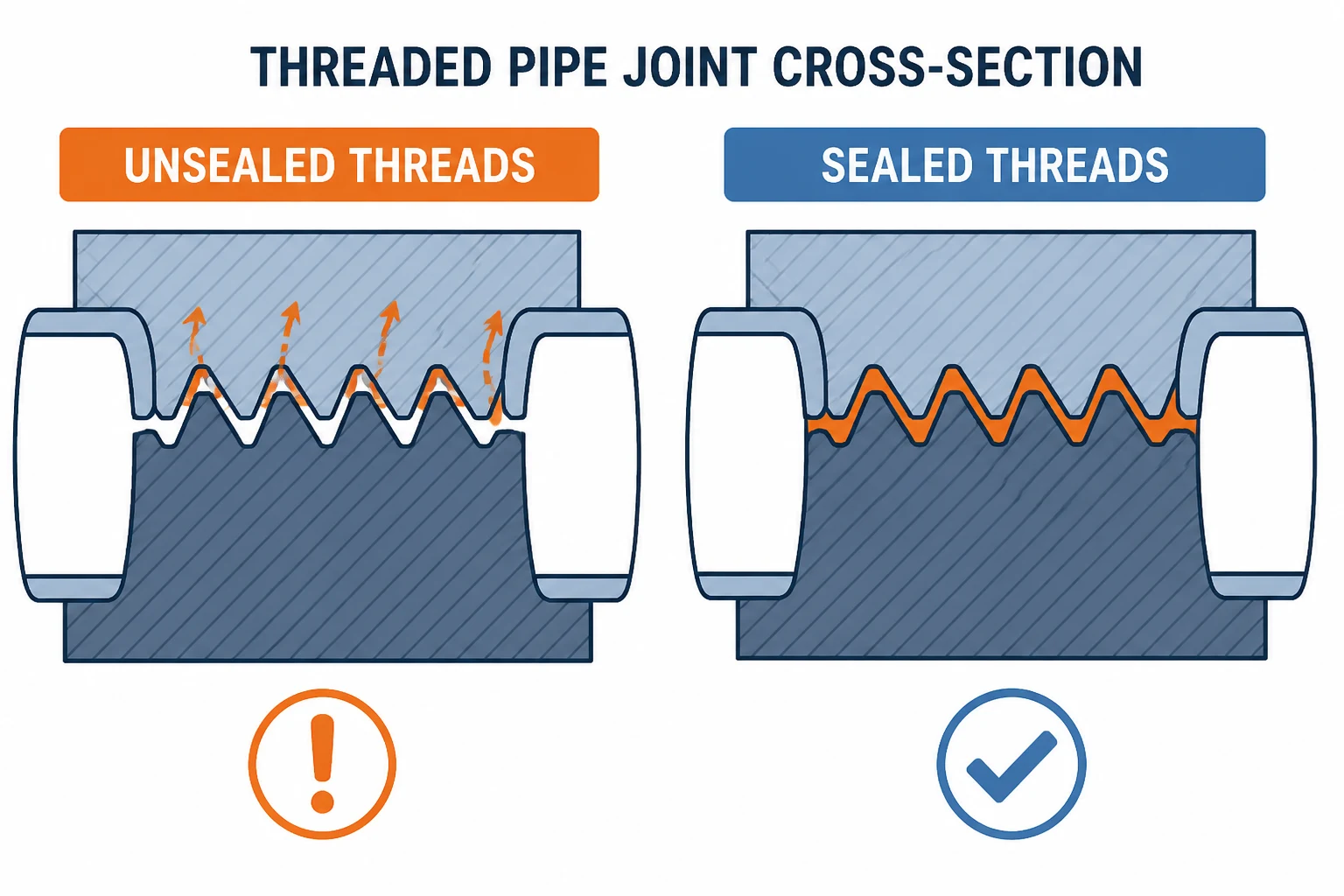
How Thread Sealant Actually Seals a Joint
Threaded pipe connections rely on mechanical interference between the male and female threads to create a seal, but that mechanical fit alone is rarely perfect — microscopic gaps remain along the thread path that can leak under pressure. Thread sealant fills those gaps, either by remaining semi-fluid and conforming to the thread profile (liquid pipe dope) or by acting as a thin, compressible gasket layer wound around the threads (PTFE tape). Both approaches are solving the same fundamental sealing problem through different physical mechanisms, which is why the choice between them often comes down to the specific application rather than one being universally superior.
Critically, thread sealant is a gap-filler and lubricant for proper thread engagement — it is not a substitute for correctly cut, undamaged threads. No sealant chemistry can reliably seal a joint where the threads themselves are damaged, cross-threaded, or worn beyond tolerance.
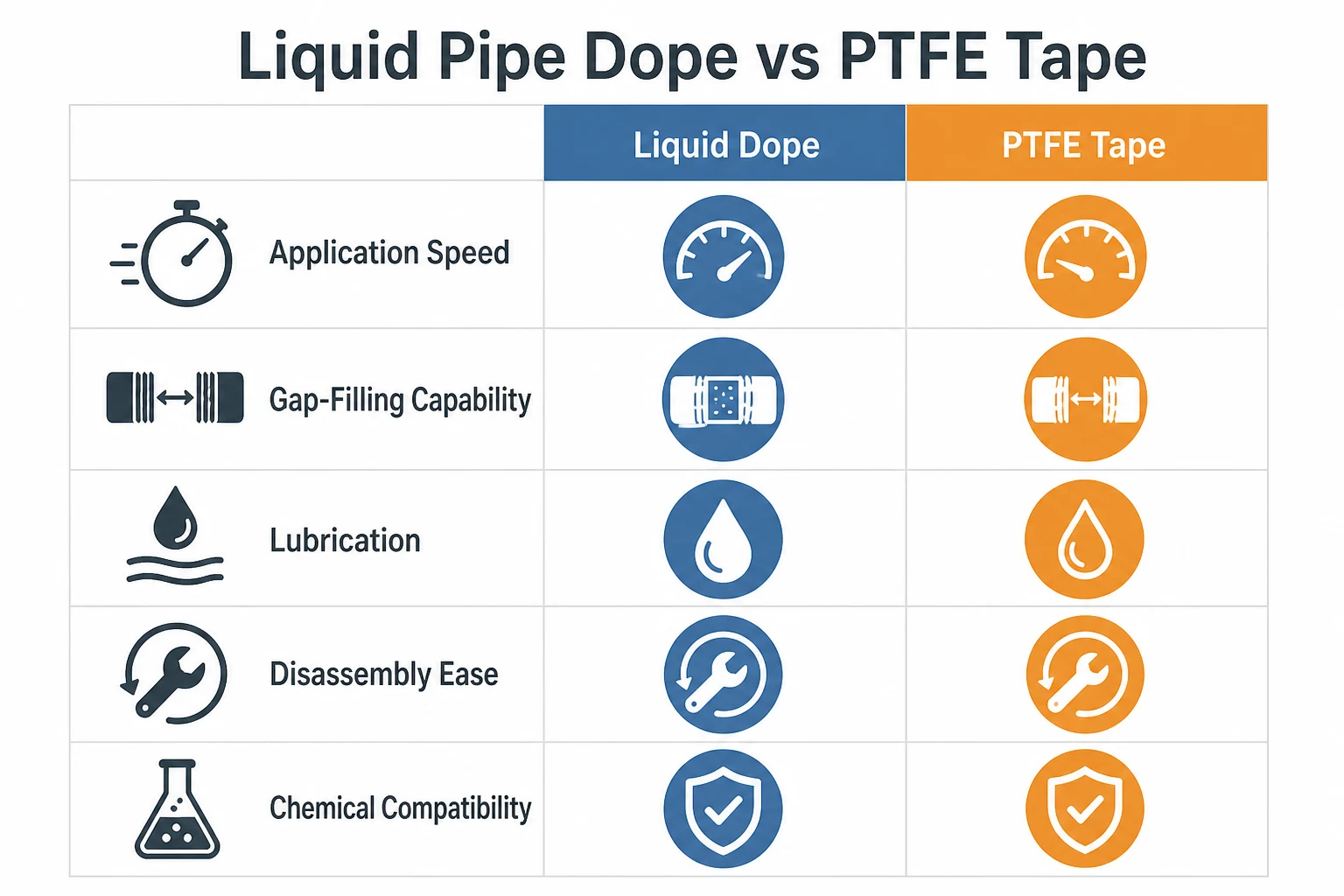
Liquid Thread Sealant vs. PTFE Tape
| Factor | Liquid Pipe Dope | PTFE (Thread Seal) Tape |
|---|---|---|
| Application speed | Slower, requires brush application | Faster, wrap and go |
| Gap-filling capability | Better for worn or slightly damaged threads | Limited — works best on clean, well-cut threads |
| Lubrication during assembly | Generally better lubrication, easier to achieve proper torque | Can reduce friction but less consistent than liquid dope |
| Disassembly | Can be harder to break free depending on formulation | Generally easier to disassemble |
| Chemical/gas compatibility | Must match formulation to the specific media (gas, water, chemical) | Specialized tapes exist for gas, oxygen, and chemical lines |
Matching Sealant to the Application
- Potable water lines require a thread sealant specifically rated for drinking water contact — not every general-purpose pipe dope or tape is certified for this use.
- Natural gas and propane lines require a sealant rated specifically for fuel gas applications; using a water-rated product on a gas line is a safety hazard, not just a performance issue.
- Oxygen and medical gas lines require oxygen-safe, non-reactive thread sealant — standard pipe dope can be a combustion hazard in oxygen-enriched environments.
- High-pressure hydraulic and chemical process lines often require sealants specifically tested and rated for the exact pressure range and chemical media involved.
Application Best Practices
- Inspect threads before sealing — damaged, corroded, or cross-threaded fittings should be replaced rather than sealed over, since no sealant reliably compensates for bad threads.
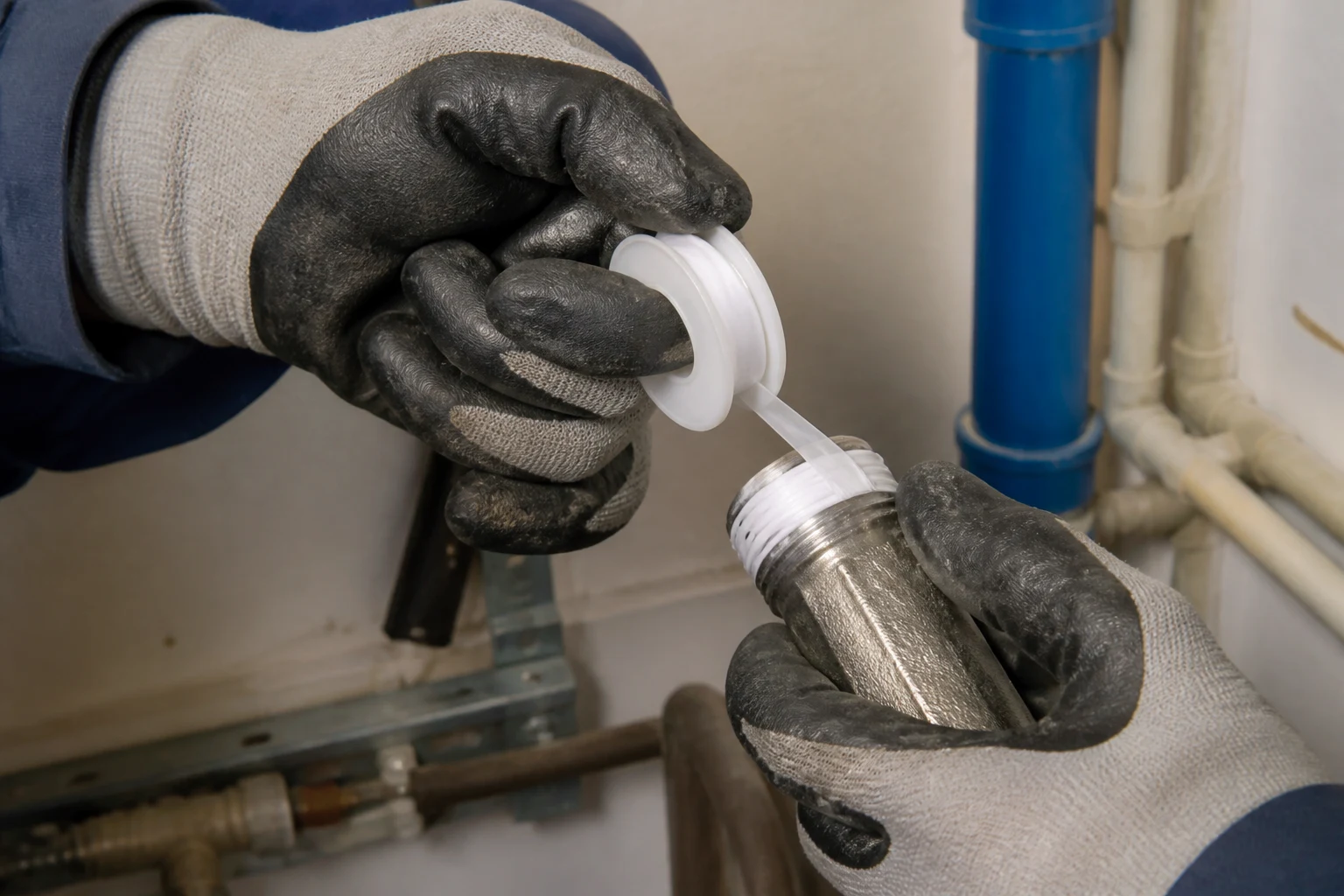
- Apply PTFE tape in the correct direction (clockwise when viewed from the pipe end, so it tightens rather than unwinds during assembly) and with appropriate overlap, typically 2-3 wraps.
- Apply liquid sealant to male threads only in most cases, leaving the first thread or two uncoated to avoid sealant entering the pipe bore and contaminating the line.
- Tighten to the manufacturer’s specified torque rather than “as tight as possible” — overtightening can crack fittings, especially in plastic or brass applications.
- Allow cure time where applicable before pressurizing the line, since some liquid thread sealants require a cure period to reach full sealing performance.
Common Thread Sealant Mistakes
- Using a general-purpose sealant on a gas line without confirming it’s specifically rated for fuel gas service.
- Wrapping PTFE tape in the wrong direction, causing it to unwind during tightening instead of compressing into the threads.
- Sealing over visibly damaged or worn threads instead of replacing the fitting.
- Overtightening fittings in an attempt to stop a leak that’s actually caused by inadequate sealant coverage or bad threads.
- Mixing excessive tape layers or sealant quantity, which can actually prevent proper thread engagement and create a weaker joint than correct, moderate application.
- Forcing together mismatched thread standards (NPT against BSP, for example) and attempting to seal the resulting gap with extra sealant rather than correcting the underlying fitting mismatch.
Frequently Asked Questions
Can I use PTFE tape and liquid thread sealant together?
Generally this isn’t necessary and can sometimes cause over-lubrication that makes it harder to achieve correct torque. Most applications are designed around using one or the other correctly applied, not both layered together.
Is yellow PTFE tape different from white tape?
Yes. Yellow tape is typically formulated and rated specifically for gas line applications, often with a denser wrap than standard white tape used for water lines. Always check the specific product rating rather than assuming color alone guarantees gas compatibility, since mislabeled or repackaged tape can occasionally end up with the wrong color-to-rating association in a mixed toolbox.
Why does my threaded joint still leak after applying sealant?
The most common causes are damaged or worn threads that sealant can’t compensate for, incorrect tape wrap direction, insufficient tightening torque, or using a sealant not rated for the specific media or pressure involved. A mismatched thread standard between the two fitting halves is another possibility worth ruling out. Inspecting the threads themselves is usually the first troubleshooting step before reapplying more sealant.
NPT vs. BSP Threads: Why Compatibility Matters Before Sealant Even Enters the Picture
Before troubleshooting a leak with more sealant, it’s worth confirming the thread standard itself is correctly matched, since this is a surprisingly common root cause that sealant alone cannot fix.
NPT (National Pipe Thread, tapered) is standard in North America, while BSP (British Standard Pipe) is common in Europe, the UK, and many international markets, and comes in both tapered (BSPT) and parallel (BSPP) variants. These standards have different thread angles and profiles, and while an NPT and BSP fitting of the same nominal size can sometimes be forced together, the mismatched thread geometry creates a joint that no amount of sealant can reliably seal under pressure. Imported equipment or fittings sourced internationally are a common source of this mismatch, and it’s worth confirming the thread standard explicitly — not just the nominal pipe size — before assuming a leaking joint is a sealant application problem rather than a thread compatibility problem.
Choosing the Right Thread Sealant
Match the sealant or tape to the specific media (water, gas, chemical, or oxygen) rather than defaulting to a general-purpose product, inspect threads before every application, confirm the thread standard is correctly matched before troubleshooting with more sealant, and follow manufacturer torque specifications rather than over-tightening to stop a leak. Together, these checks address the vast majority of threaded joint leaks far more reliably than simply applying additional sealant to an already-problematic connection. For broader sealant selection involving other specialized certification requirements, our Food Grade Sealant Guide covers a related certification-driven selection process with its own distinct verification standard.
Explore Joobond’s Silicone Sealant and Polyurethane Sealant ranges for broader joint sealing applications beyond threaded pipe connections, and consult the fitting manufacturer’s documentation when working with unfamiliar thread standards or specialized media.
Keyword research source: SeoTools8 (Semrush-backed), US database, desktop, 2026-10-17. Seed “pipe thread sealant” — Volume 3,600/mo, KD 22%. Primary long-tail “thread sealant” — Volume 3,600/mo, KD 18%.
 English
 العربية
 Español de México
 Русский
 Tiếng Việt
 Português do Brasil
 Bahasa Indonesia
 Türkçe