

Table of Contents
Removing old sealant is treated as a generic scrape-and-done task in most guides, but the correct method actually depends on which chemistry is already in the joint. Silicone, acrylic latex, and polyurethane respond to solvents and mechanical methods in completely different ways, and using the wrong approach either fails to remove the old material or damages the substrate underneath it. Getting this step wrong is one of the most common reasons a fresh sealant joint fails within months — not because the new product was bad, but because it was applied over residue the old one left behind.
Signs a Joint Needs Resealing
Cracking along the length of the bead, visible gaps where the sealant has pulled away from one or both substrate faces, and discoloration — yellowing in formerly clear sealant or dark staining in white sealant — all indicate the material has aged past its useful service life. Mold or mildew growth on or around the bead, common in consistently damp joints, signals both an aesthetic problem and a potential adhesion issue, since mold can grow in the microscopic gaps created by early adhesion failure. A joint that feels soft, tacky, or rubbery rather than firmly set has likely never fully cured or has begun breaking down chemically, and should be treated as a removal candidate even without visible cracking. Our Sealant Shelf Life vs. Service Life guide covers the chemistry-specific service life ranges that help predict when a joint is approaching this point.
Why Removal Strategy Depends on Chemistry
Cured silicone sealant resists nearly all common solvents, which is exactly why it performs well in service but makes it the hardest of the three major chemistries to remove chemically. Silicone removal relies primarily on mechanical methods — cutting, scoring, and peeling — with purpose-made silicone removal gels serving mainly to soften the surface layer and ease the mechanical work rather than dissolving the material outright.
Acrylic latex sealant is the most solvent-responsive of the three, softening noticeably with many general-purpose adhesive removers and even some household solvents, which makes it the easiest to remove chemically but also the most prone to smearing into surrounding texture if removal isn’t done carefully. Polyurethane falls between the two — it resists casual solvent attack better than acrylic latex but responds to purpose-formulated polyurethane removal products better than silicone does, making a dedicated removal product worth sourcing specifically for this chemistry rather than reaching for a general-purpose one.
Removal Method by Chemistry: Comparison Chart
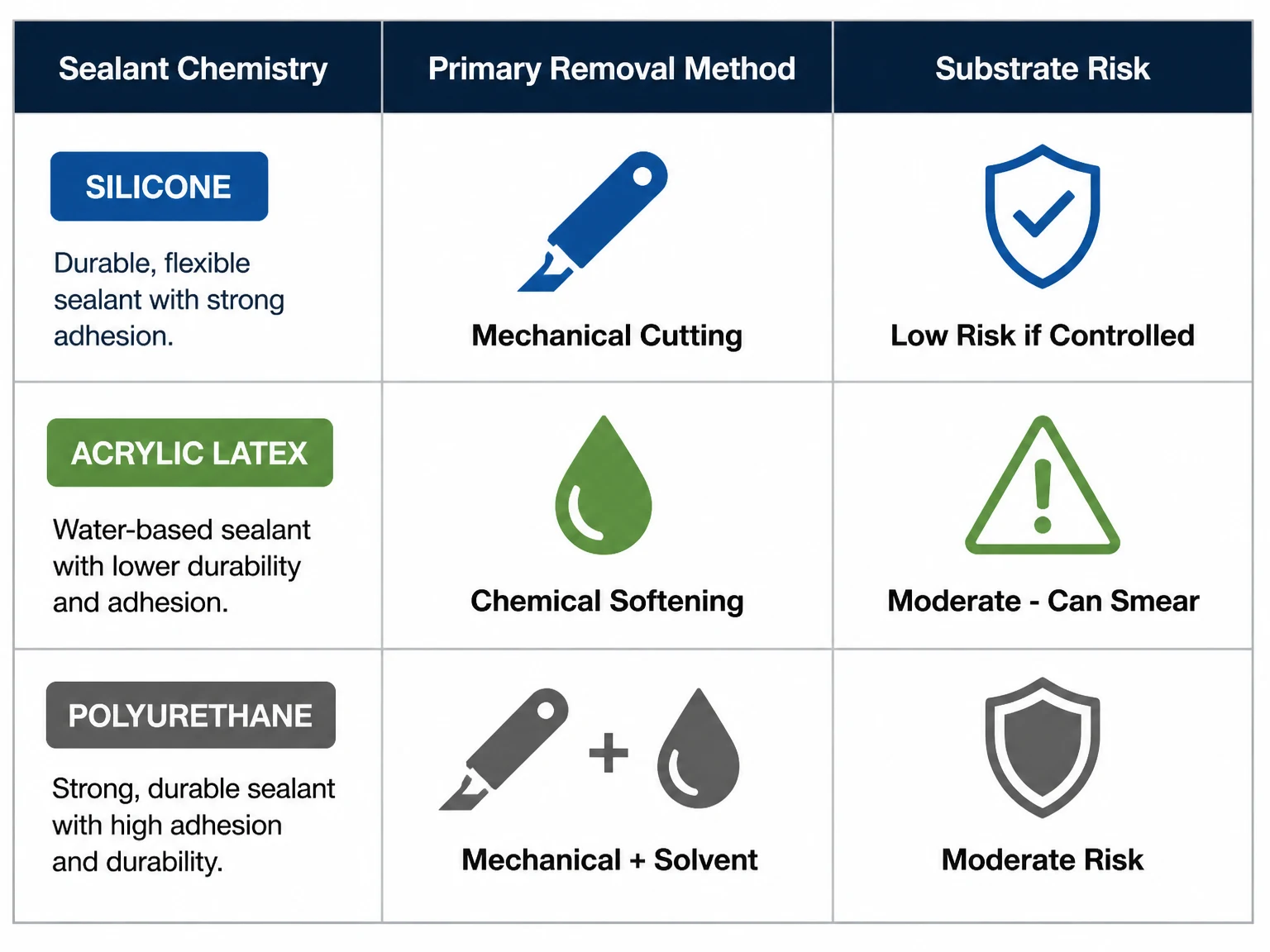
| Sealant Chemistry | Primary Removal Method | Chemical Assist | Substrate Risk |
|---|---|---|---|
| Silicone | Mechanical (cut, score, peel) | Softening gel, limited solvency | Low if blade angle controlled |
| Acrylic Latex | Chemical softening, then scrape | High — most solvent-responsive | Moderate — can smear if rushed |
| Polyurethane | Mechanical + dedicated solvent | Moderate — needs purpose-made product | Moderate — firmer bond than acrylic |
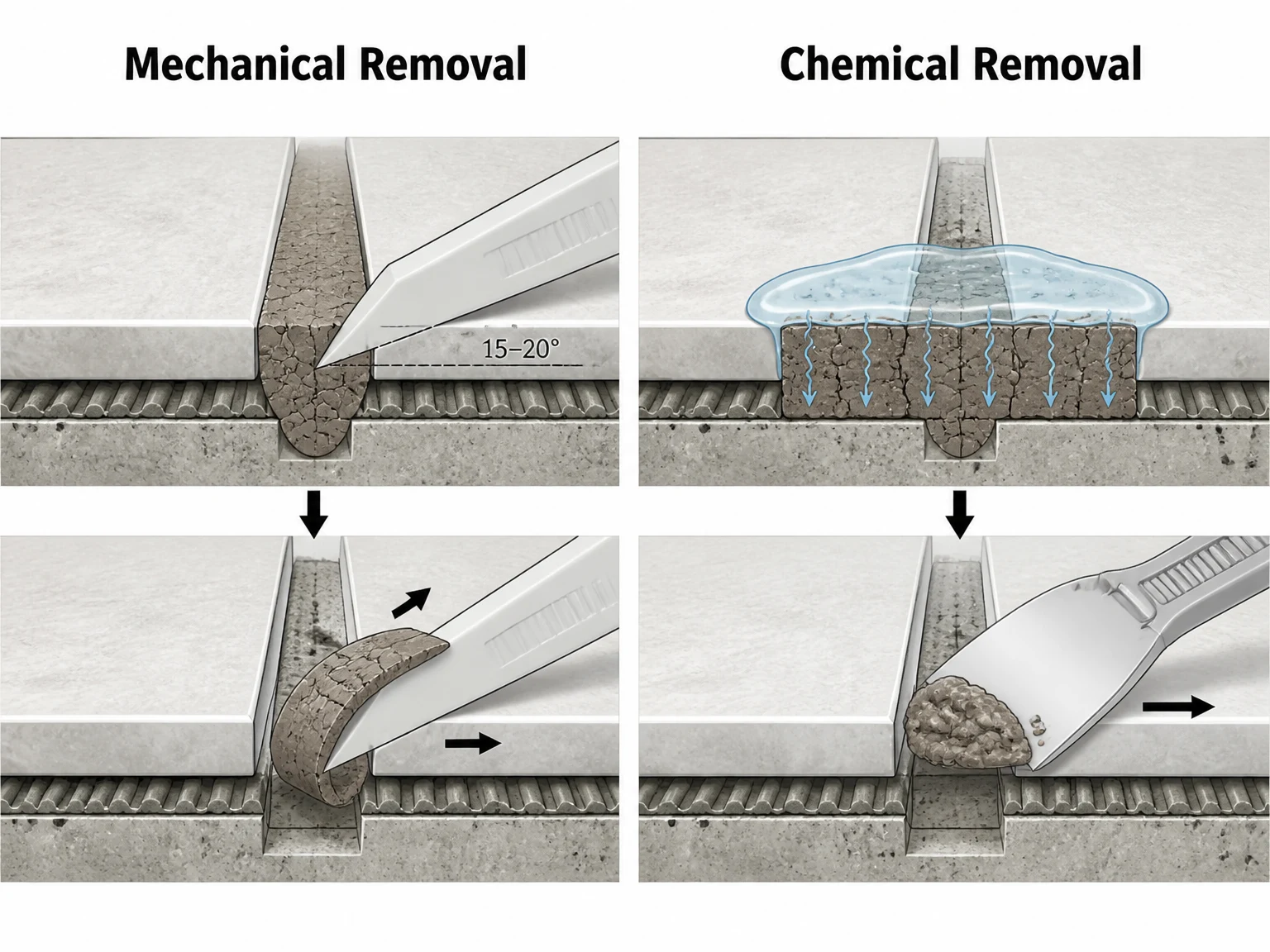
Mechanical vs. Chemical Removal
Mechanical removal uses a blade, scraper, or similar tool to cut and peel the cured sealant away from the substrate by force rather than dissolving it. This method works on any chemistry but carries real risk of scratching or gouging softer substrates — gel-coat fiberglass, some plastics, and soft woods are particularly vulnerable to blade damage if the tool angle is too aggressive. A plastic or non-metallic blade reduces this risk substantially on sensitive surfaces, trading some cutting efficiency for substrate safety.
Chemical removal uses a solvent or gel formulated to soften the cured sealant so it can be wiped or scraped away with far less mechanical force. This approach reduces substrate scratching risk but introduces its own considerations: dwell time matters, ventilation is often required, and the softened material must still be physically removed and disposed of rather than simply dissolving into nothing. Chemical removers also vary significantly in which chemistries they actually soften — a product marketed as a general caulk remover may work well on acrylic latex while doing almost nothing to cured silicone, so matching the remover to the chemistry being removed avoids wasted effort and unnecessary solvent exposure.
Industrial-Scale Joints: What Changes at Larger Sizes
A residential bathroom caulk line and an industrial expansion or control joint present very different removal problems despite using similar chemistry. Industrial joints are often wider and deeper, meaning substantially more cured material to remove per linear foot, and the sealant frequently bonds to backer rod underneath rather than directly to a rigid bottom surface — complicating mechanical removal, since the blade needs to track along a joint depth rather than a shallow surface-level bead. Our Backer Rod Guide explains why backer rod is there in the first place and how to re-size and re-seat it correctly once the old sealant and rod are removed.
Power tools — oscillating multi-tools with specialized sealant-removal blades, or dedicated joint-cleaning equipment — become practical and often necessary at industrial scale, where manual blade work on hundreds of linear feet of joint simply isn’t efficient. Substrate risk also shifts: concrete and masonry tolerate more aggressive mechanical removal than residential fixtures like fiberglass tubs or acrylic shower surrounds, but industrial joints are more likely to have been filled with backer rod that also needs replacement, adding a step residential joint removal typically skips entirely.
Preparing the Joint for New Sealant
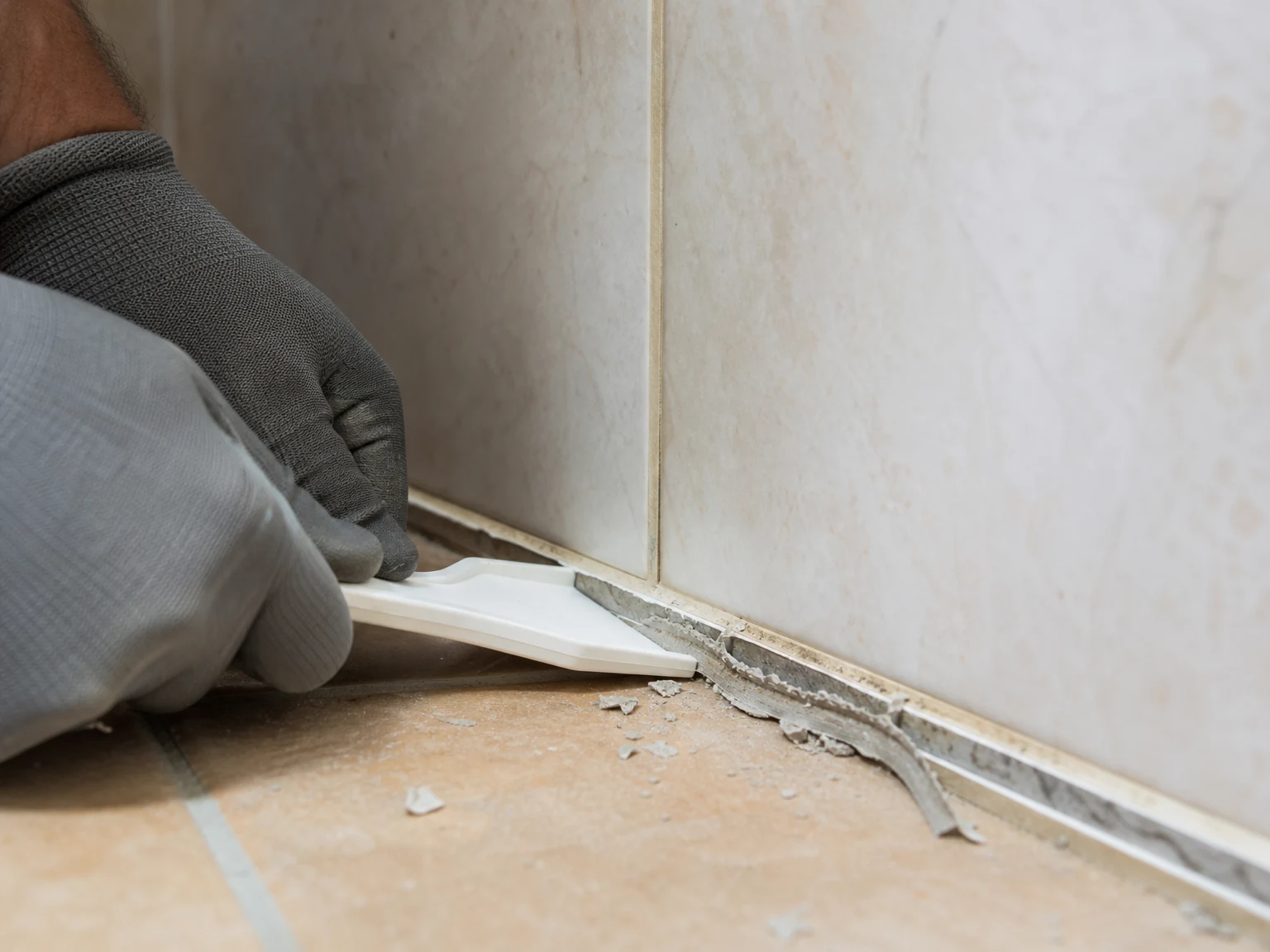
Removing the visible bulk of old sealant is only the first half of the job — residue left behind is the most common cause of poor adhesion in the fresh bead applied afterward. After mechanical or chemical removal, wipe the joint faces with isopropyl alcohol to strip remaining oils, soap film, or solvent residue from the removal process itself, since any of these can block adhesion just as effectively as the old sealant would have. Inspect the joint under good lighting for any remaining flecks or thin films, particularly in corners and at the joint’s deepest point, where removal tools tend to miss material that’s visible only on close inspection. A joint that looks clean from a normal viewing distance can still carry enough residue to compromise the new sealant’s bond, so this final check is worth the extra few minutes before applying fresh material.
Frequently Asked Questions
Why is silicone sealant so hard to remove compared to other types?
Cured silicone resists nearly all common solvents, the same chemical stability that makes it durable in service. Removal relies primarily on mechanical cutting and peeling, with chemical softening gels helping ease the mechanical work rather than dissolving the silicone outright.
Can I use any caulk remover on any type of sealant?
No. A general-purpose caulk remover may soften acrylic latex effectively while doing almost nothing to cured silicone. Match the removal product to the specific chemistry being removed rather than assuming one product works universally.
Do I always need to remove old sealant before applying new sealant?
Yes, in nearly all cases. Applying new sealant over old, failing material traps whatever caused the original failure and prevents the new bead from bonding directly to the substrate, which significantly shortens its service life.
How is removing sealant from an industrial expansion joint different from a residential caulk line?
Industrial joints are typically wider and deeper, with significantly more material to remove and often a backer rod underneath that complicates mechanical access. Power tools become practical at that scale, and the backer rod itself frequently needs replacement alongside the sealant.
Will removing old sealant damage the substrate?
It can, particularly with aggressive mechanical removal on soft substrates like fiberglass or some plastics. Using a plastic or non-metallic blade and controlling the cutting angle reduces this risk, and chemical softening before scraping further lowers the mechanical force needed.
Need Help Choosing a Sealant?
Tell us your materials and application requirements.
SEND AN INQUIRY English
 العربية
 Español de México
 Русский
 Tiếng Việt
 Português do Brasil
 Bahasa Indonesia
 Türkçe