

Table of Contents
A chimney is one of the most reliable sources of roof leaks precisely because it’s a rigid structure punching through a flexible roof plane — and the junction between the two depends on flashing, not sealant, to actually shed water. Chimney flashing sealant has a narrower job than most homeowners assume: it backs up the flashing at specific seams and terminations, it does not replace flashing, and treating it as a primary waterproofing layer is one of the most common and most expensive roofing mistakes. This guide covers exactly where sealant belongs around a chimney, how it differs from flashing and roofing cement, and the application details that keep a chimney penetration watertight.
Why Chimneys Leak More Than Any Other Roof Penetration
Unlike a vent pipe or skylight, a chimney is wide, rigid, and sits at a right angle to the roof slope, which means water has to be redirected around all four sides using different flashing geometry on each. The uphill side needs a cricket or saddle to split water flow; the downhill side needs an apron flashing; the two parallel sides need step flashing woven into each course of roofing material. Every one of those pieces has seams, and every seam is a potential entry point — which is why chimney leaks are disproportionately common compared to simpler penetrations.
Masonry also moves differently than the roof deck around it: chimneys settle, expand and contract thermally at a different rate than wood framing, and the masonry itself is porous. Flashing has to accommodate that differential movement without losing its seal, and this is exactly where sealant earns its place — not as the main barrier, but as the flexible component that tolerates movement at the seams rigid flashing pieces can’t fully close on their own.
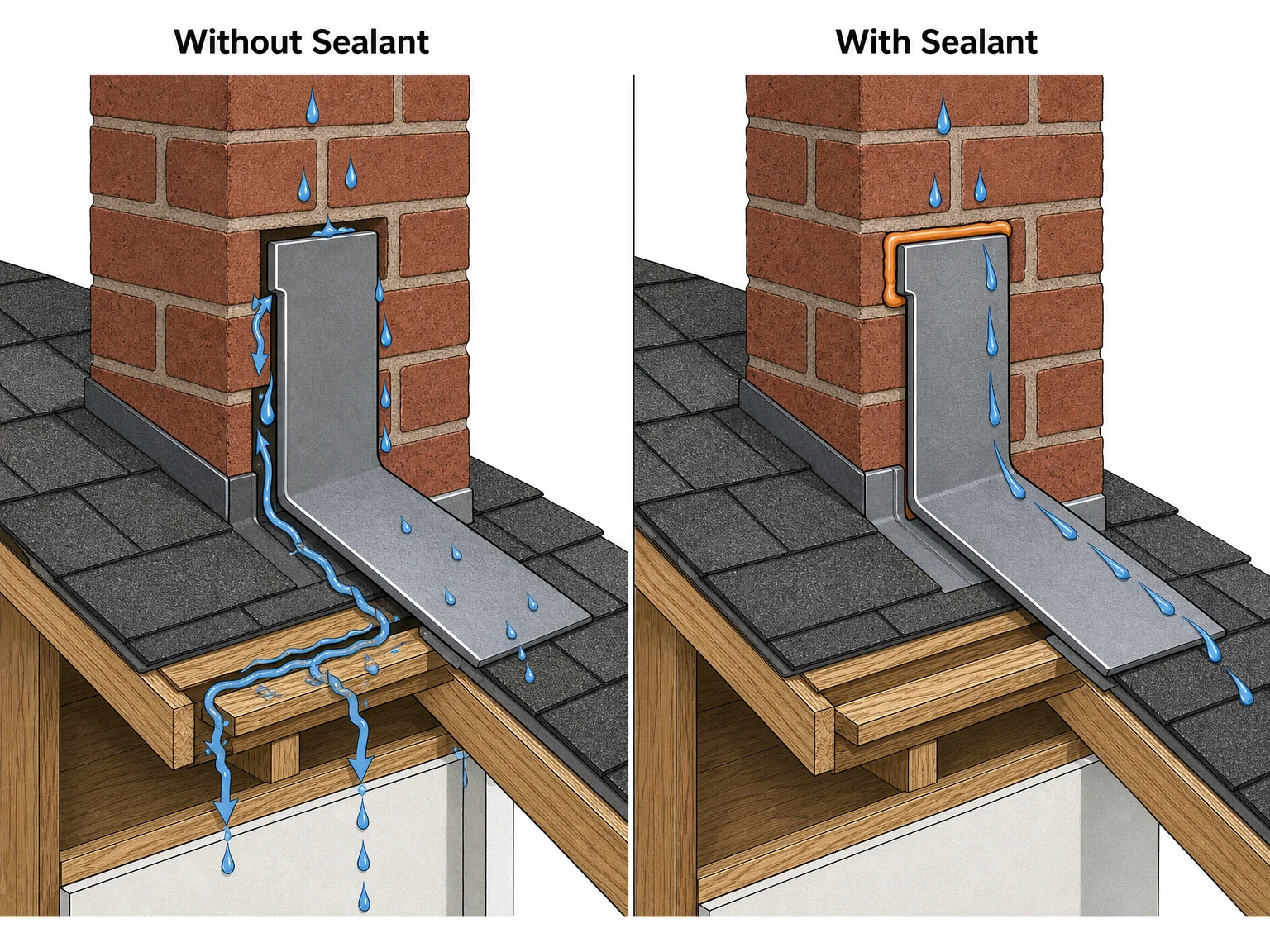
Where Sealant Belongs on a Chimney
Counter flashing — the metal strip embedded into a mortar joint or reglet groove cut into the masonry, overlapping the step flashing below — is the single most common application point. Sealant goes into the reglet groove to lock the counter flashing in place and keep water from working behind it through the saw-cut masonry joint. This is a genuine structural sealing job, not a cosmetic bead.
The remaining legitimate locations are narrower: the top edge of the cricket or saddle flashing where it meets the chimney masonry, the end laps where sections of step flashing overlap each other, and around the base of a chimney cap or crown where it meets the flue liner. What sealant should not be doing is covering gaps in step flashing itself, patching a corroded flashing section, or running as a continuous bead across the full flashing-to-shingle transition — those are flashing or roofing repairs, and sealant applied over a failing flashing system just hides the problem until it fails again, usually inside the house.
Sealant vs. Flashing vs. Roofing Cement
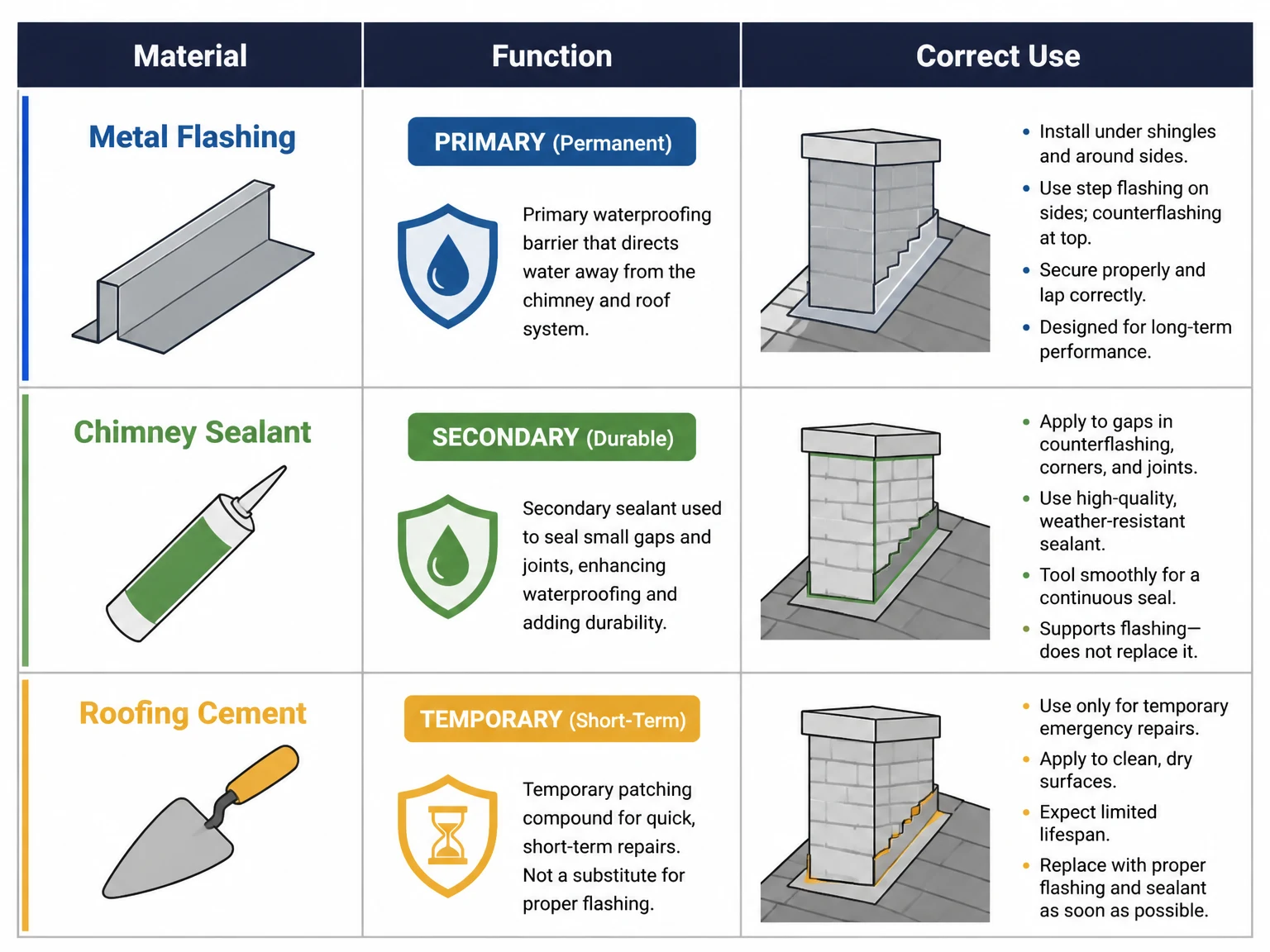
These three materials get used interchangeably in casual conversation but do fundamentally different jobs, and mixing them up is where most DIY chimney repairs go wrong.
| Material | Function | Correct Use Around a Chimney |
|---|---|---|
| Flashing (metal) | Primary waterproofing — physically sheds water off the roof plane | Step, counter, apron, and cricket flashing; cannot be substituted with sealant |
| Chimney sealant (polyurethane/MS polymer/silicone) | Secondary seal at seams, laps, and reglet grooves; accommodates movement | Reglet groove, flashing end laps, cap-to-flue junction |
| Roofing cement / mastic | Thick, trowel-applied patching compound for emergency or temporary repair | Short-term fix on damaged flashing until proper flashing repair is scheduled — not a permanent solution |
Roofing cement in particular gets misused as a long-term fix because it’s cheap and easy to apply generously, but it dries out, cracks, and loses adhesion within a few years under UV exposure — it’s a stopgap, not a chimney sealant replacement.
Choosing the Right Sealant Chemistry
Chimney sealant has to handle UV exposure, temperature swings, and adhesion to two very different substrates at once — metal flashing and masonry. Pure silicone adheres well to both but can’t be painted over, which matters on visible flashing where appearance is a factor. Polyurethane and MS polymer sealants offer strong metal-to-masonry adhesion, can usually be painted to match the flashing or mortar color, and tend to hold up better against the combination of thermal cycling and UV that a roof-level chimney joint sees year-round. For the reglet groove specifically, a sealant rated for both masonry and metal adhesion is non-negotiable — a sealant that bonds well to metal but poorly to masonry will eventually let water track in along the stone or brick side of the joint.
Application and Inspection Notes
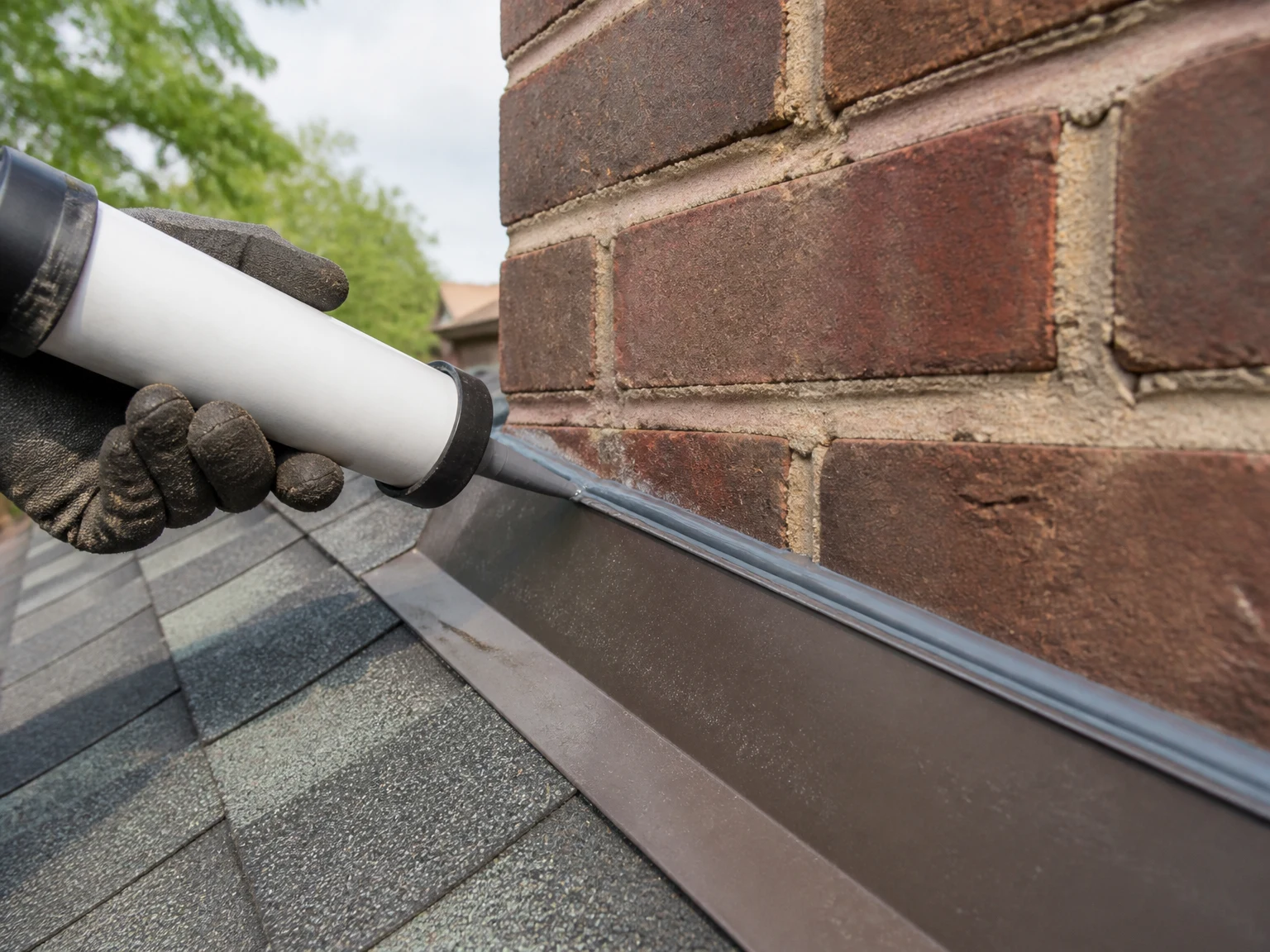
Reglet grooves should be cut to a consistent depth — roughly three-quarters of an inch — and cleaned of masonry dust before the counter flashing and sealant go in; dust left in the groove is one of the most common causes of early sealant bond failure on masonry. Apply sealant to a clean, dry joint and tool it to a smooth profile that sheds water rather than pooling against the flashing edge.
Chimney sealant has a shorter realistic service life than sealant in a more protected location, because it sits in continuous UV exposure at roof level. An annual visual check — looking for cracking, gaps pulling away from the masonry, or sealant that has turned chalky and lost flexibility — catches failures before they become interior water damage. A chimney with proper flashing and sealant in good condition rarely needs full resealing more than once every five to seven years; needing it more often usually points to an underlying flashing problem rather than a sealant problem.
Frequently Asked Questions
Can sealant alone stop a chimney leak without flashing?
No. Sealant is a secondary seal at specific seams and does not replace step, counter, apron, or cricket flashing. A chimney leaking because of damaged or missing flashing needs a flashing repair; applying sealant over the problem only delays and often worsens the eventual water damage.
What is a reglet groove and why does it need sealant?
A reglet groove is a shallow channel cut into a mortar joint or masonry face where the top edge of counter flashing is inserted and locked in place. Sealant fills this groove around the flashing edge to keep water from tracking in behind the counter flashing through the cut masonry joint.
Is roofing cement a substitute for chimney sealant?
Only as a short-term measure. Roofing cement is a thick, trowel-applied patching compound that dries out and cracks within a few years under UV exposure. It can buy time before a proper flashing or sealant repair, but it is not a durable long-term chimney sealing solution.
How often should chimney flashing sealant be reapplied?
A properly applied sealant on sound flashing typically lasts five to seven years before needing resealing, given continuous roof-level UV exposure. Needing resealing more frequently than that usually indicates an underlying flashing issue rather than a sealant failure on its own.
Keeping the Secondary Seal Secondary
The chimney penetrations that fail are rarely the ones with a visible, thick bead of sealant — they’re the ones where sealant was asked to do a flashing’s job. Reserving sealant for reglet grooves, end laps, and cap junctions, choosing a chemistry rated for both metal and masonry, and inspecting it annually keeps the secondary seal doing exactly what it’s supposed to do while the actual flashing handles the real waterproofing work.
Need Help Choosing a Sealant?
Tell us your materials and application requirements.
SEND AN INQUIRY English
 العربية
 Español de México
 Русский
 Tiếng Việt
 Português do Brasil
 Bahasa Indonesia
 Türkçe