

Table of Contents
Skylight leaks are rarely caused by the glazing unit itself — they almost always trace back to the flashing-to-roof transition around the perimeter, or to a sealant that was asked to do a flashing kit’s job. Skylight sealant plays a real but limited role: it backs up specific seams in the flashing system and handles the curb-to-roof junction, but it is not a substitute for a properly installed, manufacturer-matched flashing kit. This guide covers how curb-mounted and deck-mounted skylights differ in their sealing requirements, where sealant actually belongs, and the mistakes that turn a small flashing gap into a ceiling stain.
Curb-Mounted vs. Deck-Mounted: Different Sealing Requirements
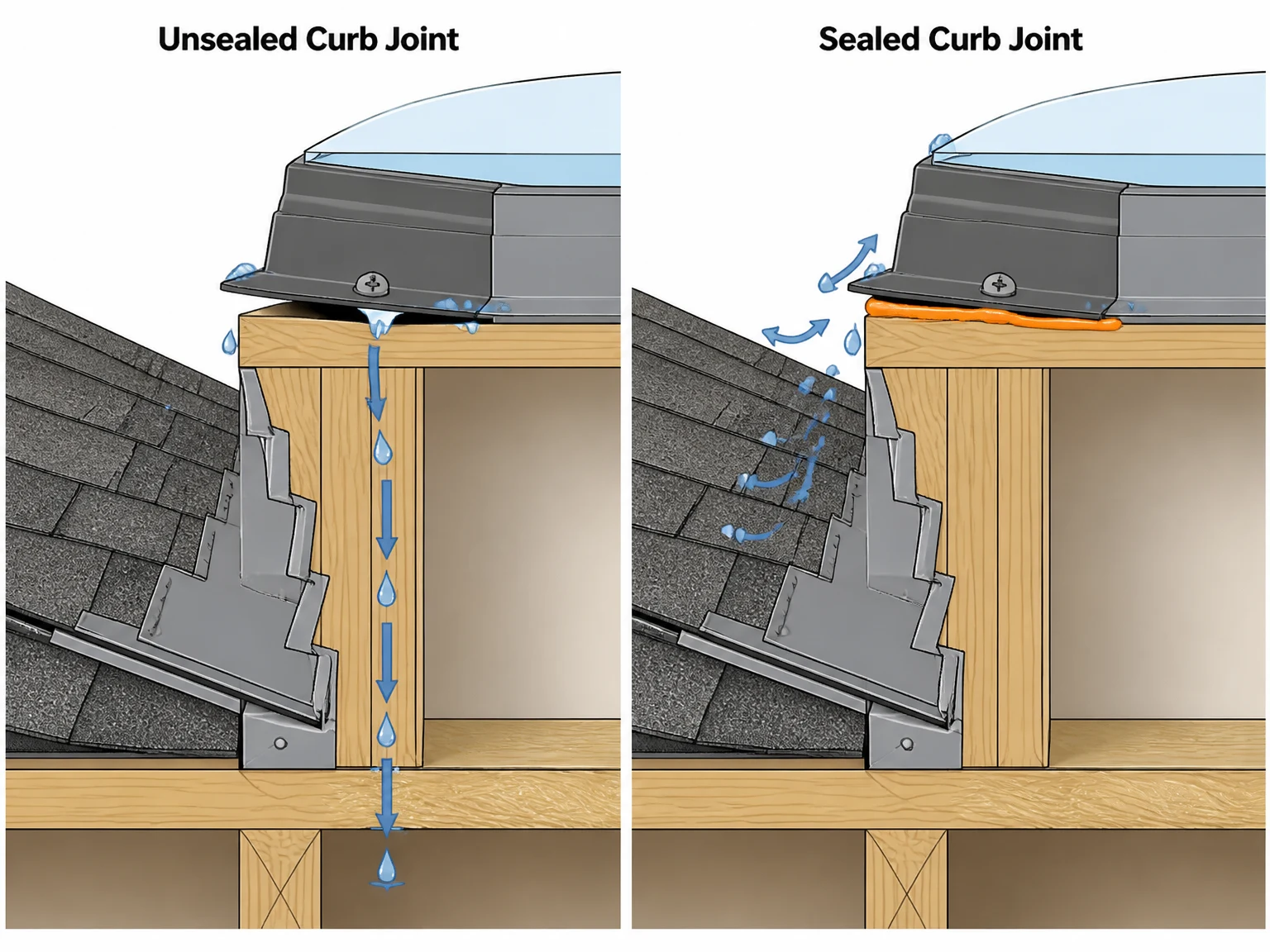
A curb-mounted skylight sits on a raised wooden or metal curb built up from the roof deck, with step flashing integrated into the roofing material around the curb’s perimeter, similar in principle to chimney flashing. The skylight unit itself sits on top of the curb, sealed at the point where it meets the curb cap. A deck-mounted skylight, by contrast, sits directly on the roof deck with an integrated flashing frame that’s part of the unit, and the critical seal is where that frame meets the surrounding roofing material.
The distinction matters because curb-mounted units have an extra joint — skylight-to-curb — that deck-mounted units don’t, and that joint is a legitimate sealant application point. Deck-mounted units concentrate almost all of their watertightness in the factory-integrated flashing frame, which means sealant there is doing secondary work at flashing laps rather than sealing a structural gap the way it does on a curb-mounted unit.
Retrofit and replacement installations add a third variable: if a deck-mounted unit is going into an opening originally built for a curb-mounted skylight, or vice versa, the flashing kit has to match the mounting type exactly. A mismatched flashing kit is one of the more common causes of chronic leaks after a skylight replacement, and no amount of sealant at the perimeter compensates for flashing geometry that doesn’t match the roof pitch and curb height it’s installed on.
Where Sealant Belongs in a Skylight System
On a curb-mounted skylight, sealant goes at the skylight-to-curb cap joint, where the glazing unit’s mounting flange meets the top of the curb — this is a genuine primary seal location, not just a backup. On both mounting types, sealant also belongs at flashing end laps and corner joints, where individual flashing pieces overlap and a small gap is common even with correct installation.
What sealant should not be doing is covering the entire perimeter where the flashing meets the roofing material in place of properly woven step flashing, or patching a flashing kit that’s missing pieces or installed out of sequence. A continuous bead of sealant laid over a flashing system that isn’t shedding water correctly on its own will fail — usually within one to two seasons — because it’s being asked to be the primary waterproofing layer rather than the secondary seal it’s designed to be.
Condensation is a separate issue that gets mistaken for a sealant failure almost as often as flashing problems do. Skylight shafts that run through unconditioned attic space can accumulate condensation on the interior frame in cold weather, and that moisture drips in a pattern that looks identical to an exterior leak from inside the room below. Checking whether water appears only during or shortly after rain (exterior leak, likely flashing or sealant) versus during cold snaps regardless of weather (condensation, likely an insulation or ventilation issue) saves a lot of wasted resealing work on a problem sealant can’t fix.
Sealant Compatibility by Skylight Frame Material
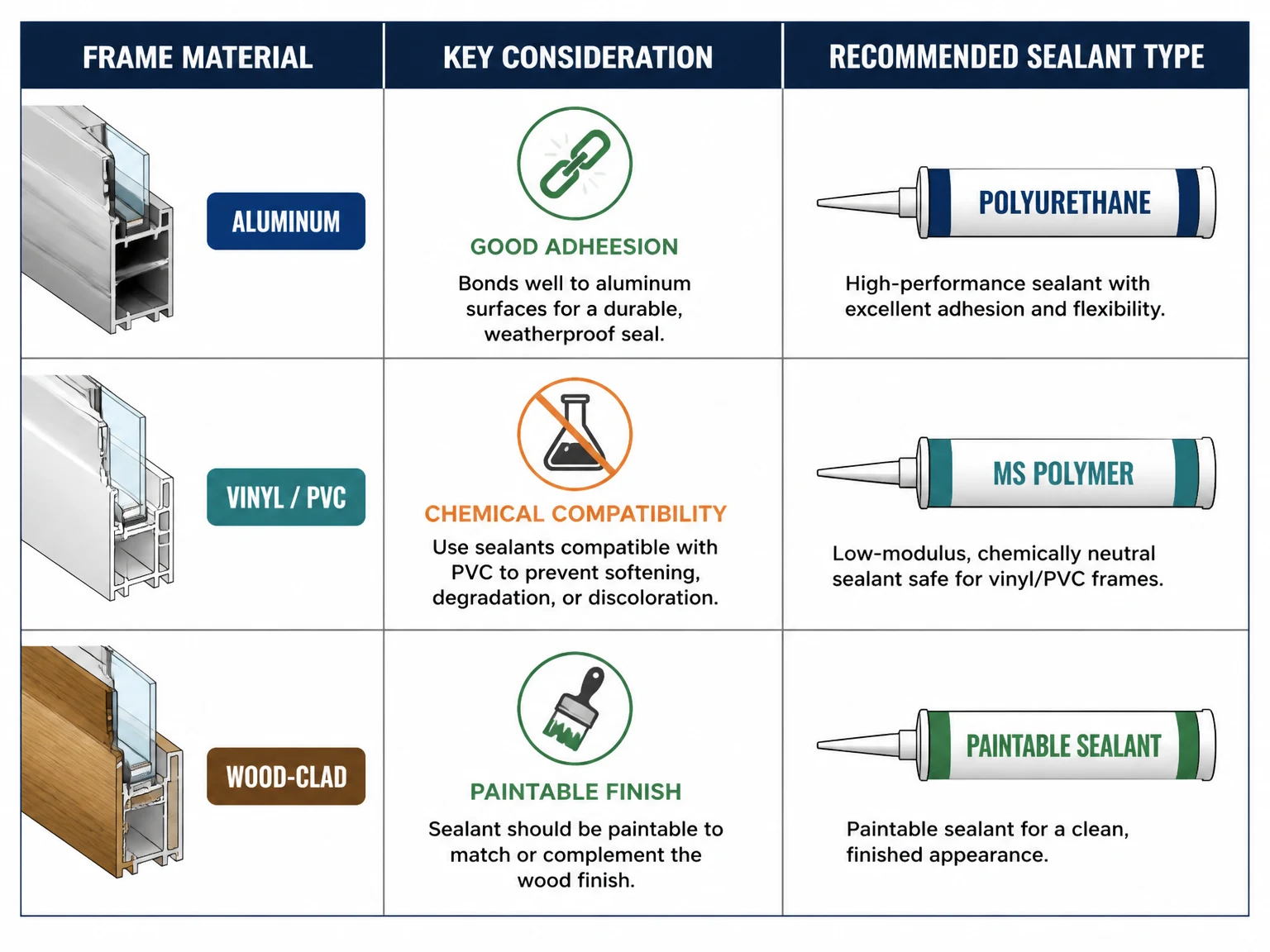
Skylight frames are commonly aluminum, vinyl, or wood-clad, and each has different sealant compatibility considerations tied to both adhesion and the frame’s own expansion behavior under temperature swings.
| Frame Material | Key Consideration | Recommended Sealant Type |
|---|---|---|
| Aluminum | Good adhesion with most chemistries; moderate thermal expansion | Polyurethane or MS polymer rated for exterior glazing |
| Vinyl / PVC | Some sealants (especially solvent-based) can degrade PVC over time | MS polymer or sealant explicitly listed as PVC-safe by the manufacturer |
| Wood-clad | Needs paintable/stainable sealant if finish matching matters; wood movement with humidity | Paintable polyurethane or high-movement acrylic-polyurethane hybrid |
Checking the skylight manufacturer’s approved sealant list before buying is worth doing — some manufacturers explicitly exclude certain chemistries because of frame material incompatibility, and using an unlisted sealant can both cause premature failure and void the unit’s warranty.
Application Practices That Prevent Repeat Leaks
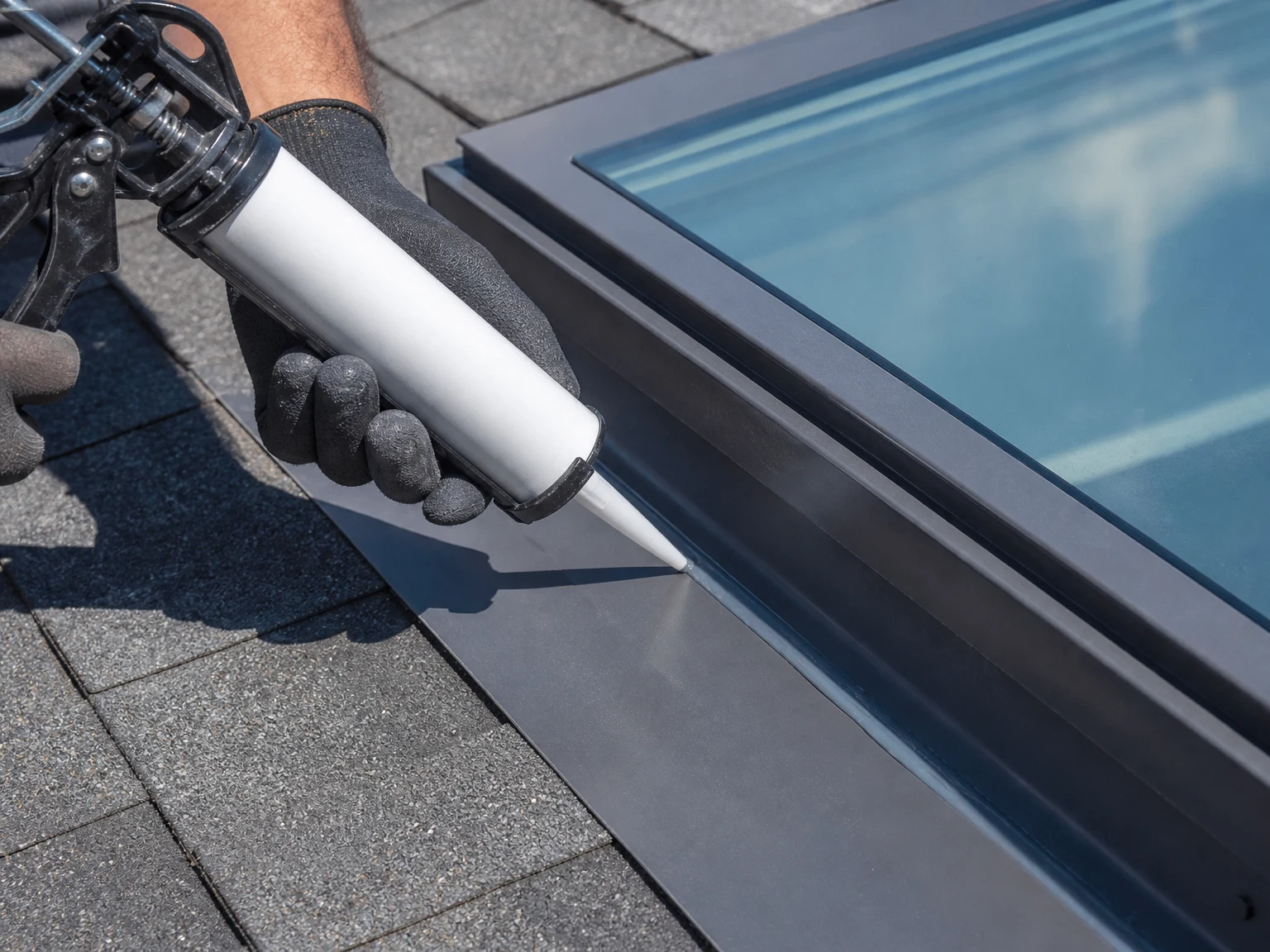
Never apply new sealant directly over old, failing sealant. Degraded silicone in particular leaves a residue that prevents proper adhesion of anything applied on top, including more silicone — the old material has to be fully removed, and the surface cleaned with an appropriate solvent, before new sealant goes in. This is the single most common reason a “resealed” skylight leaks again within a year.
Work in dry, moderate conditions — sealant applied to a damp surface or in direct hot sun often skins over before it can properly bond and tool. Tool the bead to a smooth, slightly concave profile that sheds water away from the joint rather than pooling against it, and allow full cure time before the roof sees heavy rain, which on most polyurethane and MS polymer formulations means at least 24 hours in moderate conditions.
A visual inspection once a year — ideally in early spring after winter freeze-thaw cycling — catches most sealant problems before they become interior damage. Look specifically for cracking or chalking at the skylight-to-curb joint, gaps where sealant has pulled away from either surface rather than staying bonded to both, and any flashing lap where the overlap looks shorter than the surrounding laps. Any of those signs warrant closer inspection rather than a reflexive bead of new sealant over the top.
Frequently Asked Questions
Can I fix a leaking skylight by just adding more sealant?
Only if the leak is actually at a sealant joint rather than a flashing problem. Most persistent skylight leaks trace back to flashing that was installed incorrectly or has failed, and sealant applied over a flashing problem typically fails again within one to two seasons because it’s being used as a primary waterproofing layer instead of its intended secondary role.
Do curb-mounted and deck-mounted skylights use the same sealant?
The sealant chemistry can be the same, but the application points differ. Curb-mounted skylights need sealant at the skylight-to-curb cap joint in addition to flashing laps, while deck-mounted skylights concentrate sealing at the integrated flashing frame’s laps and corners, since there’s no separate curb joint.
Why does resealing a skylight sometimes fail within a year?
The most common cause is applying new sealant directly over old, degraded sealant without fully removing it first. Residue from failing silicone in particular prevents proper adhesion of new sealant, so the repair looks complete but never actually bonds to the surface underneath.
Does skylight frame material affect which sealant to use?
Yes. Vinyl and PVC frames can be degraded by some solvent-based sealants over time, and wood-clad frames may need a paintable formulation to match the finish. Checking the skylight manufacturer’s approved sealant list before buying avoids both compatibility issues and warranty voids.
Sealant as the Backup, Not the System
A skylight that leaks every year or two despite repeated resealing almost always has an underlying flashing problem that sealant alone can’t fix. Matching sealant chemistry to the frame material, applying it only at the legitimate joint locations for the mounting type, and fully removing old sealant before resealing are what keep the secondary seal doing its actual job while the flashing system handles the real waterproofing.
Need Help Choosing a Sealant?
Tell us your materials and application requirements.
SEND AN INQUIRY English
 العربية
 Español de México
 Русский
 Tiếng Việt
 Português do Brasil
 Bahasa Indonesia
 Türkçe