

Table of Contents
- 1. Foundation Waterproofing Sealant vs. Foundation Waterproofing: Two Different Scopes
- 2. Where Foundation Sealant Actually Belongs
- 3. Sealant Chemistry for Below-Grade Conditions
- 4. Application From Inside vs. Outside the Foundation
- 5. Foundation Sealant vs. Full Waterproofing: Quick Reference
- 6. Common Mistakes
- 7. Frequently Asked Questions
Foundation waterproofing sealant and foundation waterproofing get used interchangeably online, but they describe two different scopes of work — one seals specific joints and penetrations, the other covers the entire below-grade wall surface. Confusing the two leads to the most common foundation leak repair mistake: caulking a crack and assuming the wall is now waterproofed, when the actual leak path was hydrostatic pressure pushing water through porous concrete well away from any visible joint.
Foundation Waterproofing Sealant vs. Foundation Waterproofing: Two Different Scopes
Foundation waterproofing is a system-level treatment applied to the exterior (or sometimes interior) of the entire foundation wall — typically a membrane, a liquid-applied coating, or a dimpled drainage board, often combined with a perimeter drain tile system that carries groundwater away from the structure entirely. It addresses hydrostatic pressure across the whole wall, not a single gap.
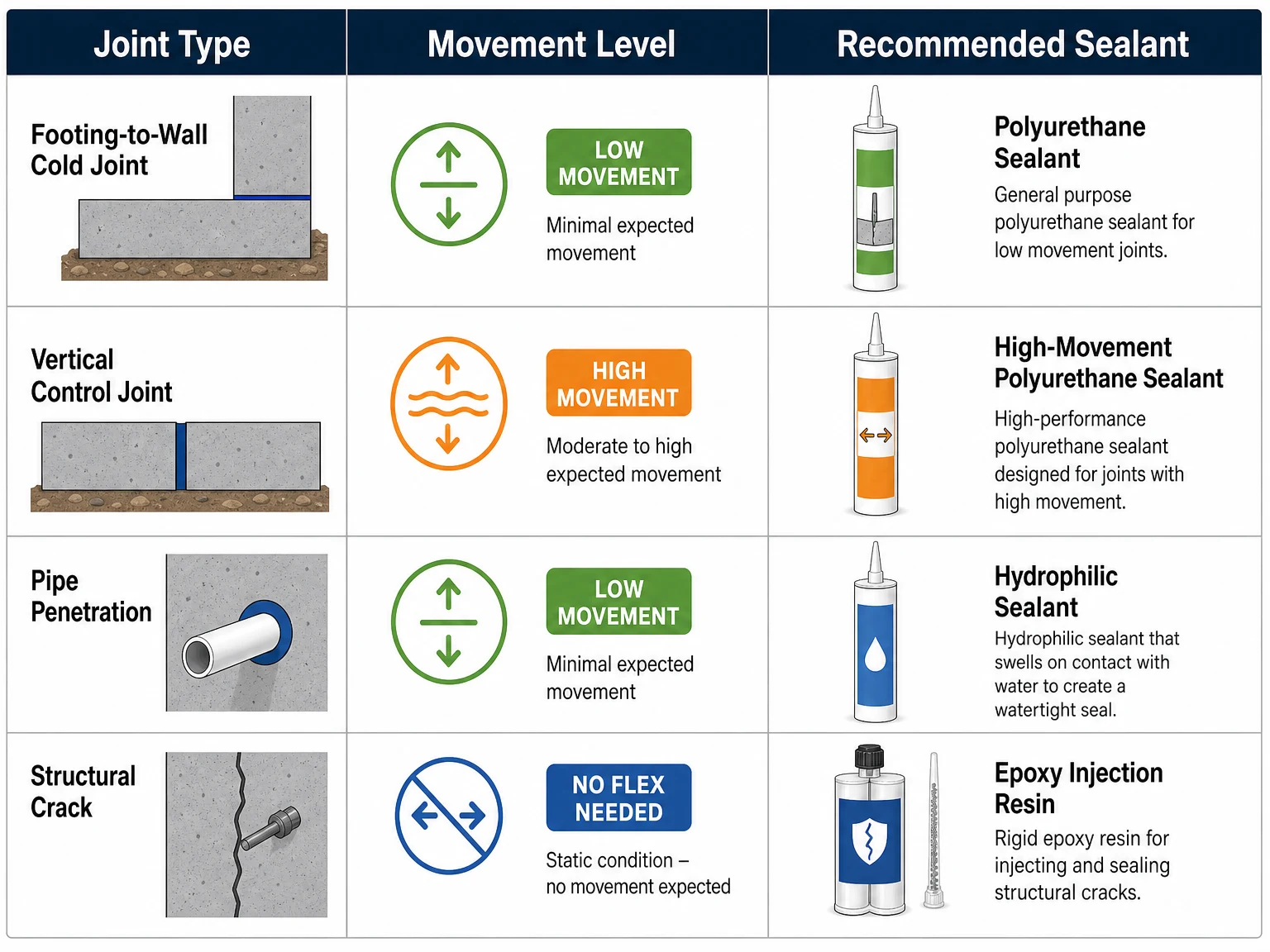
Foundation waterproofing sealant is a joint-specific compound used at a small number of defined locations: the cold joint between a footing and the foundation wall, vertical control joints poured into long wall runs, pipe and conduit penetrations through the concrete, and hairline cracks that have been assessed as non-structural. It cannot substitute for a drainage system or a full membrane, and it will not stop water driven by sustained hydrostatic pressure across an otherwise untreated wall. Treating a handful of visible cracks with sealant while ignoring a failed exterior membrane or a clogged drain tile is why many foundation “repairs” fail within one wet season.
Where Foundation Sealant Actually Belongs
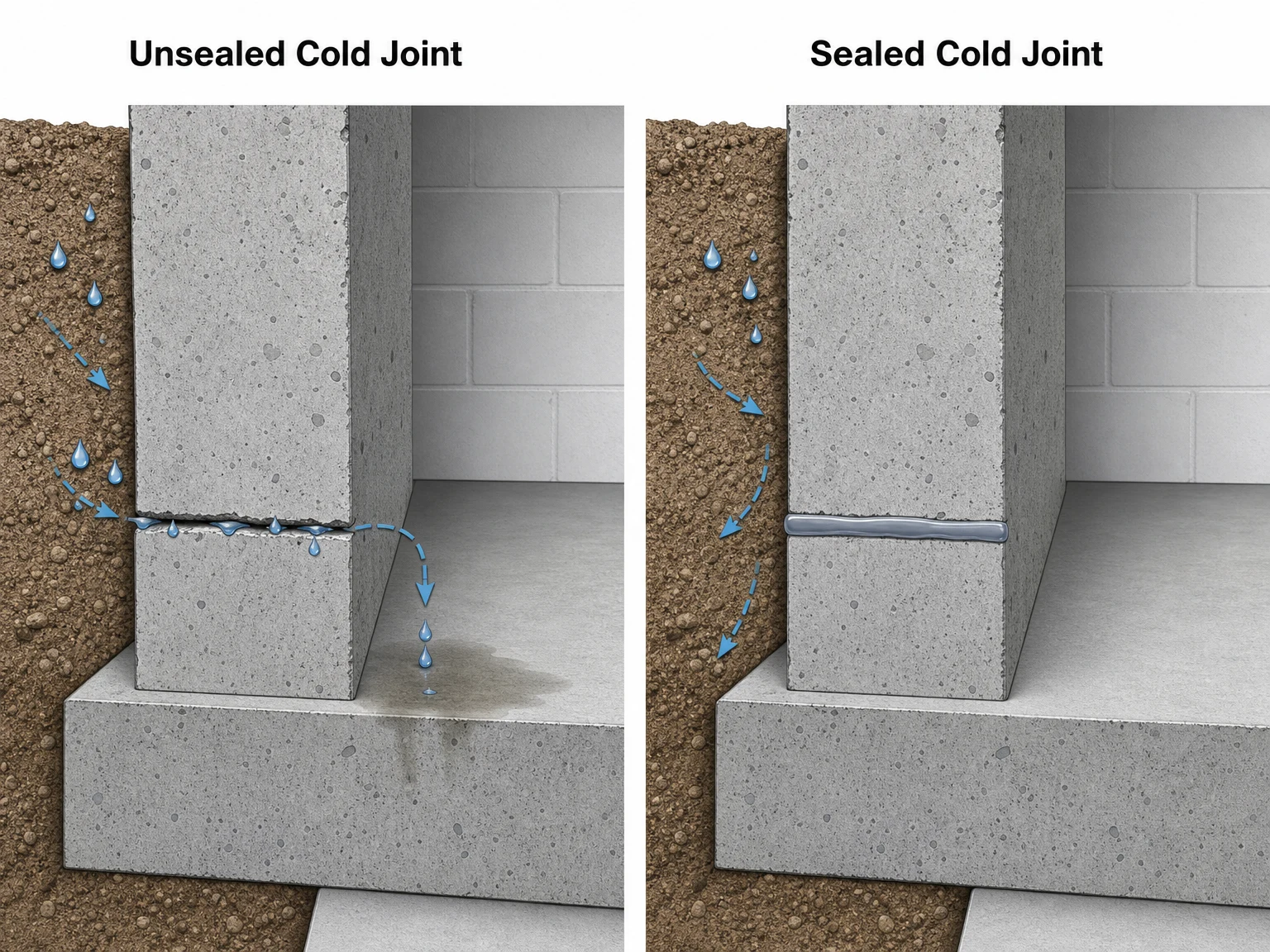
The cold joint between the footing and the foundation wall is the single most common point sealant is asked to address, since this horizontal seam is created in a separate concrete pour and rarely bonds perfectly to the footing below it. A flexible, hydrophilic or polyurethane sealant placed along this joint — ideally during construction with a proper waterstop, or as remedial injection afterward — handles the small amount of movement and minor seepage typical at this seam.
Vertical control joints, placed intentionally every 20 to 30 feet in long foundation walls to control where shrinkage cracking occurs, need a sealant rated for the expected joint movement — these are designed gaps, not accidental cracks, and they move seasonally as the concrete expands and contracts. Pipe and conduit penetrations through the foundation wall need sealant around the annular gap between the pipe and the cored or formed opening, since this is a near-universal leak point wherever a sleeve wasn’t properly waterstopped during the original pour. Non-structural hairline cracks — thin, stable, showing no displacement or stepping — can be sealed directly, but any crack wider than roughly 1/8 inch, actively growing, or showing a stepped offset needs structural evaluation before any sealant is applied, since sealing over a structural problem only hides it until it’s more expensive to fix.
Sealant Chemistry for Below-Grade Conditions
Below-grade joints face a chemistry problem most above-grade applications never see: constant soil moisture contact, occasional direct hydrostatic pressure, and in many regions, alkaline soil and groundwater conditions that degrade poorly-chosen sealants over several seasons. Polyurethane sealants remain the most common choice for foundation joints because they bond well to concrete, tolerate moderate movement, and hold up to sustained ground moisture. Hydrophilic polyurethane sealants, a specialized subset, actually expand on contact with water, which makes them well-suited to injection repairs at active seepage points where a standard sealant would struggle to achieve a dry bond in the first place.
Epoxy injection resins serve a different purpose at structural cracks — they’re chosen for strength restoration rather than flexibility, bonding the two sides of a crack rigidly rather than accommodating movement. This matters because a structural crack and a non-structural settling crack need opposite sealant properties: the structural crack needs a rigid epoxy bond to restore load transfer, while the non-structural crack needs a flexible sealant that can move with the concrete without re-opening.
Application From Inside vs. Outside the Foundation
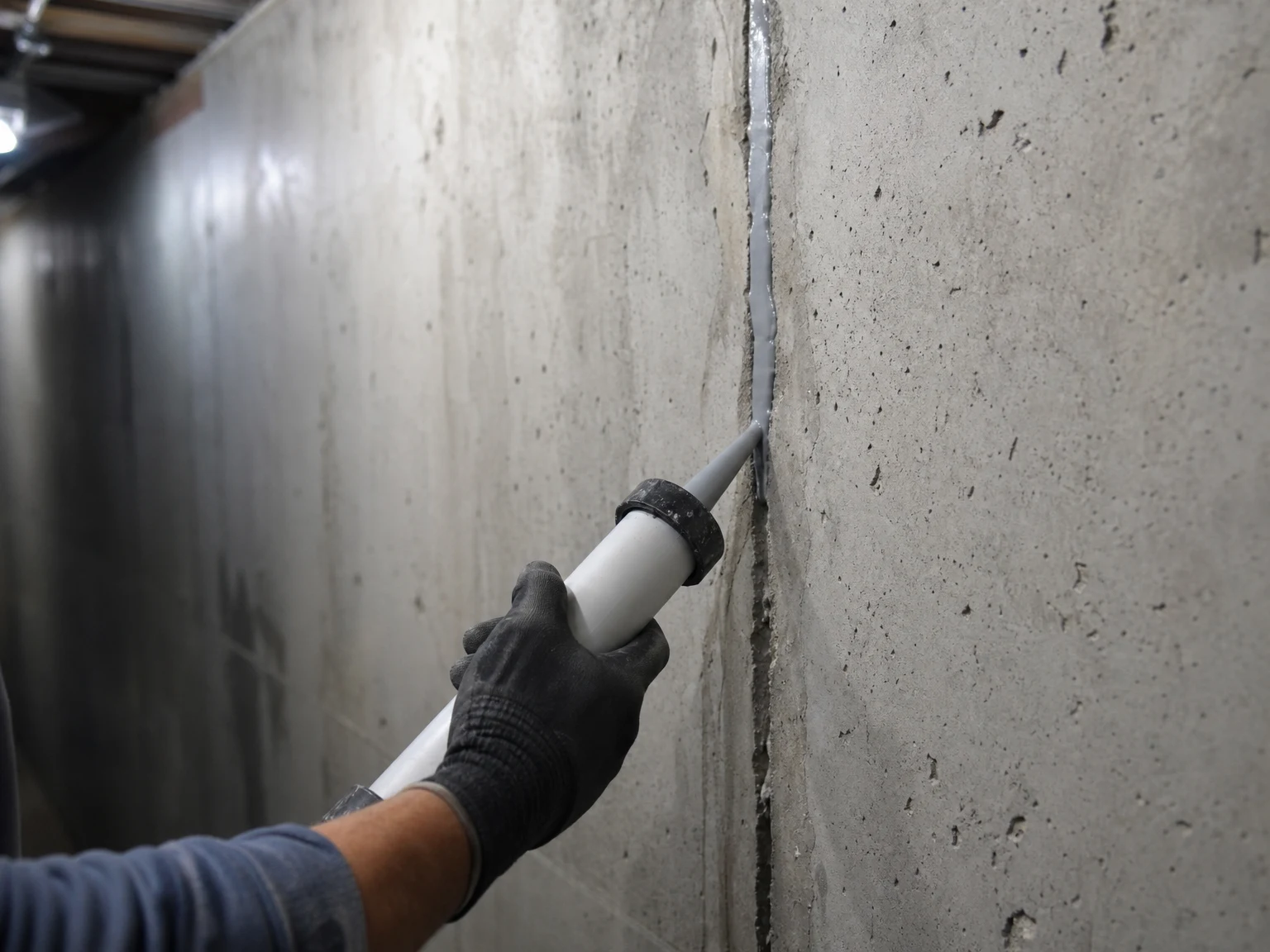
Interior sealant application — working from inside a basement or crawlspace — is far more common for remedial repairs since it doesn’t require excavation, but it only addresses the symptom at that specific joint and does nothing for the hydrostatic pressure building against the wall from outside. This is appropriate for isolated, confirmed non-structural cracks and pipe penetrations where full excavation isn’t justified by the scope of the problem.
Exterior application, which requires excavating down to the footing, allows sealant to be placed directly in the path of water before it ever reaches the wall, and is typically paired with a drainage board or membrane rather than sealant alone. This approach is reserved for cases where multiple joints are failing, a drainage or grading problem is driving water against the wall broadly, or an already-planned excavation (for a new drain tile, for example) makes exterior access practical anyway.
Foundation Sealant vs. Full Waterproofing: Quick Reference
| Question | Foundation Sealant | Foundation Waterproofing |
|---|---|---|
| What it addresses | Specific joints, cracks, penetrations | Hydrostatic pressure across the whole wall |
| Typical scope | A single seam or crack | Entire below-grade wall surface |
| Usually paired with | Nothing extra at that joint | Drainage board, membrane, drain tile |
| Fixes a wet basement alone? | Only if the cause is one isolated joint | Yes, if sized and installed correctly |
| Can one replace the other? | No — leaves broad seepage unaddressed | No — doesn’t target movement-prone joints |
Common Mistakes
Sealing a crack without identifying whether it’s structural is the most consequential mistake — a structural crack papered over with flexible sealant will keep moving, and the sealant will tear at the edges within a season or two, sometimes while masking a foundation problem that’s actually getting worse underneath. Assuming a few sealed cracks equal “the basement is waterproofed now” is the second most common error, when the real driver of ongoing moisture might be poor exterior grading, a disconnected downspout, or a failed drain tile that sealant at the wall can’t touch.
Using a rigid or acid-cure sealant at a joint designed to move, such as a vertical control joint, causes the sealant to crack and debond within one or two seasonal cycles — these joints need a sealant explicitly rated for the expected range of movement, not whatever caulk happens to be on hand. Skipping surface prep on concrete — not removing efflorescence, loose aggregate, or old failed sealant before reapplying — is another frequent cause of early adhesion failure, since none of these sealant chemistries bond reliably to a contaminated or friable concrete surface.
Frequently Asked Questions
Is foundation waterproofing sealant the same as foundation waterproofing?
No. Foundation waterproofing sealant addresses specific joints, cracks, and penetrations. Foundation waterproofing is a system-level treatment — membrane, coating, or drainage board — applied across the entire below-grade wall to manage hydrostatic pressure. Neither substitutes for the other.
Can sealant alone fix a leaking basement?
Only if the leak source is one isolated, confirmed non-structural joint or crack. If water is entering broadly across the wall due to hydrostatic pressure, poor grading, or a failed drainage system, sealant at individual cracks will not resolve the underlying cause.
How do I know if a foundation crack is structural?
Non-structural cracks are typically thin, stable in width, and show no vertical offset between the two sides. Cracks wider than roughly 1/8 inch, actively growing, or showing a stepped or displaced edge should be evaluated by a structural professional before any sealant is applied.
What sealant is best for the joint between the footing and foundation wall?
Polyurethane sealants are the most common choice for this cold joint due to their bond strength to concrete and moderate movement tolerance. For active seepage at this joint, a hydrophilic polyurethane injection resin, which expands on contact with water, is often used for remedial repairs.
Should foundation sealant be applied from inside or outside the wall?
Interior application is more common for isolated repairs since it avoids excavation, but it only treats the symptom at that joint. Exterior application, done during excavation, addresses water before it reaches the wall and is typically paired with a drainage board or membrane rather than sealant alone.
Need Help Choosing a Sealant?
Tell us your materials and application requirements.
SEND AN INQUIRY English
 العربية
 Español de México
 Русский
 Tiếng Việt
 Português do Brasil
 Bahasa Indonesia
 Türkçe