

Table of Contents
Most conduit connections rely on a liquid-tight connector or a threaded coupling to keep water out — a mechanical seal, not a chemical one. Electrical conduit sealant enters the picture only at a specific set of joints where mechanical fittings alone can’t guarantee a seal: penetrations through exterior walls or roof decks, connections into hazardous-location enclosures, and underground conduit runs where sustained water and soil contact exceeds what a standard fitting gasket was designed for. Treating every conduit joint as a sealant application, or assuming a liquid-tight connector needs no sealant backup at all, both lead to real failures — one wastes material and labor, the other leaves a water path straight into a panel or junction box.
Mechanical Seal vs. Chemical Seal: Knowing Which One You Have
A liquid-tight connector or a threaded rigid conduit coupling achieves its seal through compression — a gasket, an O-ring, or threaded engagement that mechanically excludes water without any applied sealant. This works reliably for the vast majority of exposed conduit runs, both indoors and outdoors, and adding sealant on top of a correctly installed mechanical fitting is redundant at best and, with the wrong sealant chemistry, can actually degrade the fitting’s own gasket material over time.
Sealant becomes necessary where the mechanical fitting’s design limit is exceeded or where no fitting exists at all — a conduit cored directly through a concrete wall with no sleeve, a cable entry into an enclosure through a hole that wasn’t sized for a proper fitting, or a penetration where code requires an additional sealed barrier beyond the connector itself. The sealant is doing a job the fitting wasn’t designed to do, not duplicating one it already does well.
Where Conduit Sealant Actually Belongs
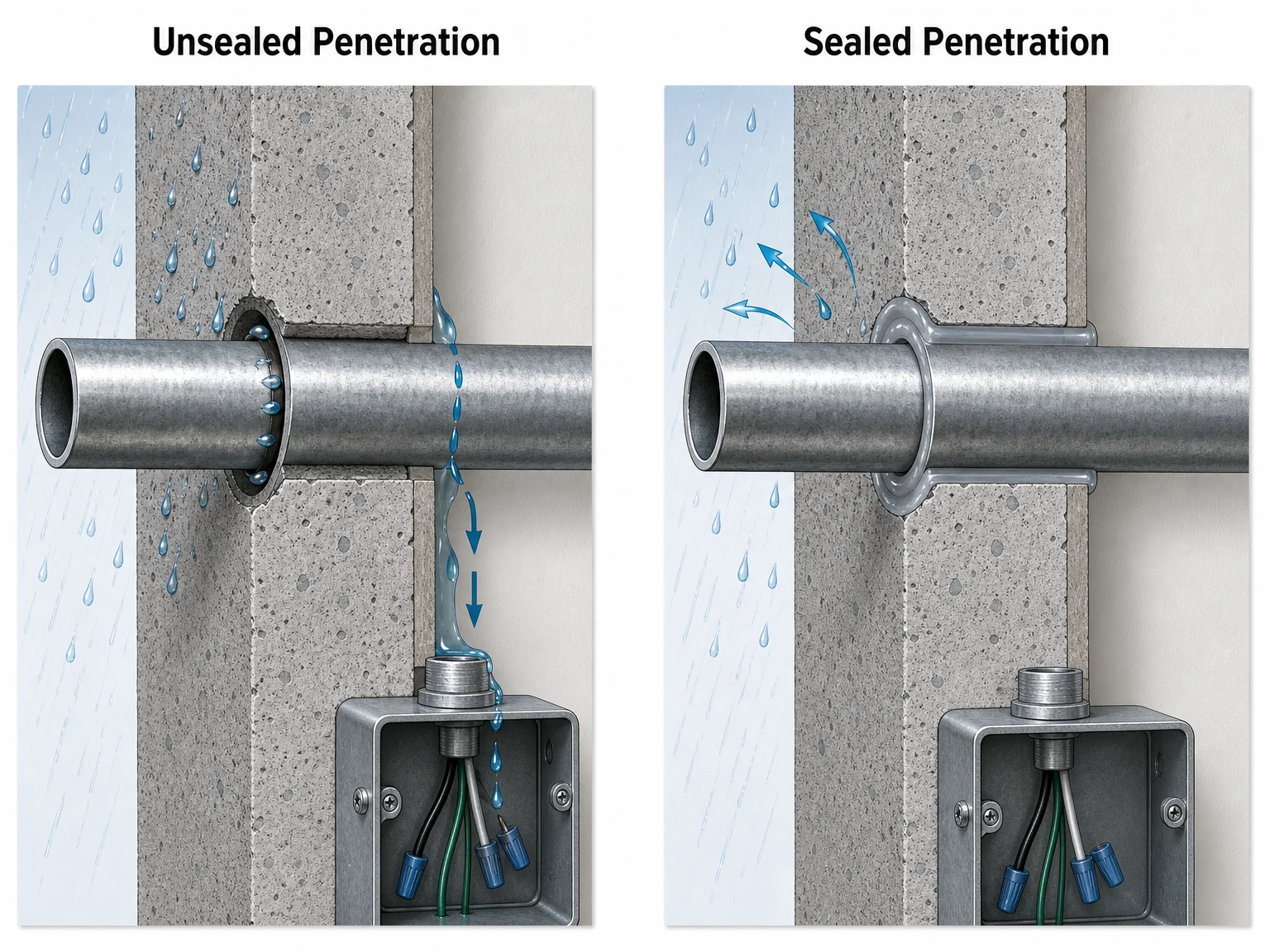
Exterior wall and roof penetrations are the most common legitimate application — wherever a conduit passes through an exterior envelope, the annular gap between the conduit and the core-drilled or formed opening needs sealant to stop water tracking along the conduit’s outer surface into the building interior, especially on vertical runs where water can run down the conduit length and pool at the penetration.
Hazardous-location and explosion-proof installations have their own sealing requirement separate from general weatherproofing — conduit seals (often called “EYS” or “EZS” fittings depending on orientation) filled with a specific sealing compound are mandated by code to prevent the passage of gases, vapors, or flames between electrical enclosures in classified areas. This isn’t a general-purpose sealant choice; the compound must be the one specified for that fitting type and listed for the hazardous classification involved, and substituting a generic conduit sealant here is a code violation, not just a quality shortcut.
Underground and direct-burial conduit runs see continuous soil moisture contact at every coupling and fitting, conditions well beyond what an exposed-run liquid-tight connector was tested for. Below-grade joints typically need a sealant rated for continuous submersion rather than splash or weather exposure, since intermittent exposure assumptions built into standard weatherproof connectors don’t hold underground.
Material Compatibility: What the Sealant Touches Matters
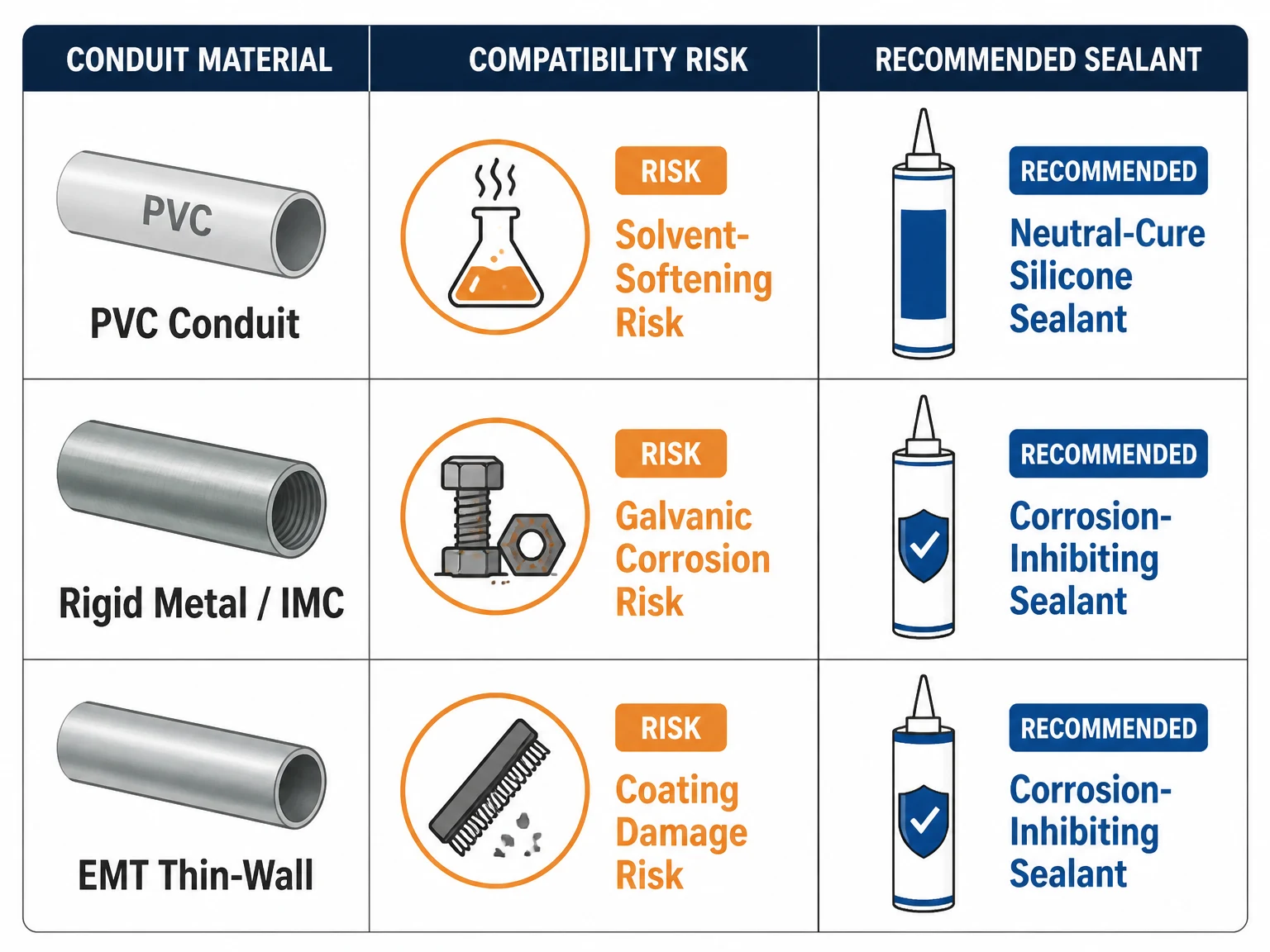
Conduit material changes which sealant chemistry is actually appropriate. PVC conduit can be attacked by some solvent-based sealants that soften or craze the plastic at the joint — a sealant explicitly compatible with PVC, typically a neutral-cure silicone or a PVC-safe polyurethane, avoids this. Rigid metal conduit (RMC) and intermediate metal conduit (IMC) need a sealant that won’t accelerate galvanic corrosion at the joint, particularly where dissimilar metals meet, such as a steel conduit entering an aluminum enclosure. EMT (electrical metallic tubing), the thinnest-walled and least corrosion-resistant of the common conduit types, benefits from a sealant that also offers some corrosion inhibition at the cut or threaded edge, since EMT’s thin galvanized coating is easily compromised during installation.
Beyond the conduit itself, the sealant frequently contacts the enclosure gasket material and sometimes the cable jacket insulation passing through the same penetration. A sealant that’s compatible with the conduit but incompatible with a neoprene gasket or a PVC cable jacket can cause one of those materials to degrade even while the primary conduit seal holds — checking compatibility against every material at the joint, not just the conduit, avoids a seal that looks successful until the gasket fails months later.
Conduit Sealant vs. Liquid-Tight Connector: Quick Reference
| Question | Liquid-Tight Connector | Conduit Sealant |
|---|---|---|
| How it seals | Mechanical compression (gasket/O-ring) | Chemical bond filling a gap |
| Typical use | Standard exposed conduit runs | Wall penetrations, hazardous locations, underground |
| Needs sealant backup? | No, if correctly installed | N/A — sealant is the seal itself |
| Code-mandated in some cases? | Rarely a code requirement alone | Yes, for hazardous-location conduit seals |
| Can one replace the other? | No — doesn’t seal unfitted penetrations | No — doesn’t replace a required mechanical fitting |
Application Notes
Surface prep on conduit is often skipped because the surface looks clean, but galvanized coating, PVC mold-release residue, and construction dust all reduce adhesion even when invisible. Wipe the conduit and the surrounding penetration surface with isopropyl alcohol before applying sealant, and confirm the conduit is fully seated in its opening rather than sealing around a gap that’s still shifting during the pour or installation.
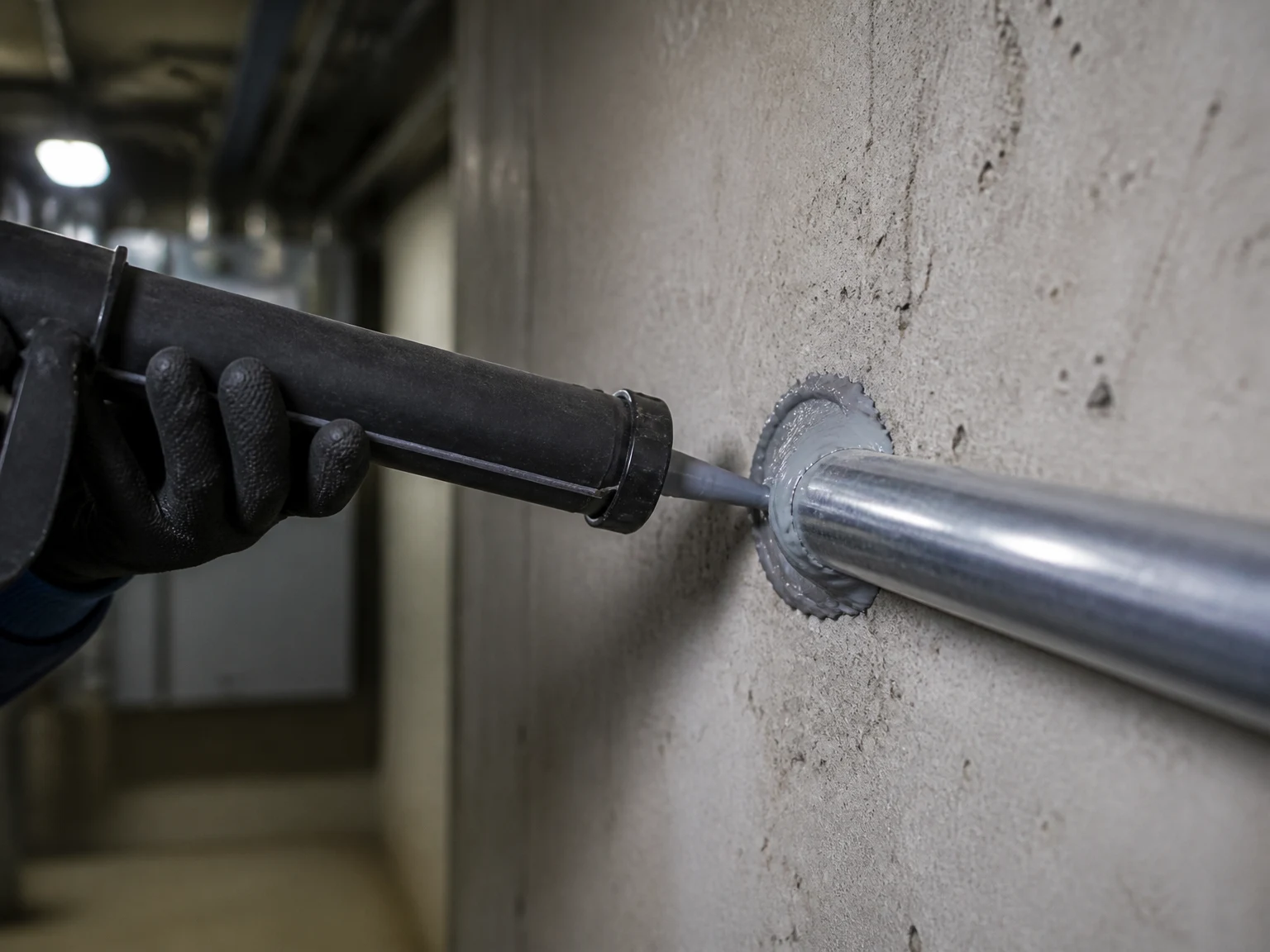
Apply sealant to fill the full depth of the annular gap, not just a surface skim coat across the opening — a thin surface bead looks finished but leaves a hollow channel behind it where water can still track along the conduit. For penetrations expected to see any conduit movement from thermal expansion or building settlement, choose a sealant rated for that movement rather than a rigid, non-flexible compound that will crack at the interface.
Common Mistakes
Using a generic caulk instead of a listed sealing compound at a hazardous-location conduit seal is both a code violation and a real safety risk — these fittings exist specifically to block flame and gas propagation between enclosures, and an unlisted substitute undermines that function even if it looks watertight. Assuming a liquid-tight connector needs sealant reinforcement “just in case” wastes time and can introduce chemical incompatibility with the connector’s own gasket, while skipping sealant at an actual unfitted penetration — a cored wall opening with no proper sleeve — leaves a direct water path that often isn’t discovered until water damage shows up inside the wall or enclosure.
Frequently Asked Questions
Do all conduit connections need sealant?
No. Most exposed conduit runs rely on liquid-tight connectors or threaded couplings for a mechanical seal and don’t need additional sealant. Sealant is needed at wall and roof penetrations without a proper fitting, hazardous-location conduit seals, and underground runs exposed to continuous soil moisture.
Can I use regular silicone caulk on PVC conduit?
Some solvent-based sealants can soften or craze PVC at the joint. Use a sealant explicitly labeled compatible with PVC, typically a neutral-cure silicone or a PVC-safe polyurethane formulation, to avoid damaging the conduit.
What is a hazardous-location conduit seal and does it need special sealant?
A hazardous-location conduit seal (often an EYS or EZS fitting) is code-mandated in classified hazardous areas to block the passage of gases, vapors, or flames between enclosures. It requires a specific listed sealing compound for that fitting and classification — a generic conduit sealant is not an acceptable substitute.
Does underground conduit need a different sealant than above-ground conduit?
Yes. Underground joints face continuous soil moisture contact, conditions beyond what standard weatherproof connectors are tested for. Below-grade conduit sealant should be rated for continuous submersion rather than intermittent weather exposure.
Why did my conduit seal fail even though the sealant looked properly applied?
A thin surface skim coat over the penetration can look complete while leaving a hollow channel behind it along the conduit, letting water track in from the side. Fill the full depth of the annular gap, and confirm the sealant is compatible with every material it contacts, including enclosure gaskets and cable jackets, not just the conduit itself.
Need Help Choosing a Sealant?
Tell us your materials and application requirements.
SEND AN INQUIRY English
 العربية
 Español de México
 Русский
 Tiếng Việt
 Português do Brasil
 Bahasa Indonesia
 Türkçe