

Table of Contents
- 1. Why Pool Environments Degrade Sealant Faster Than Expected
- 2. Matching Sealant Chemistry to the Joint Type
- 3. UV and Freeze-Thaw: The Two Stresses Compounding Chemical Exposure
- 4. Application Best Practices
- 5. Common Pool Sealant Mistakes
- 6. Frequently Asked Questions
- 7. Fiberglass and Vinyl-Lined Pools: A Different Set of Joints
- 8. Choosing the Right Sealant for Your Pool Project
A pool deck expansion joint sealed with the wrong material doesn’t just look bad when it fails — it lets water, pool chemicals, and freeze-thaw cycling attack the structural joint underneath, turning a sealant problem into a concrete repair problem. Pool sealant has to survive a combination of stresses that most general-purpose sealants were never tested for: constant chlorine or salt exposure, UV load, and in many climates, repeated freezing and thawing. This guide covers what actually determines pool sealant performance and where selection most commonly goes wrong.
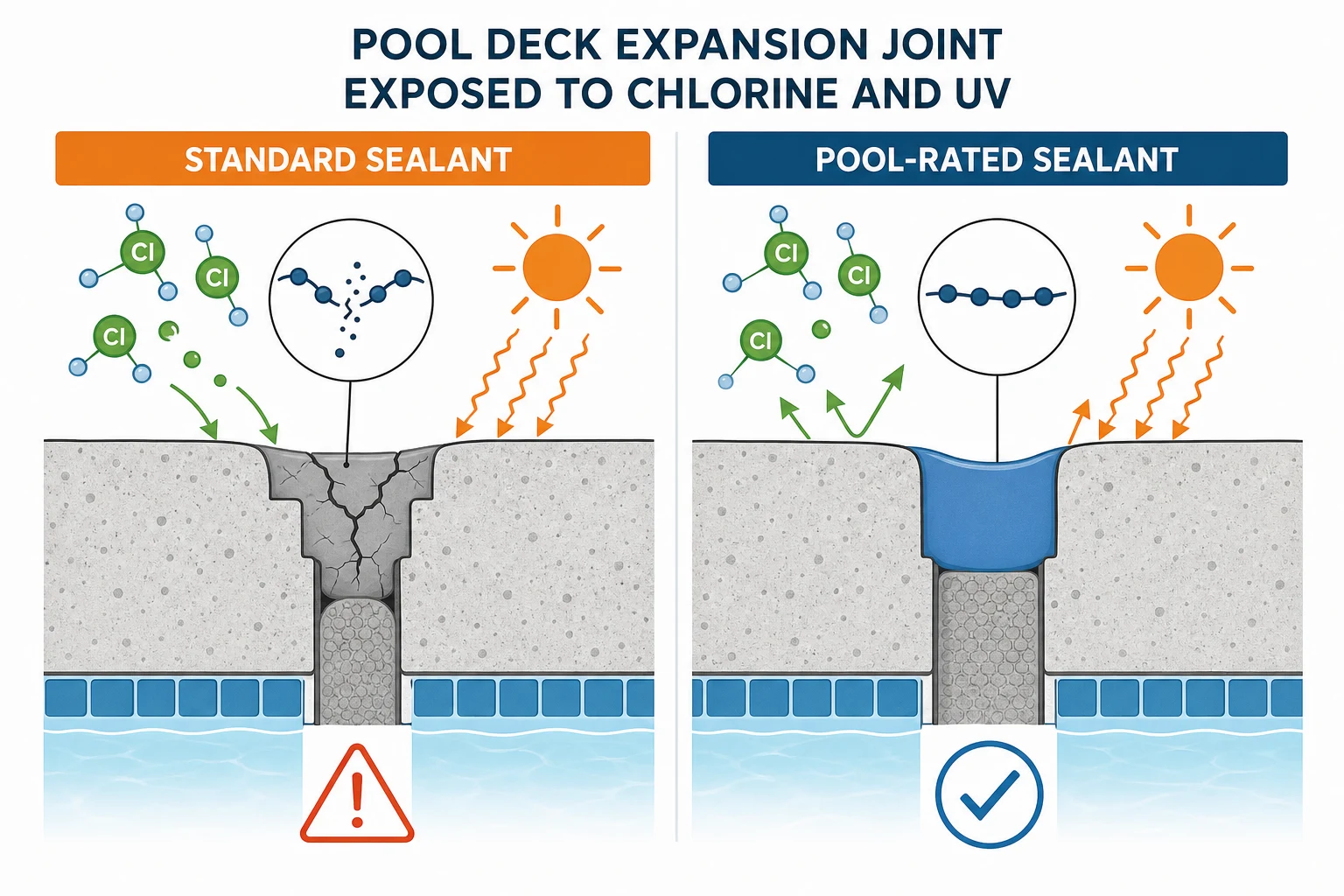
Why Pool Environments Degrade Sealant Faster Than Expected
Chlorine and bromine sanitizers, along with the pH-balancing chemicals used to maintain pool water, are more chemically aggressive to many standard sealant formulations than typical outdoor weathering alone. Sealants not specifically rated for chemical resistance can degrade, discolor, or lose adhesion faster around a pool than the same product would in a non-chemical outdoor application, even when both locations see similar sun and temperature exposure.
Saltwater pools add a second variable: the dissolved salt used in salt chlorination systems is corrosive to many metals and can also affect certain sealant formulations differently than chlorinated fresh water. A sealant rated for standard chlorinated pools isn’t automatically validated for a saltwater system, and that distinction matters more as salt systems have become more common in residential pools.
Matching Sealant Chemistry to the Joint Type
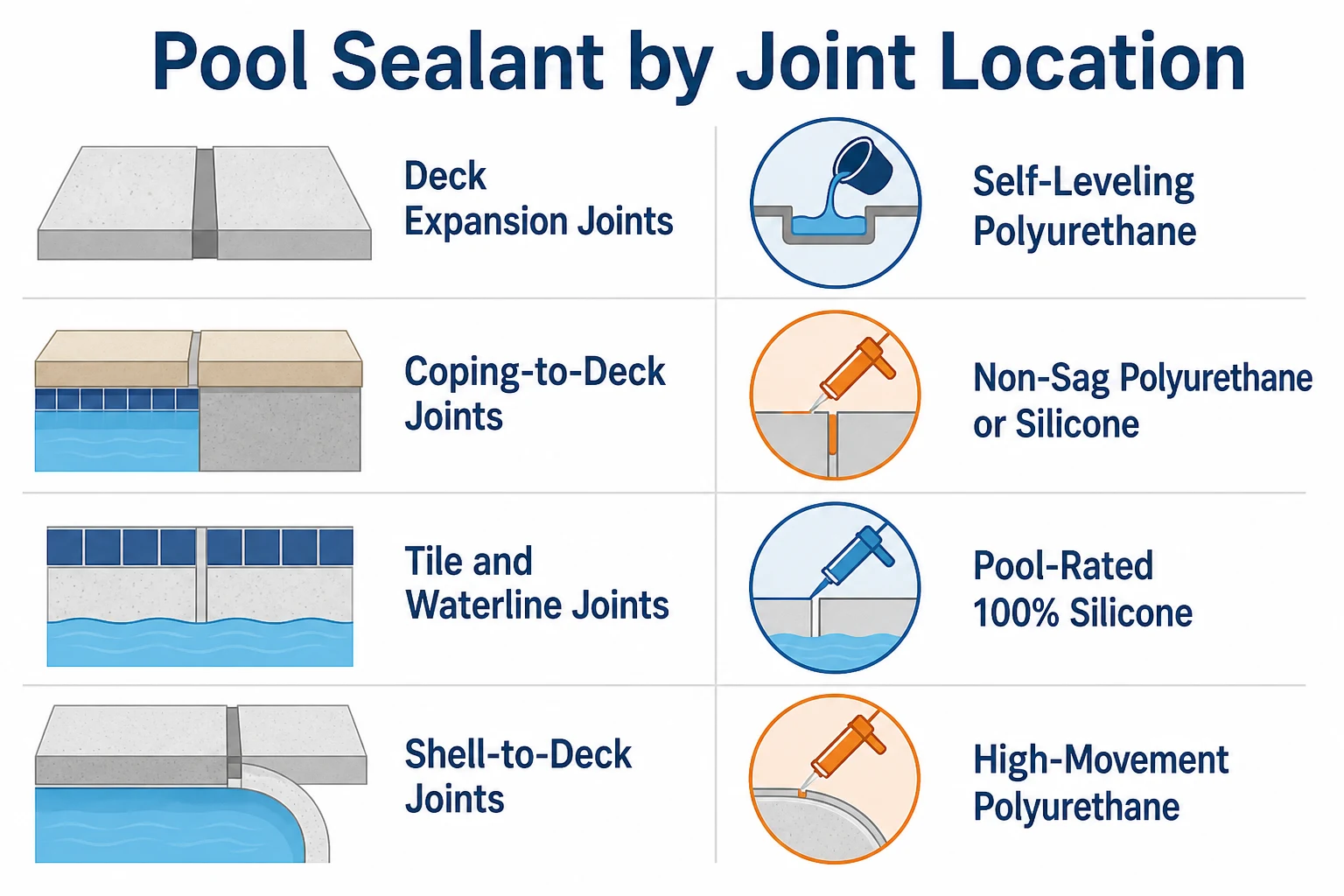
| Joint Location | Typical Sealant Approach | Key Consideration |
|---|---|---|
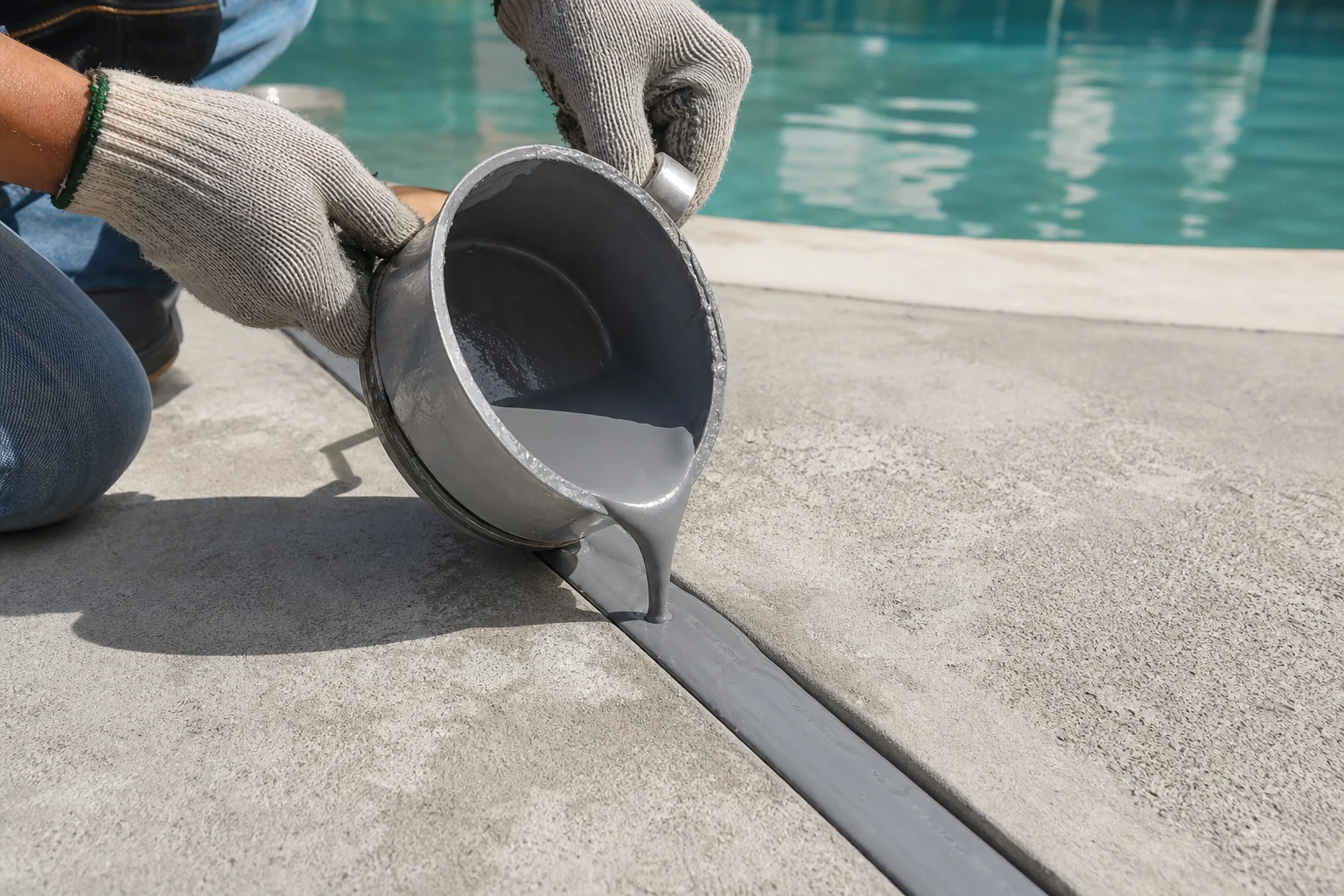
| Pool deck expansion joints | Self-leveling polyurethane sealant | Must handle foot traffic and horizontal joint movement without tearing |
| Coping-to-deck joints | Non-sag polyurethane or silicone | Vertical joint face needs a non-sag formulation to avoid slumping during cure |
| Tile and waterline joints | 100% silicone, pool-rated | Constant water immersion requires a formulation specifically tested for sustained submersion |
| Shell-to-deck or structural movement joints | High-movement-capability polyurethane | Must accommodate larger structural movement than a standard control joint |
UV and Freeze-Thaw: The Two Stresses Compounding Chemical Exposure
Pool sealant rarely fails from a single stress in isolation — it’s usually the combination of chemical exposure, UV degradation, and (in applicable climates) freeze-thaw cycling acting together that shortens service life below what any single-stress rating would suggest.
- UV exposure on an uncovered deck or waterline joint can degrade sealant elasticity over time even in a product with good chemical resistance, so UV stability needs to be verified as a separate spec rather than assumed from chemical resistance alone.
- Freeze-thaw cycling in climates with winter freezing puts repeated expansion and contraction stress on joints that stay wet or damp near the pool, which can accelerate sealant fatigue compared to a dry joint experiencing the same temperature swings.
- Standing water contact at waterline and tile joints is a more demanding condition than splash or spray exposure, and not every “water-resistant” sealant is rated for sustained submersion the way a pool-specific product is tested to be.
Application Best Practices
- Confirm chemical compatibility with the specific sanitation system — chlorine, bromine, and saltwater chlorination can have different compatibility profiles with a given sealant, and the product documentation should confirm compatibility with the actual system in use.
- Clean and prime per the manufacturer’s substrate-specific instructions. Pool decks and coping are frequently concrete, natural stone, or tile, each with different priming requirements for reliable adhesion.
- Size the joint and backer rod correctly for the expected movement, following the same hourglass bond-breaker principle used in other expansion joint sealing, so the sealant can stretch and compress without tearing.
- Allow full cure before pool chemical exposure where possible — curing a sealant while it’s already in frequent contact with sanitizing chemicals can compromise the final cured properties compared to curing in a drier initial period.
- Inspect waterline and expansion joints seasonally, especially after winter in freeze-thaw climates, since early-stage cracking or debonding is far easier and cheaper to address than a fully failed joint that has allowed water intrusion.
Common Pool Sealant Mistakes
- Using a general-purpose exterior sealant without verifying chemical resistance to the specific pool sanitation system.
- Applying a standard sealant on a saltwater pool without confirming compatibility with salt chlorination specifically, not just chlorine in general.
- Skipping backer rod and proper joint sizing, resulting in a sealant bead that tears under normal deck movement.
- Ignoring UV rating on an uncovered deck joint that will see years of direct sun exposure.
- Delaying maintenance inspection until a leak or visible failure appears, rather than catching early cracking during routine seasonal checks.
- Resealing over old, degraded sealant without fully removing the previous bead — new sealant generally doesn’t bond reliably to old cured sealant residue, regardless of chemistry, so a reseal performed over remnants of the prior joint is prone to early repeat failure.
Frequently Asked Questions
Is silicone or polyurethane better for pool deck joints?
It depends on the joint location and movement. Self-leveling polyurethane is typically used for horizontal deck expansion joints that see foot traffic, while 100% silicone rated for pool use is often preferred for tile and waterline joints with sustained water contact. Neither is universally “better” — the joint’s location, movement, and exposure determine the appropriate choice.
Does saltwater require a different sealant than a chlorinated pool?
Not always, but compatibility should be confirmed specifically rather than assumed. Some sealants are tested and rated for both chlorinated and saltwater systems, while others are validated for one but not explicitly tested against the other. Check the product documentation for the specific sanitation system in use.
How often should pool deck sealant joints be inspected?
A seasonal inspection, particularly after winter in climates with freeze-thaw cycling, is a reasonable baseline for catching early cracking or debonding before it progresses to a full joint failure that allows water intrusion into the structural joint beneath.
Fiberglass and Vinyl-Lined Pools: A Different Set of Joints
Concrete and gunite pools aren’t the only type on the market, and fiberglass or vinyl-lined pools present a different set of sealing requirements around their specific transition points.
Fiberglass pool shells typically need sealant at the shell-to-deck transition, where the rigid fiberglass shell meets the surrounding deck material and the two surfaces can move independently under thermal and structural loads. Vinyl-lined pools have their own set of transition points, usually at the top rail and coping where the liner track meets the deck, and the sealant there needs to accommodate the liner’s own movement without compromising the water-tight seal at the track. In both cases, the sealant choice should be confirmed against the specific pool manufacturer’s installation guidance, since shell and liner warranties can be affected by using an incompatible sealant at these transition points.
Choosing the Right Sealant for Your Pool Project
Match the sealant chemistry to the specific joint location and movement requirement, confirm chemical compatibility with the actual sanitation system (chlorine, bromine, or saltwater) rather than assuming general pool-rated coverage, and verify UV and freeze-thaw performance separately from chemical resistance. Pool deck and waterline joints endure a more demanding combination of stresses than most other sealant applications on a property, so treating pool sealant selection as a specialized decision — rather than extending whatever sealant is already on hand from another project — pays off directly in joint service life. For broader sealant selection criteria beyond pool-specific applications, our Precast Concrete Joint Sealant Guide covers related expansion joint design principles.
Explore Joobond’s Silicone Sealant and Polyurethane Sealant ranges for formulations suited to chemical-resistant, long-term joint sealing applications.
Keyword research source: SeoTools8 (Semrush-backed), US database, desktop, 2026-10-11. Seed “pool sealant” — Volume 480/mo, KD 5%.
 English
  العربية
  Español de México
  Русский
  Tiếng Việt
  Português do Brasil
  Bahasa Indonesia
  Türkçe