

Table of Contents
Most published explanations of sealant versus adhesive stop at a dictionary-style definition: one bonds, one seals. That’s true, but it doesn’t tell a buyer what to actually do when a joint needs both strength and movement tolerance, or when a technical data sheet lists a product as “adhesive sealant” and offers no further guidance. The real decision hinges on what the joint needs to survive over its service life — not on which word appears on the label.
The Core Difference: What Each Product Is Optimized For
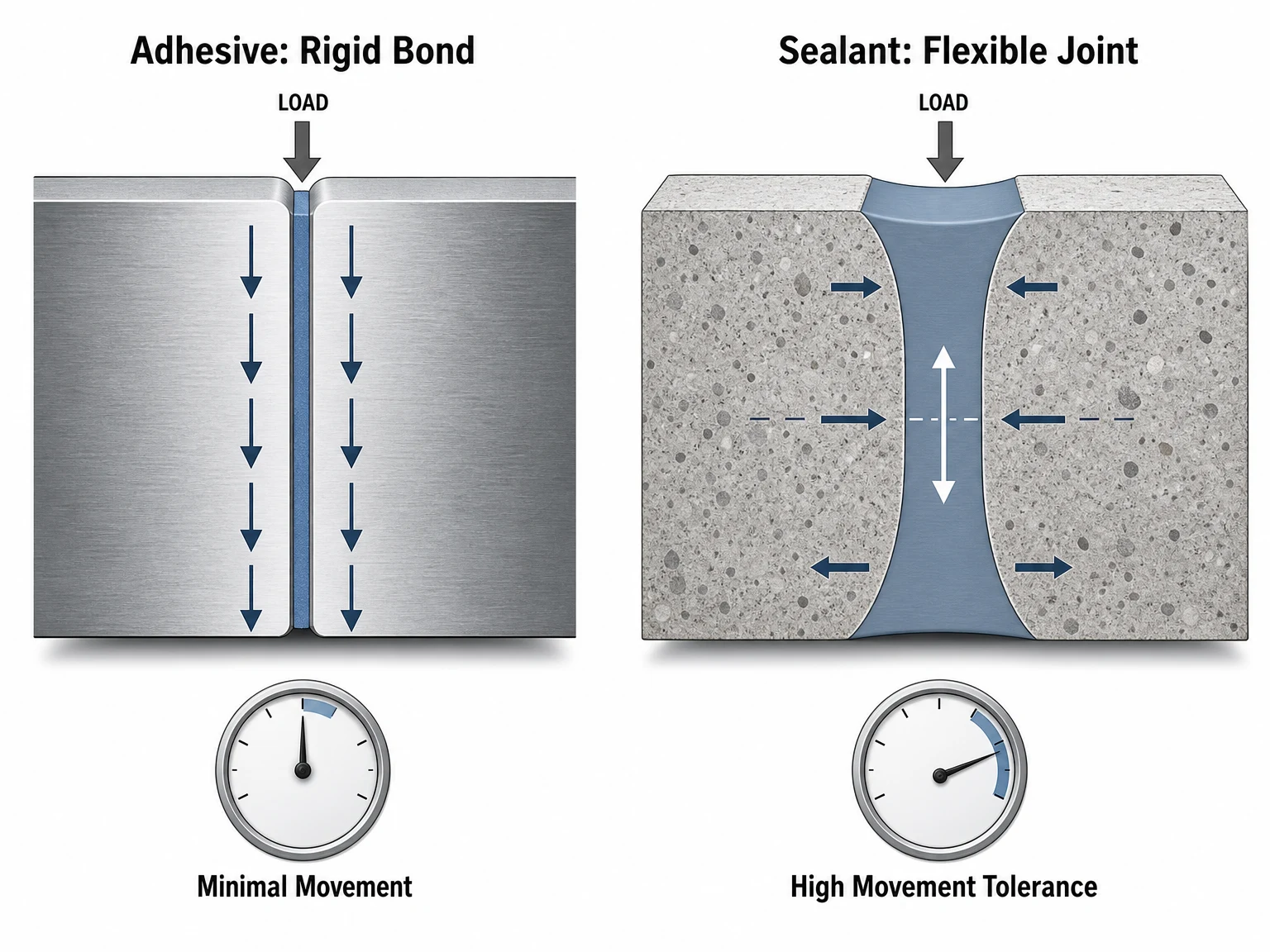
Adhesives are formulated to maximize bond strength while minimizing deformation under load. Their job is to transfer stress between two substrates so the assembly behaves as a single structural unit — a bonded panel, a laminated beam, a structural glazing joint. A good structural adhesive resists creep, meaning it won’t slowly deform under sustained load the way a flexible sealant would.
Sealants are formulated for the opposite priority: they’re designed to remain flexible enough to accommodate ongoing joint movement — thermal expansion, building settlement, vibration — without tearing or losing adhesion at either face. A sealant that behaves like a structural adhesive, rigid and creep-resistant, will crack at a moving joint within one seasonal cycle, because it has no capacity to stretch and recover. This is the mechanical trade-off neither FEICA’s industry overview nor most manufacturer blogs spell out: strength and movement capability pull in opposite directions, and a single formulation rarely excels at both.
A Decision Framework: Four Questions to Ask
Rather than starting from chemistry (silicone, polyurethane, epoxy), start from what the joint actually has to do. These four questions, answered in order, point to the correct product category before chemistry selection even begins.
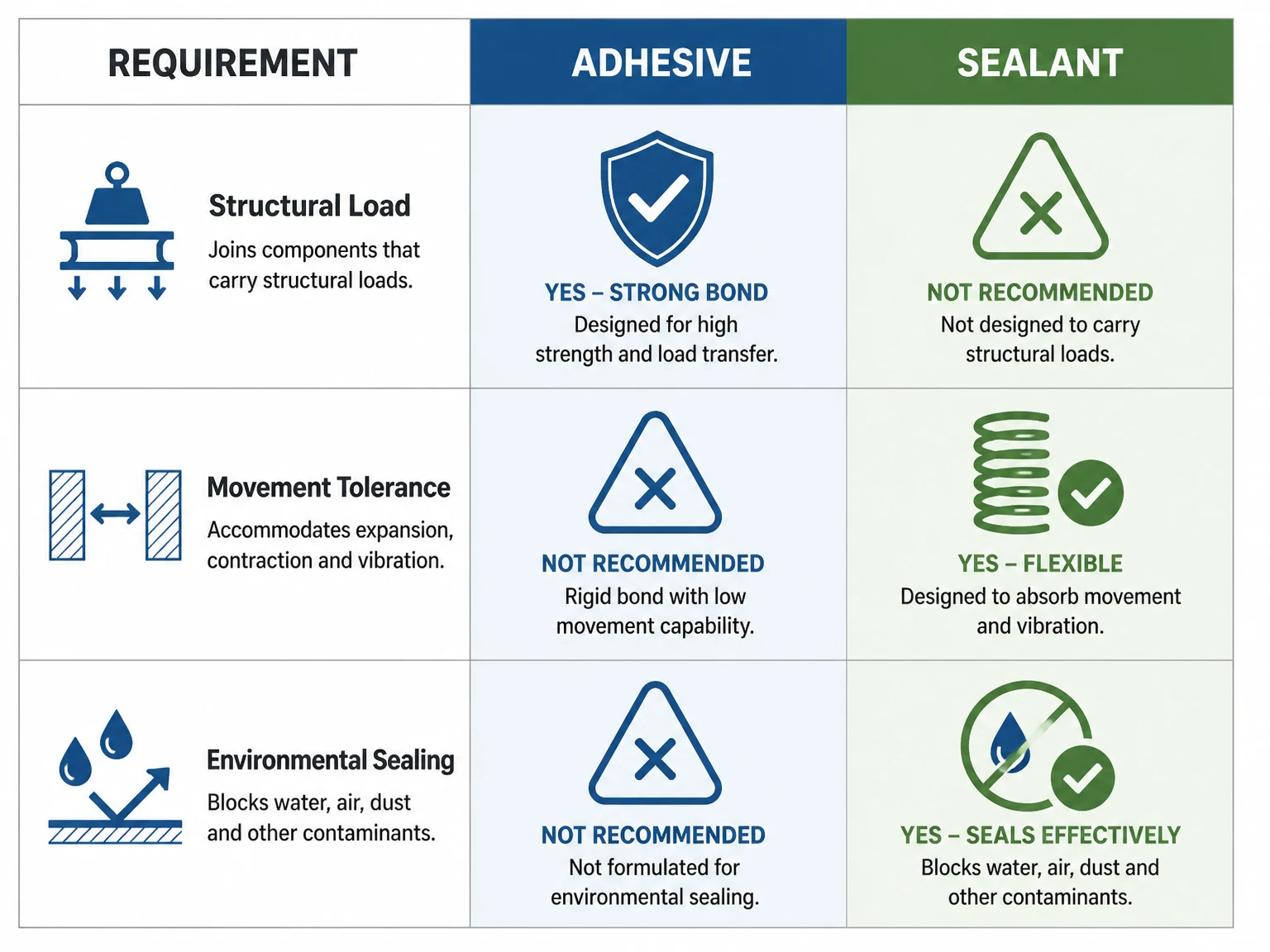
- Does the joint need to carry structural load? If the assembly depends on this bond to hold weight or resist shear force, that’s adhesive territory. Sealants are not rated for structural load transfer, and using one there risks progressive joint failure under sustained stress.
- Does the joint need to move? If the two substrates expand, contract, vibrate, or shift relative to each other during normal use, the product needs elongation and recovery — that’s sealant territory. A rigid adhesive at a moving joint transfers stress directly to the substrate or the bond line, and something eventually gives.
- Does the joint need to exclude water, air, or gas? This is explicitly a sealant function. Adhesives are not formulated or tested for long-term environmental exclusion, even when they happen to fill a gap completely.
- Is reversibility or future serviceability required? Some sealants are chosen partly because they can be cut out and reapplied for maintenance access; structural adhesives are generally intended as permanent bonds and are far harder to remove without damaging the substrate.
A joint that needs both structural bonding and environmental sealing — a common situation in curtain wall glazing or vehicle body panel work — typically needs two separate products applied in sequence, not one product doing both jobs by default.
Where “Adhesive Sealant” Products Actually Fit
Product lines labeled “adhesive sealant” aren’t a loophole around the distinction above — they’re a defined middle category with real trade-offs, not a universal substitute for either pure adhesives or pure sealants. MS polymer (silane-modified polymer) formulations and many polyurethane hybrids are built to provide meaningful bond strength while retaining enough flexibility to tolerate moderate joint movement, which is genuinely useful for applications like panel bonding, window and door installation, or automotive trim attachment where some structural contribution and some movement tolerance are both present.
The trade-off is real: an adhesive-sealant hybrid won’t match a dedicated structural adhesive’s peak bond strength, and it won’t match a dedicated movement-rated sealant’s elongation ceiling. For a joint with mild requirements on both fronts, that compromise is the right answer. For a joint with a demanding requirement on either axis — genuine structural load-bearing, or a wide expansion joint with large seasonal movement — a dedicated single-purpose product outperforms the hybrid, and substituting the hybrid there is a common and avoidable failure mode.
Misuse Patterns and Their Consequences
Using structural epoxy at a joint that needs to move is one of the most common and costly mistakes in the field. The bond itself may hold, but the rigid cured epoxy transfers the full movement stress into the substrate instead of absorbing it, and the surrounding material — concrete, masonry, metal panel — cracks or deforms at the joint edge over one or two seasonal cycles. The failure often gets misdiagnosed as a substrate problem when the actual cause was product selection.
The reverse mistake, using a flexible sealant where structural bonding is required, shows up as slow joint creep under sustained load — the assembly gradually shifts out of alignment rather than failing suddenly, which can delay detection until the misalignment has already caused secondary damage elsewhere in the structure. Neither failure mode is really about product quality; both come from matching the wrong category of product to the joint’s actual mechanical requirement.

Sealant vs. Adhesive: Quick Reference
| Requirement | Adhesive | Sealant | Adhesive-Sealant Hybrid |
|---|---|---|---|
| Primary function | Structural bonding | Gap/joint sealing | Moderate bonding + moderate sealing |
| Movement tolerance | Low — resists creep | High — designed to flex | Moderate |
| Environmental exclusion | Not rated for this | Primary purpose | Good |
| Best for | Load-bearing joints, panel bonding | Expansion joints, weatherproofing | Window/door install, trim, mild-duty panels |
| Common failure if misused | Cracks substrate at moving joints | Fails under sustained structural load | Underperforms at extreme ends of either requirement |
Frequently Asked Questions
What is the actual difference between a sealant and an adhesive?
Adhesives are formulated to maximize bond strength and resist deformation under sustained load, making them suitable for structural bonding. Sealants are formulated to stay flexible and accommodate ongoing joint movement while excluding water, air, or gas. The two priorities work against each other, so a single formulation rarely performs both roles equally well.
Can I use a sealant as an adhesive, or vice versa?
Not reliably for demanding applications. A sealant used at a structural joint tends to creep under sustained load; a rigid adhesive used at a moving joint tends to crack the substrate within one or two seasonal cycles. For joints with mild requirements on both fronts, a dedicated adhesive-sealant hybrid product is a better choice than substituting one category for the other.
What is an adhesive sealant and when should I use one?
Adhesive sealants, often MS polymer or hybrid polyurethane formulations, provide moderate bond strength with moderate flexibility. They suit applications like panel bonding, window and door installation, or trim attachment where some structural contribution and some movement tolerance are both needed, but they underperform dedicated products at the extremes of either requirement.
How do I know if my joint needs to move?
Any joint between materials with different thermal expansion rates, any joint exposed to seasonal temperature swings, and any joint near a vibration source should be assumed to require movement tolerance unless a structural engineer has specified otherwise. Expansion and control joints in concrete, exterior building envelope joints, and automotive panel seams are typical examples.
Why did my structural adhesive joint crack even though the bond held?
This is a common sign that the joint actually needed to move and a rigid, structural-grade product was applied there instead of a flexible sealant. The adhesive bond itself may remain intact while the surrounding substrate cracks under the transferred movement stress — the fix is replacing the product category, not just reapplying the same adhesive.
Need Help Choosing a Sealant?
Tell us your materials and application requirements.
SEND AN INQUIRY English
 العربية
 Español de México
 Русский
 Tiếng Việt
 Português do Brasil
 Bahasa Indonesia
 Türkçe