

Table of Contents
- 1. How Underwater-Curing Epoxy Actually Works
- 2. Where Underwater Epoxy Repair Is (and Isn’t) Appropriate
- 3. Surface Preparation: The Step Most Often Done Wrong
- 4. Application Methods for Submerged Repairs
- 5. Verification Data to Request From a Supplier
- 6. Common Mistakes in Underwater Epoxy Repair Projects
- 7. Conclusion: Match the Chemistry and the Process to the Site Conditions
Bridge piers, dam faces, dock pilings, and submerged pipelines all share the same maintenance challenge: the concrete or steel that needs repair is permanently or seasonally underwater, and dewatering the structure for a conventional repair is often prohibitively expensive or simply not possible. Underwater epoxy repair systems exist specifically to solve this problem — but they only work when the chemistry, surface preparation, and application method are matched correctly to a submerged environment. This guide covers how underwater-curing epoxy actually works, where it is and is not appropriate, and what to verify before specifying a product for a live underwater repair.
How Underwater-Curing Epoxy Actually Works
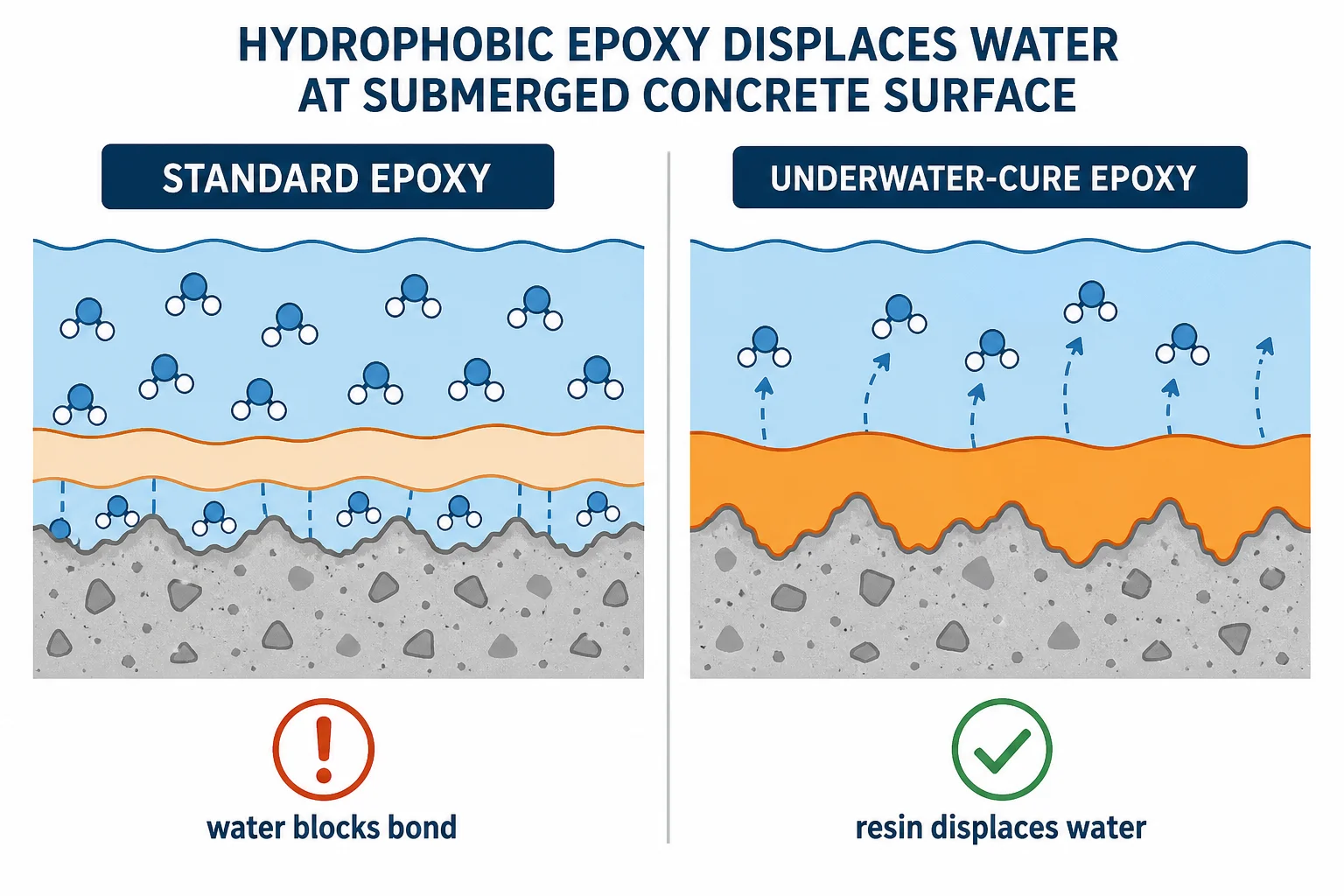
Standard epoxy formulations rely on evaporation of surface moisture and often lose adhesion when applied to a wet or submerged substrate — water at the bond line interferes with the resin-hardener reaction and prevents proper wet-out on the substrate. Underwater epoxy repair systems are formulated differently in two key ways:
- Hydrophobic resin chemistry that physically displaces water at the point of contact rather than being blocked by it, allowing the epoxy to wet out and bond to a genuinely submerged surface.
- Water-tolerant curing agents that complete the cross-linking reaction in the presence of moisture, rather than requiring a dry cure environment the way general-purpose epoxies do.
This is why a standard structural epoxy — even a high-strength one rated for industrial bonding on dry substrates — will typically fail or never fully cure when applied underwater; the chemistry itself needs to be engineered for the wet environment, not just tolerant of humidity.
Where Underwater Epoxy Repair Is (and Isn’t) Appropriate
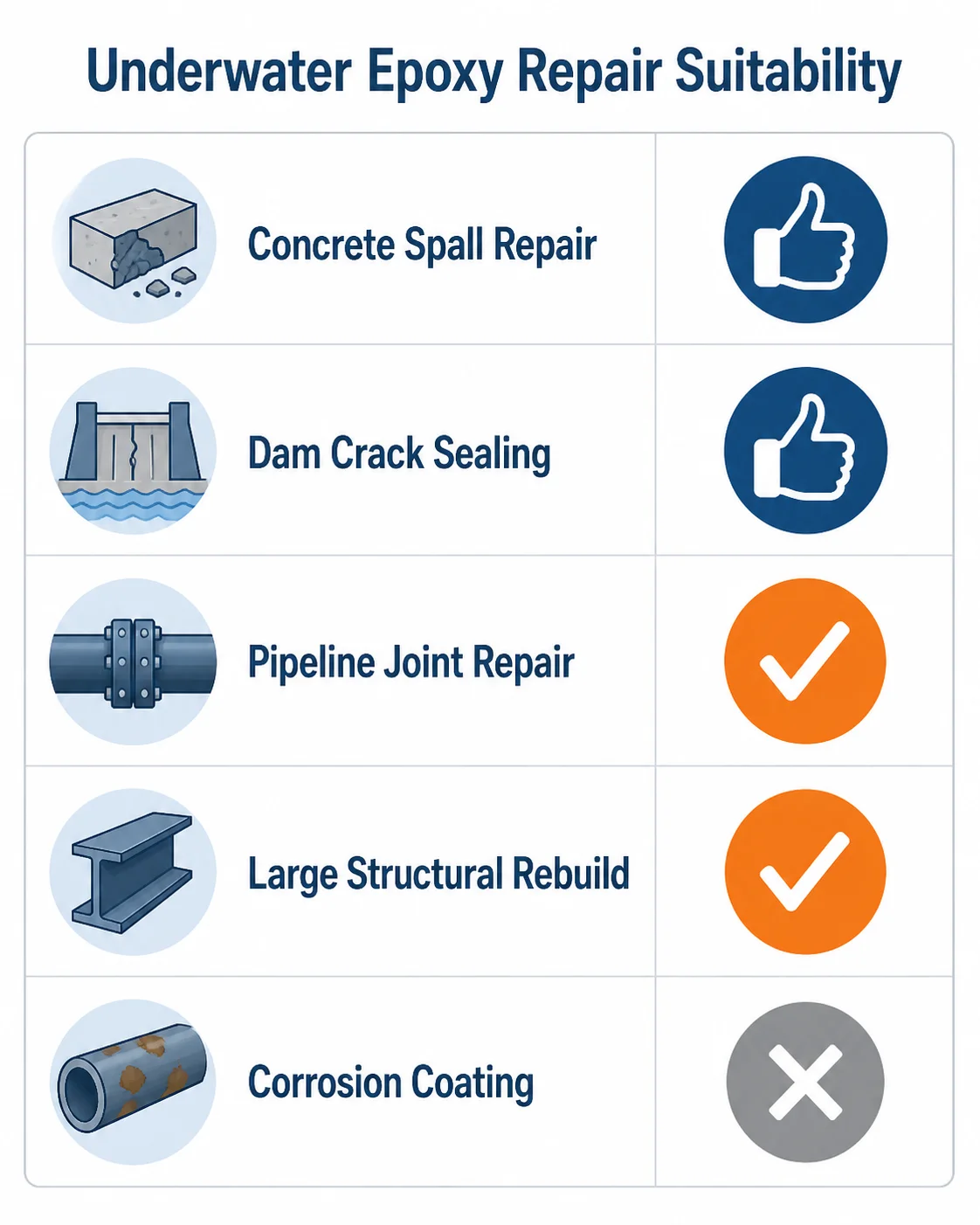
| Application | Suitability |
|---|---|
| Concrete spall repair on bridge piers / dock pilings | Well-suited — underwater epoxy mortars are widely used for this |
| Sealing cracks in dam faces below the waterline | Suited, typically via injection ports rather than surface trowel application |
| Pipeline joint repair (submerged sections) | Suited for localized leaks and joint reinforcement, not a substitute for full pipeline replacement |
| Large-scale structural rebuild of load-bearing members | Generally not appropriate as a standalone fix — requires structural engineering assessment |
| Long-term corrosion-prevention coating on steel | Requires a specific underwater-cure coating system, not a general repair epoxy |
Surface Preparation: The Step Most Often Done Wrong
Surface preparation underwater is harder to verify than on a dry site, which is exactly why it is the most common point of failure in underwater epoxy repairs:
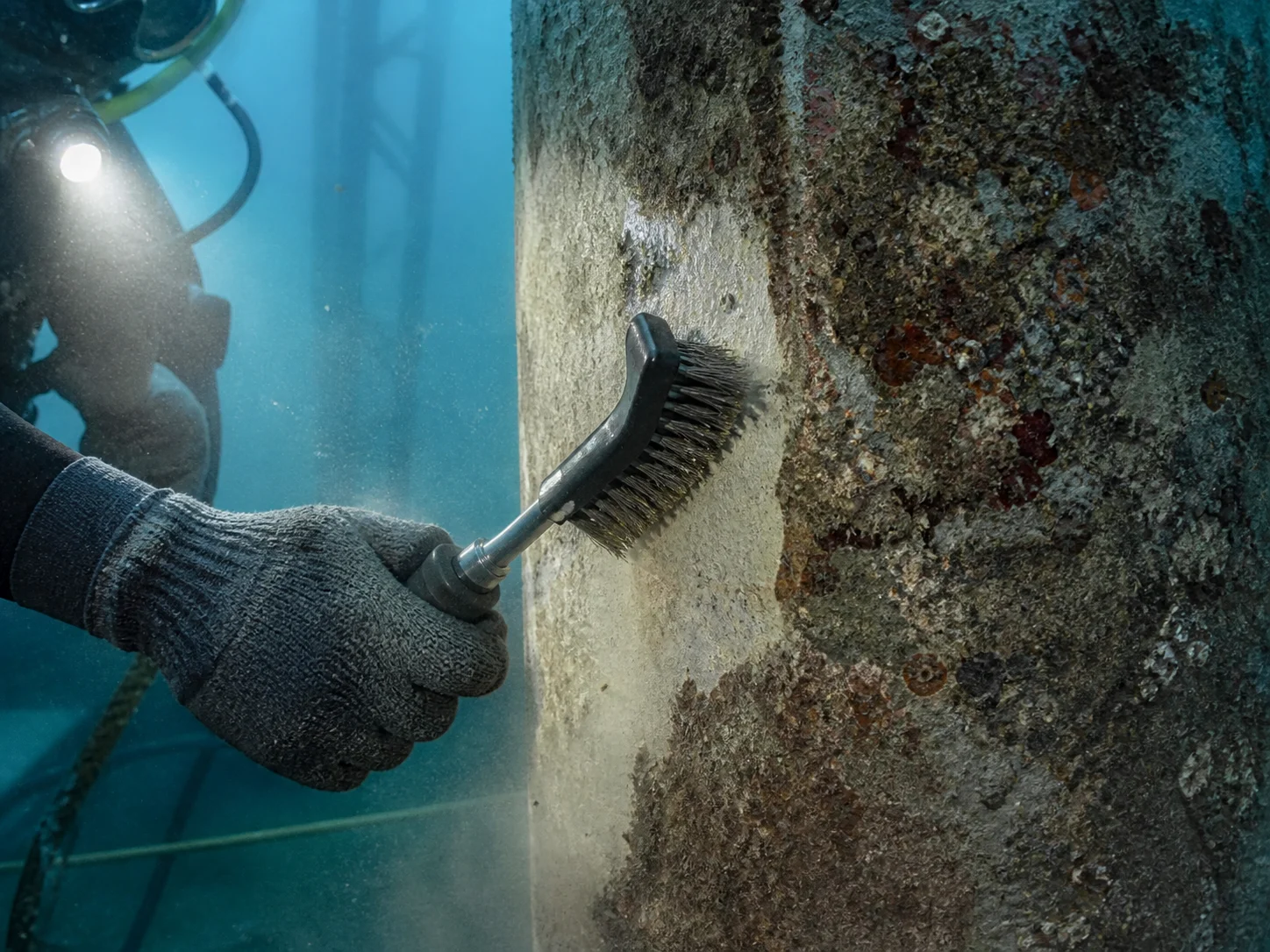
- Removing marine growth and loose material from the repair area — algae, barnacles, and loose spalled concrete must be mechanically removed, typically by diver-operated wire brushing or low-pressure water jetting, before any epoxy is applied.
- Confirming a sound substrate, not just a clean one — a diver-conducted hammer test (sounding) on the surrounding concrete helps confirm the repair boundary extends into solid material.
- Verifying real-time water conditions, since strong current or high turbidity can wash out uncured epoxy or prevent proper diver visibility during application.
Application Methods for Submerged Repairs
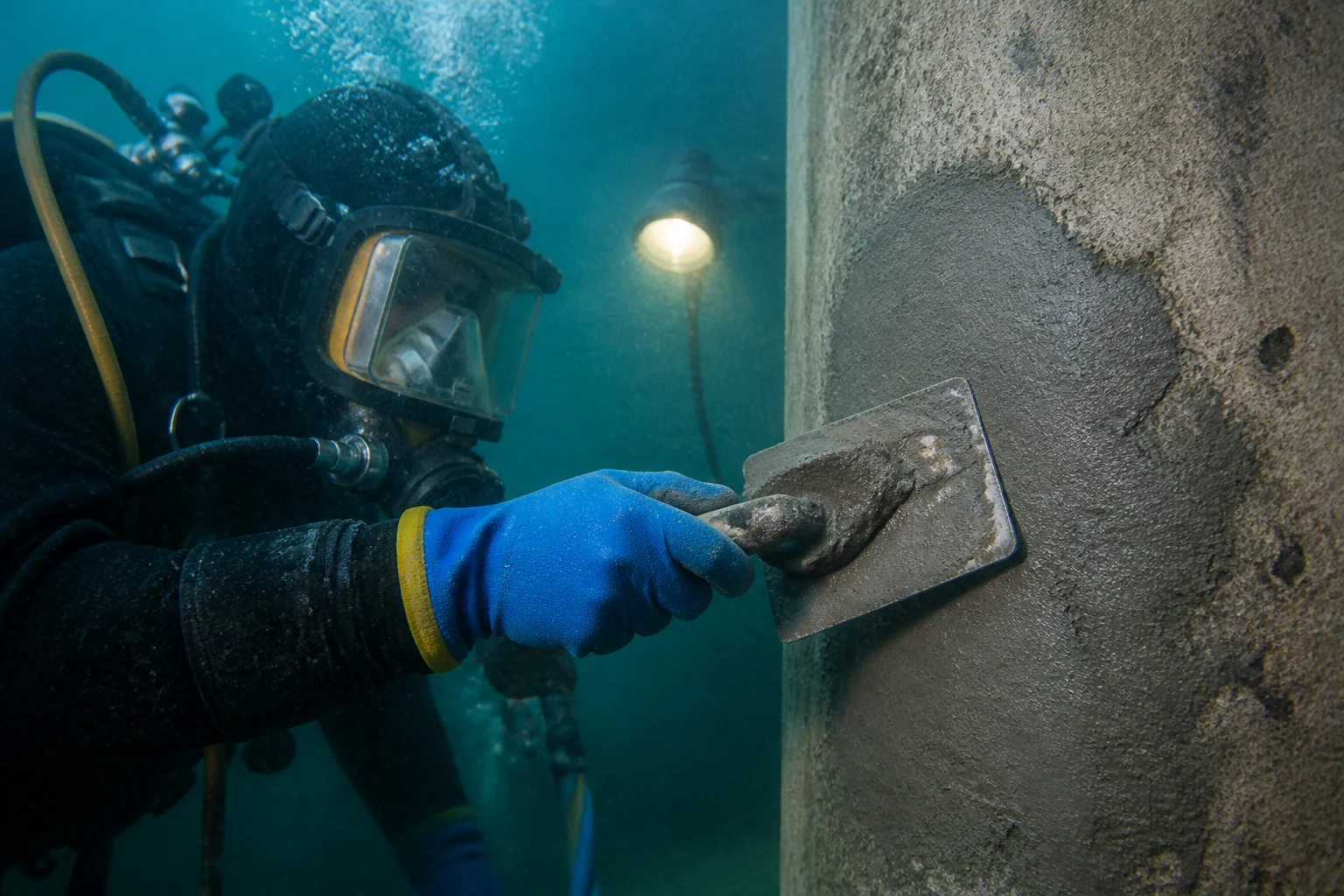
- Trowel-applied epoxy mortar: Used for larger spall repairs and surface reprofiling where a diver can directly access and shape the repair by hand.
- Injection through pre-drilled ports: Used for crack repair where the objective is to fill an internal void or crack rather than rebuild a surface profile.
- Pre-formed underwater patch systems: Increasingly used for standardized repairs where consistency between repairs matters more than custom shaping.
Verification Data to Request From a Supplier
- Bond strength when cured fully submerged (not just “moisture-tolerant” claims tested on damp-but-not-submerged surfaces).
- Cure time underwater at the actual water temperature of your site — cure chemistry slows significantly in cold water.
- Compressive and flexural strength data specific to the submerged-cure condition, since these values are frequently lower than dry-cure ratings.
- Compatibility with the specific water chemistry at your site — freshwater, brackish, and saltwater environments affect durability differently.
Common Mistakes in Underwater Epoxy Repair Projects
- Using a general-purpose structural epoxy instead of an underwater-rated formulation. The most common cause of repair failure.
- Skipping the sounding/hammer test on surrounding concrete. Leads to repairs that fail at the edge within a short time.
- Ignoring water temperature effects on cure time. Divers may consider the job complete before full working strength is reached.
- Underestimating current and turbidity risk during application. Uncured epoxy can be washed out if current exceeds tested tolerance.
- Treating underwater repair as a substitute for structural assessment. Does not replace engineering evaluation of load capacity.
Conclusion: Match the Chemistry and the Process to the Site Conditions
Underwater epoxy repair is a proven and cost-effective method for maintaining submerged infrastructure without dewatering — but only when the product is genuinely engineered for submerged cure, surface preparation is verified rather than assumed, and site-specific conditions are checked against the supplier’s actual test data rather than general marketing claims.
For structural bonding chemistry that complements underwater and marine repair work above the waterline, explore Joobond’s Polyurethane Sealant range, and see our Marine Adhesive Sealant Guide for above-waterline marine bonding and sealing applications.
 English
 العربية
 Español de México
 Русский
 Tiếng Việt
 Português do Brasil
 Bahasa Indonesia
 Türkçe