

Table of Contents
- 1. Control Joint vs. Expansion Joint: Why the Filler Has to Match the Joint Type
- 2. Polyurea vs. Epoxy vs. Polyurethane: Where Polyurea Actually Wins
- 3. Where Polyurea Joint Filler Gets Used
- 4. Application Basics
- 5. Polyurea vs. Epoxy vs. Polyurethane: Quick Reference
- 6. Common Mistakes
- 7. Frequently Asked Questions
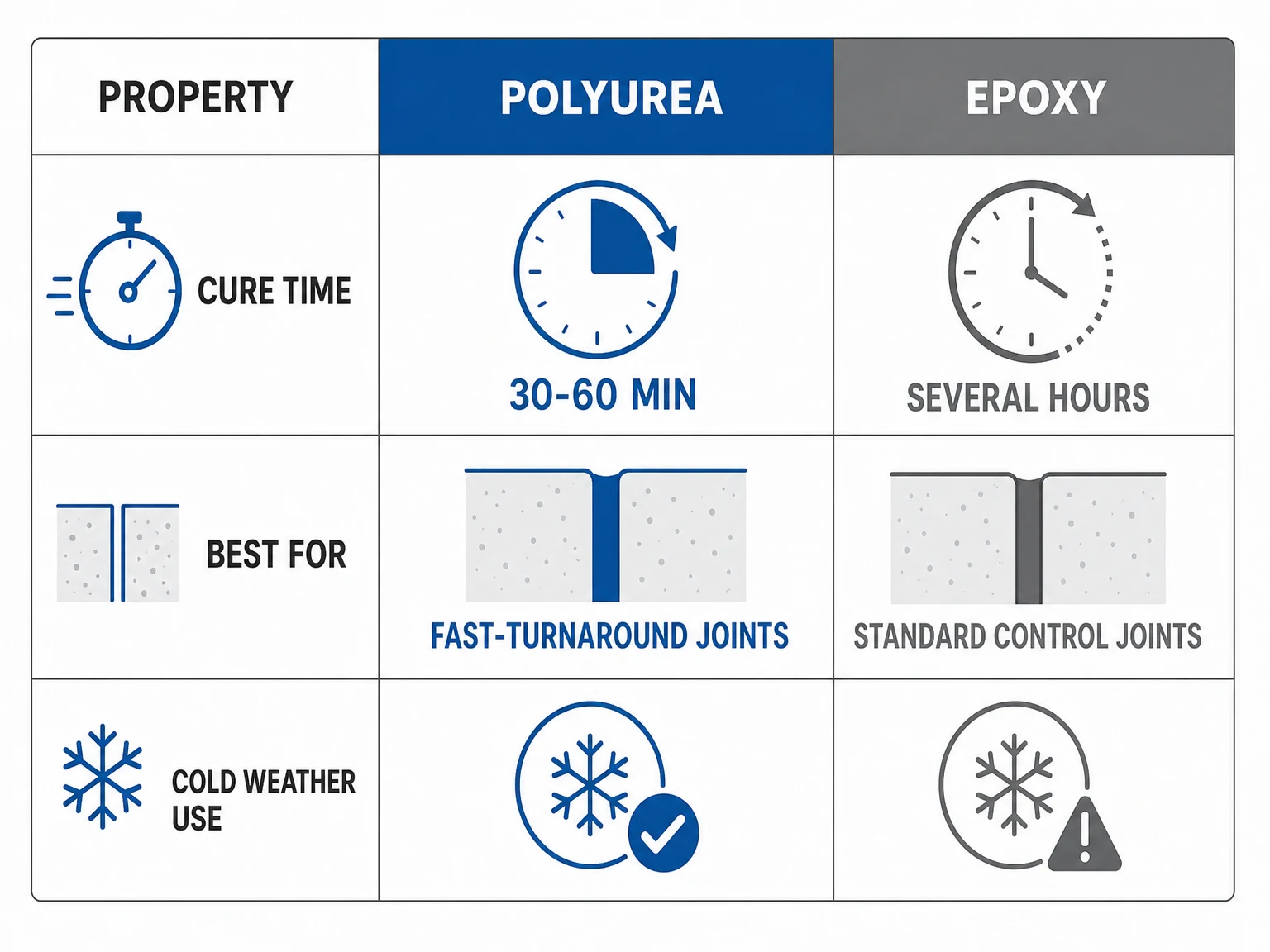
Polyurea joint filler gets chosen for one reason above all others in industrial settings: cure speed. Where an epoxy joint filler needs hours before a warehouse floor can take forklift traffic again, a polyurea formulation can often be driven on within 30 to 60 minutes. That single property reshapes which facilities can realistically schedule joint repair during a planned shutdown rather than losing a full day or more of floor access.
Control Joint vs. Expansion Joint: Why the Filler Has to Match the Joint Type
Control joints are cut intentionally into a concrete slab during construction to control where shrinkage cracking occurs as the concrete cures — they’re a designed weak point, not a structural gap, and they see relatively minor movement once the slab has fully cured. Expansion joints, by contrast, are built to accommodate real structural movement: thermal expansion between slab sections, building settlement, or movement between a slab and an adjoining wall or column.
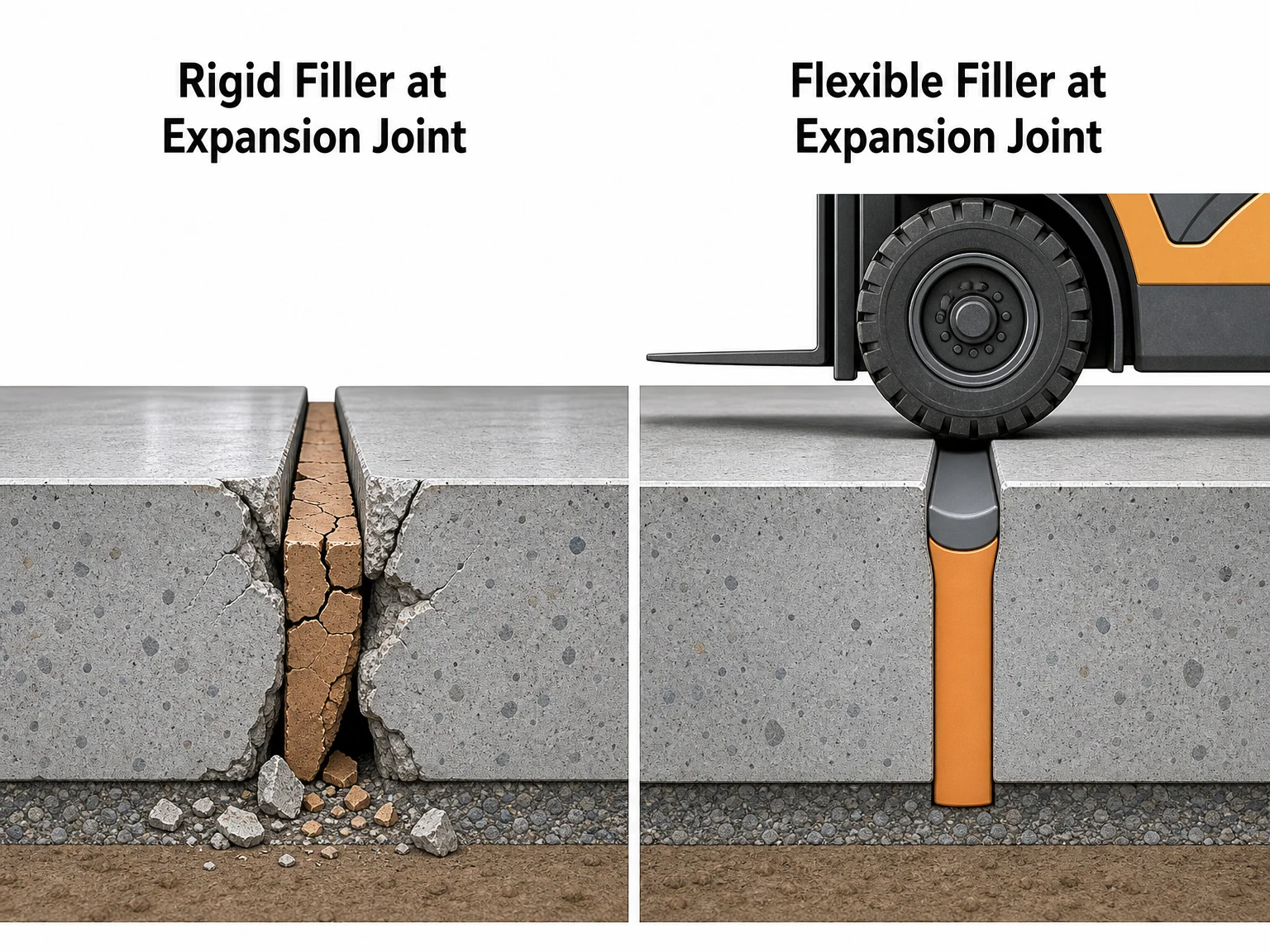
This distinction decides filler chemistry. Control joints, with their limited ongoing movement, are commonly filled with a semi-rigid polyurea or epoxy that locks the joint edges together and supports the slab against spalling under wheel loads — too much flexibility here actually lets the joint edges deflect independently under load, accelerating edge breakdown. Expansion joints need a genuinely flexible filler that can compress and extend repeatedly without tearing away from either side, since treating a true expansion joint with a rigid filler guarantees cracking at the bond line within one seasonal cycle.
Polyurea vs. Epoxy vs. Polyurethane: Where Polyurea Actually Wins
Epoxy joint filler remains the standard choice where rigidity and compressive strength under forklift wheel loads matter most, and where the project timeline allows for several hours of cure before returning the floor to service. It’s also generally lower in material cost per linear foot than polyurea, which matters on large-footprint warehouse floors with thousands of feet of joint to fill.
Polyurea’s advantage shows up specifically where any of three conditions apply: the facility cannot tolerate extended floor downtime, ambient or floor temperatures are low enough that epoxy’s cure time would stretch even longer, or the joint sees enough thermal cycling that epoxy’s relative brittleness becomes a liability over repeated seasons. Polyurea also tolerates a wider application temperature range than most epoxies, making it the more practical choice for joint work scheduled during cold-weather shutdowns.
Polyurethane sealants occupy a different niche entirely — they’re the right choice for joints with substantial ongoing movement, like true expansion joints or exterior slab joints exposed to seasonal thermal cycling, where their superior elongation and recovery outperform both epoxy and semi-rigid polyurea. Polyurethane is rarely the choice for interior control joints under heavy forklift traffic, since it lacks the compressive support that epoxy and polyurea provide at the joint edge.
Where Polyurea Joint Filler Gets Used
Warehouse and distribution center floors are the most common application, where joint filler directly determines how long forklift wheels and racking legs can roll across a joint before it starts to spall and throw debris. Manufacturing floors with heavy equipment traffic see similar demands, often with the added requirement of chemical resistance where coolants, oils, or cleaning chemicals regularly contact the joint. Parking structures use polyurea at both control joints within a level and at larger expansion joints between structural bays, though the formulation and flexibility needed differs sharply between those two joint types within the same facility.
Application Basics
Joint prep determines bond quality more than any other single factor. Remove all old filler, debris, and loose concrete from the joint using a joint saw or grinder to create clean, parallel vertical faces — a joint with rounded or spalled edges won’t give the new filler a proper bond surface regardless of how good the material is. Vacuum the joint thoroughly immediately before pouring; any dust left in the joint acts as a bond-breaker between the concrete and the filler.
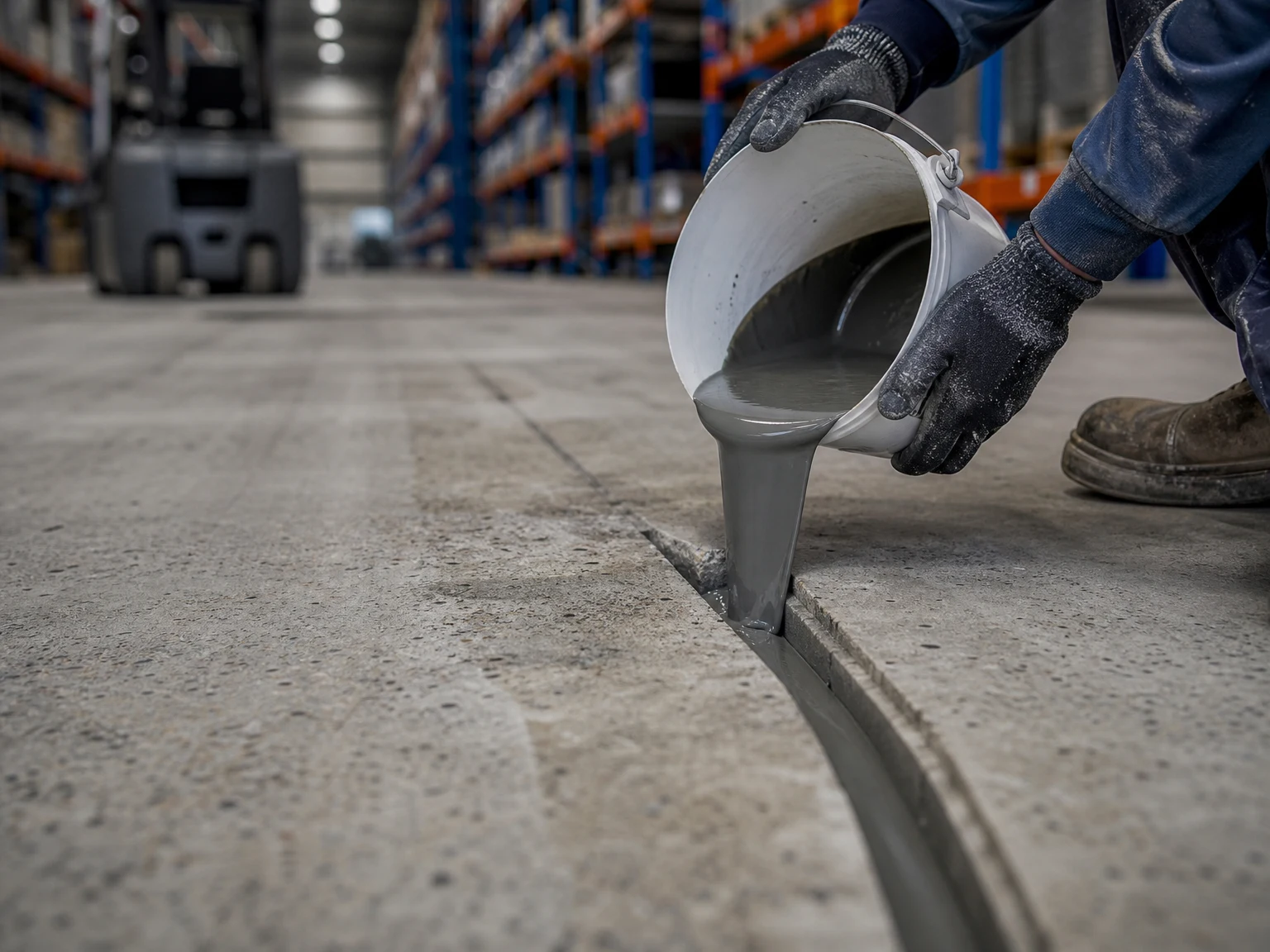
Polyurea’s rapid cure means mixing and pouring must happen efficiently — most two-component systems have a working time measured in single-digit minutes once combined, far shorter than epoxy’s typical 20 to 30 minute pot life. This makes polyurea less forgiving of interruptions mid-pour, so crews need the joint fully prepped and the pour sequence planned before mixing the first batch, especially for longer joint runs that need to be tackled in sections.
Overfilling slightly and shaving the cured filler flush with the slab surface after it sets produces a cleaner result than trying to fill exactly level, since polyurea’s fast cure leaves little time to tool a perfectly flush finish before it sets. For joints exposed to heavy forklift traffic, a filler rated specifically for that load class should be confirmed on the product’s technical data sheet — not every polyurea formulation is rated for the same wheel-load tolerance.
Polyurea vs. Epoxy vs. Polyurethane: Quick Reference
| Property | Polyurea | Epoxy | Polyurethane |
|---|---|---|---|
| Typical cure time | 30-60 minutes | Several hours | 24+ hours |
| Best for | Fast-turnaround control joints | Rigid control joints, lower cost | True expansion joints with movement |
| Flexibility | Semi-rigid | Rigid | Highly flexible |
| Cold-weather application | Good | Limited | Moderate |
| Forklift traffic support | Strong | Strong | Weak |
Common Mistakes
Using a rigid polyurea or epoxy at a joint that actually sees structural movement is the most consequential mistake, since the filler will crack and debond within one seasonal cycle once real expansion joint movement starts testing a material that was never designed to flex. Skipping proper joint-edge preparation and pouring over dust or loose aggregate is the next most common failure point, producing a filler that looks properly installed but delaminates from one or both edges within weeks of forklift traffic.
Underestimating polyurea’s short working time and trying to pour a long joint run in one continuous batch often results in the material setting before the pour is finished, leaving an uneven, poorly bonded section at the end of the run. Planning pour sections in advance and mixing only what can be placed within the product’s working time avoids this entirely.
Frequently Asked Questions
Is polyurea better than epoxy for joint filling?
Neither is universally better. Polyurea cures faster and tolerates cold weather better, making it preferable when floor downtime must be minimized. Epoxy is generally lower cost and remains a strong choice for control joints where extended cure time is acceptable.
Can polyurea be used in an expansion joint?
Semi-rigid polyurea is best suited to control joints with limited movement, not true expansion joints with substantial structural movement. For genuine expansion joints, a flexible polyurethane sealant rated for the expected joint movement is the more appropriate choice.
How long does polyurea joint filler take to cure?
Most two-component polyurea systems reach a traffic-ready state within 30 to 60 minutes, significantly faster than epoxy’s typical cure time of several hours. Exact cure time varies by product and ambient temperature, so the manufacturer’s technical data sheet should be checked for the specific formulation used.
Why did my polyurea joint filler fail at the edges?
Edge delamination is most often caused by incomplete joint preparation — dust, loose aggregate, or rounded joint edges prevent proper bonding even when the material itself was applied correctly. Confirm the joint faces are clean, vacuumed, and squared before pouring.
Does polyurea joint filler work in cold weather?
Polyurea generally tolerates a wider application temperature range than epoxy, making it a more practical choice for joint work scheduled during cold-weather shutdowns. Specific minimum application temperatures still vary by product and should be confirmed before scheduling cold-weather work.
Need Help Choosing a Sealant?
Tell us your materials and application requirements.
SEND AN INQUIRY English
 العربية
 Español de México
 Русский
 Tiếng Việt
 Português do Brasil
 Bahasa Indonesia
 Türkçe