

Table of Contents
- 1. What Does “Low-VOC” Actually Mean?
- 2. Why Low-VOC Adhesives Contribute to Workplace Safety
- 3. Are Low-VOC Adhesives as Strong as Traditional Formulations?
- 4. Low-VOC Adhesive Categories and Where They’re Required
- 5. Sourcing Checklist: Verifying a Supplier’s Low-VOC Claims
- 6. Common Mistakes When Switching to Low-VOC Adhesives
- 7. Conclusion: Compliance as a Competitive Advantage
Green building certification is no longer a niche request from a handful of eco-conscious developers — it is becoming a baseline procurement requirement across commercial construction, automotive supply chains, and industrial manufacturing. At the center of this shift sits one deceptively simple question: does your adhesive off-gas volatile organic compounds (VOCs) into the air your workers and end-users breathe? This guide breaks down what “low-VOC adhesive” actually means, how it intersects with LEED and REACH compliance, and what to look for when sourcing a supplier in 2026.
What Does “Low-VOC” Actually Mean?
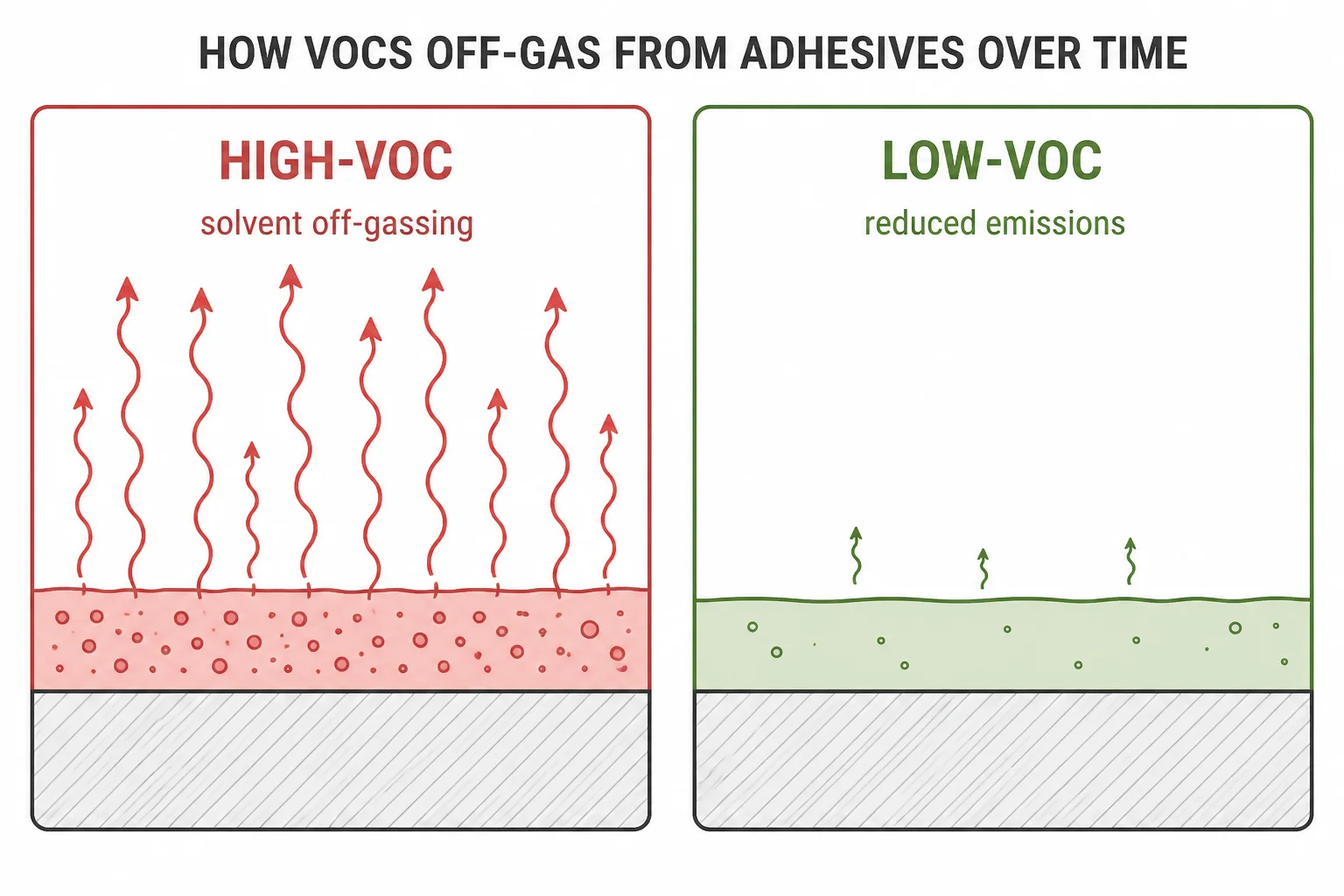
VOCs (Volatile Organic Compounds) are carbon-based chemicals that evaporate easily at room temperature. In adhesives, they typically come from solvents used to keep the product workable before it cures. Once applied, these solvents evaporate into the air — which is exactly the problem regulators are targeting.
“Low-VOC” is not a single fixed number; it is a threshold defined by the certification body you’re targeting:
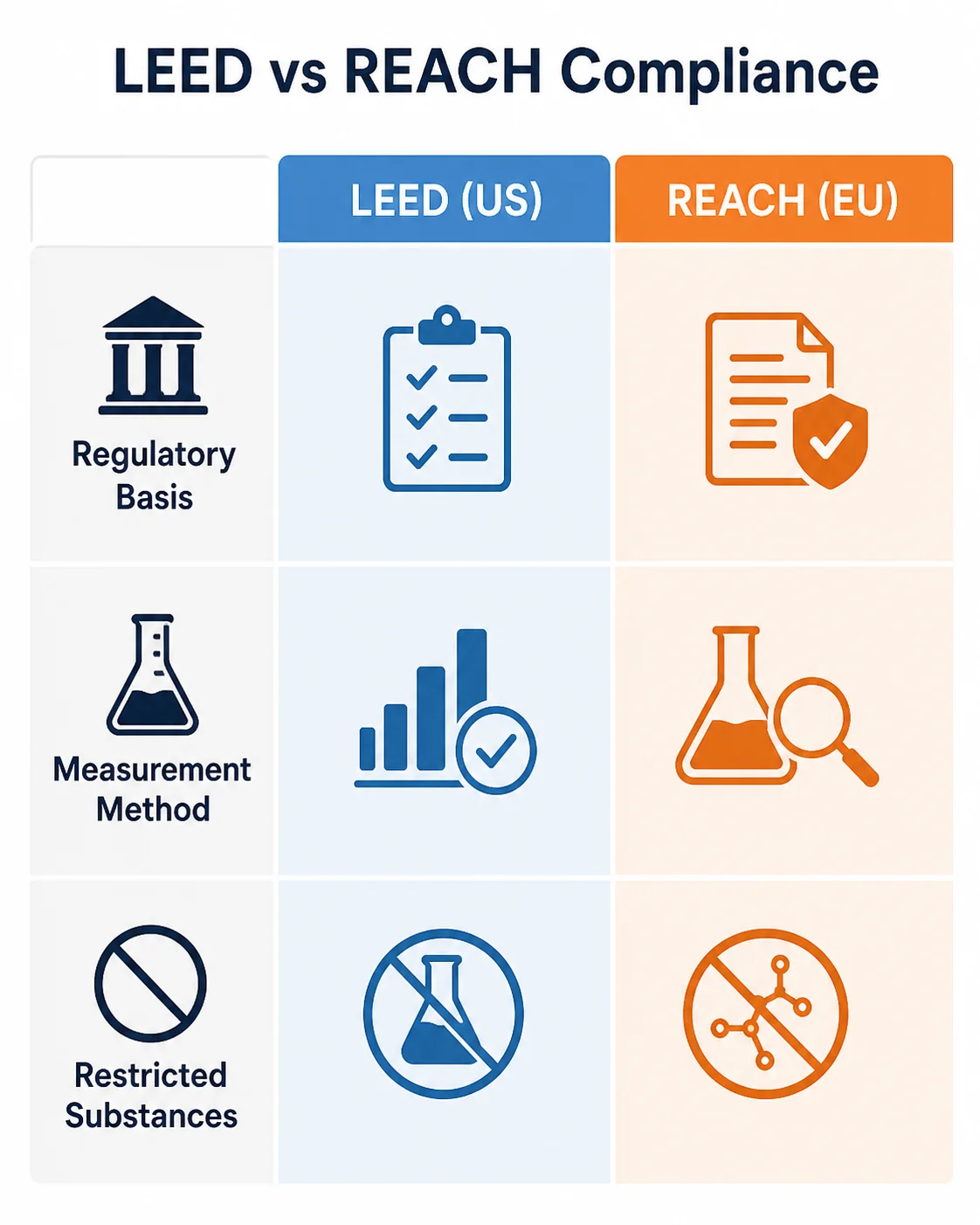
- LEED (Leadership in Energy and Environmental Design) references VOC content limits set by regulations such as the California Air Resources Board (CARB) and SCAQMD Rule 1168, typically requiring adhesives used indoors to fall under specific g/L thresholds depending on the application category.
- REACH (Registration, Evaluation, Authorisation and Restriction of Chemicals), the EU regulation, does not set a single “low-VOC” number but restricts specific substances (like certain isocyanates and solvents) outright, regardless of concentration.
This means a product that is “REACH compliant” is not automatically “LEED compliant” and vice versa — procurement teams sourcing for international projects need documentation for both frameworks separately.
Why Low-VOC Adhesives Contribute to Workplace Safety
Search data shows procurement and safety teams are actively researching how low-VOC formulations affect daily workplace conditions, not just certification paperwork. The practical safety benefits break down into three areas:
- Reduced respiratory exposure: Workers applying adhesive in enclosed spaces face far lower inhalation risk with low-VOC formulations.
- Lower fire and explosion risk: Many VOC solvents are flammable. Reducing solvent content directly reduces flash-point-related hazards during storage and application.
- Improved indoor air quality post-installation: Off-gassing from high-VOC adhesives can continue for days or weeks after curing.
Are Low-VOC Adhesives as Strong as Traditional Formulations?
This is one of the most common objections procurement teams raise, and it deserves a direct answer: it depends on the chemistry, not the VOC content itself. Reducing solvent content does not inherently weaken an adhesive bond — the bond strength comes from the polymer backbone (epoxy, polyurethane, MS polymer, silicone), not from the solvent carrier.
In fact, many of the highest-performing modern formulations are simultaneously low-VOC and high-strength. Our MS Polymer vs. Silicone comparison shows how hybrid sealants achieve isocyanate-free, low-VOC profiles without sacrificing mechanical strength.
Low-VOC Adhesive Categories and Where They’re Required
| Application | Typical Regulatory Driver | Common Low-VOC Chemistry |
|---|---|---|
| Flooring adhesives | LEED v4.1 EQ Credit, CARB | Water-based acrylic, low-VOC polyurethane |
| Structural glazing / curtain wall | REACH, EN 15651 | Low-VOC MS Polymer, silicone |
| HVAC duct sealing | Indoor air quality codes | Water-based or low-VOC butyl |
| Automotive interior bonding | REACH (EU), EPA (US) | Low-VOC acrylic foam tape, hybrid sealants |
| General construction sealing | LEED, local building codes | Low-VOC construction adhesive |
For construction-grade sealing specifically, our Energy-Efficient Construction Guide covers how airtight sealing and low-VOC compliance work together toward the same LEED credit categories.

Sourcing Checklist: Verifying a Supplier’s Low-VOC Claims
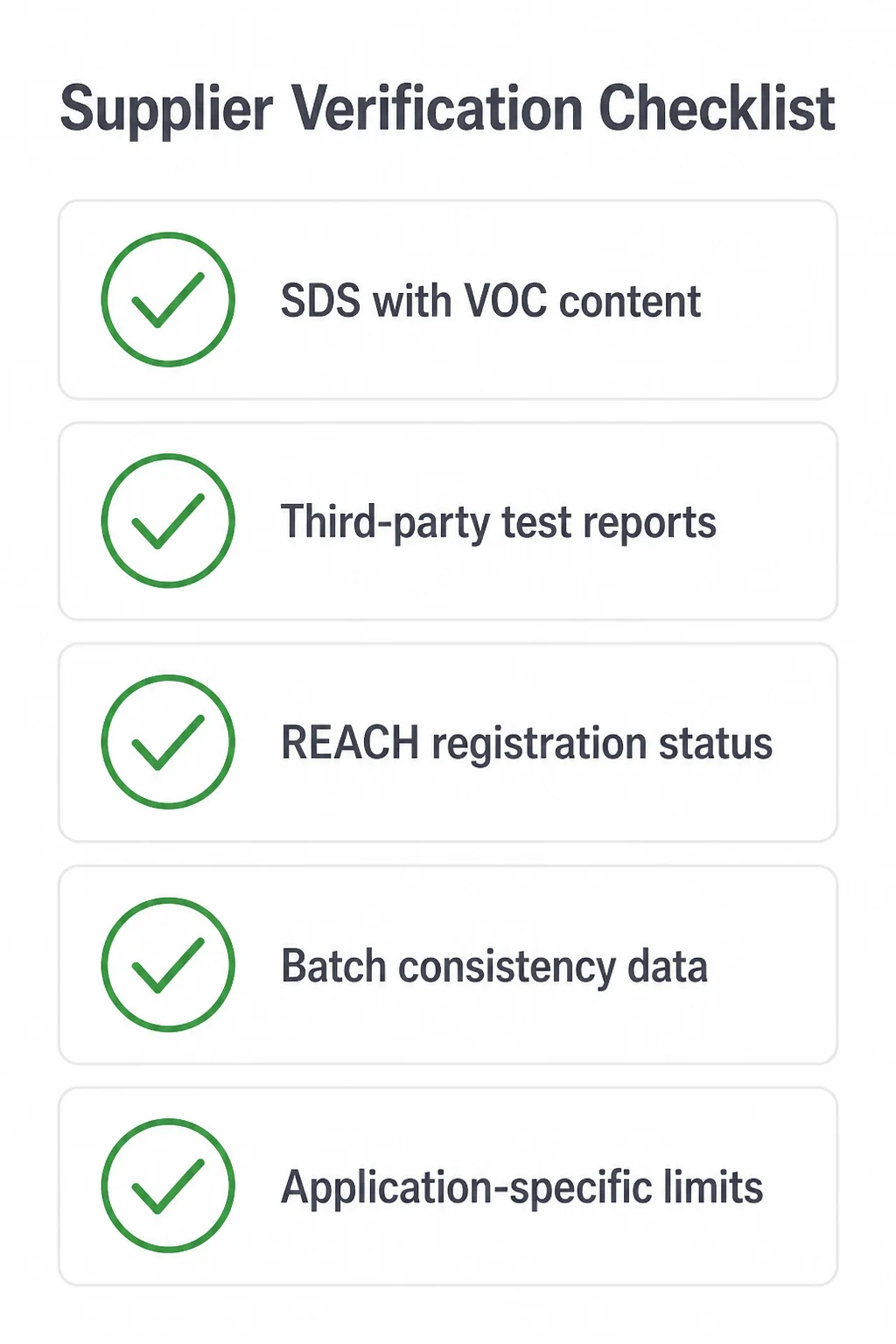
Marketing copy claiming “eco-friendly” or “green” is not the same as documented compliance. When evaluating suppliers, request:
- A Safety Data Sheet (SDS) listing actual VOC content in g/L, not just a pass/fail claim.
- Third-party test reports referencing the specific standard (CARB SCM2, SCAQMD Rule 1168, or the relevant EN standard).
- REACH registration status for any substances of concern, particularly isocyanates in polyurethane-based products.
- Batch-level consistency data — VOC content can drift between production batches.
- Application-specific limits, since a single certification does not automatically cover every use case.
Common Mistakes When Switching to Low-VOC Adhesives
- Assuming all “green” labels are equivalent. LEED, REACH, GREENGUARD, and various regional eco-labels test different things.
- Ignoring cure-time changes. Some low-VOC water-based formulations cure more slowly, especially in low-temperature or high-humidity conditions.
- Overlooking substrate compatibility. Water-based low-VOC adhesives sometimes require different surface preparation than solvent-based products.
- Treating VOC compliance as a one-time checkbox. Regulations tighten over time; a product compliant years ago may not meet 2026 thresholds.
- Failing to request updated documentation annually. Supplier formulations change over time.
Conclusion: Compliance as a Competitive Advantage
As green building certification requirements tighten globally, low-VOC adhesive compliance is shifting from a “nice-to-have” differentiator to a baseline procurement requirement. Suppliers who can provide transparent, third-party-verified VOC data — rather than marketing claims — will increasingly be the default choice for specification-driven procurement teams.
For your next project, request documented VOC content alongside standard technical specifications. Explore Joobond’s full range of Silicone and Polyurethane products formulated to meet modern low-VOC compliance requirements without compromising on bond performance.
 English
 العربية
 Español de México
 Русский
 Tiếng Việt
 Português do Brasil
 Bahasa Indonesia
 Türkçe